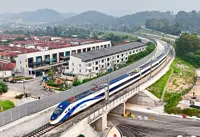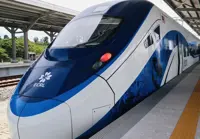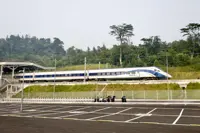
THE East Coast Rail Link (ECRL) project, a steel dragon winding through Peninsular Malaysia, is not only a milestone in Malaysia's infrastructure development but also a shining example of deep and strategic cooperation with China under the Belt and Road Initiative (BRI).
With the project ahead of schedule and coinciding with the recent visit by Chinese President Xi Jinping to Malaysia, the ECRL's strategic significance is increasingly apparent.

It is steadily becoming a key driver in promoting balanced regional development, enhancing national connectivity and bolstering regional integration.
Ahead of schedule: A national artery progressing efficiently
The ECRL is one of Malaysia's most ambitious and transformative infrastructure projects.
Stretching 665km across Selangor, Pahang, Kelantan and Terengganu, it aims to dismantle the historical logistical divide between the peninsula's east and west coasts.
For decades, the lack of efficient transportation links has hindered economic development on the east coast states, leaving them relatively underdeveloped compared to the more industrialised west.
As of April, the ECRL had reached 82.45% completion, with the 400km track from Maran (Pahang) to Kota Baru (Kelantan) laid two months ahead of schedule. The project will achieve 90% overall completion by year-end, reflecting steady progress in both civil and systems works.
A key technical milestone during this period is the installation of communication, information and signalling (CIS) systems, an integrated suite of technologies that forms the core operational backbone of the railway, enabling real-time train control, traffic management, data transmission and safety assurance across the network.
This is slated for completion at 15 stations by March next year, paving the way for smooth operations.
Once the ECRL is fully operational by 2027, travel time from Kota Baru to Gombak in Selangor is expected to be cut from over eight hours to just four hours, greatly enhancing transport efficiency for passengers and cargo.
A new engine for economic growth: Unlocking Malaysia’s potential
The economic implications of the ECRL for Malaysia are both profound and far-reaching.
According to government estimates, it is expected to boost Malaysia’s GDP by at least 3.8% or RM1.4 trillion by 2047.
This figure is not merely symbolic, and it represents the potential for increased industrial output, higher investment inflows and stronger productivity across various sectors – ultimately contributing to the Malaysian government's revenue and national development goals.
Employment creation is another key benefit for Malaysia. During its construction phase, the ECRL is estimated to create more than 80,000 jobs, providing a vital boost to local labour markets and supporting communities along the route.
After the railway becomes operational, around 6,000 permanent jobs will be generated annually in areas such as railway operations, maintenance, logistics and station services.
These employment opportunities will be particularly impactful in rural and semi-urban regions that traditionally lack high-quality job prospects.
In addition, the ECRL is positioned to act as a catalyst for industrial development. By significantly improving transportation infrastructure and reducing travel and shipping times, it is expected to attract more foreign direct investment (FDI), especially in manufacturing, logistics and agro-based industries.
Industrial parks and logistics hubs are being planned or developed along the ECRL corridor, with several joint ventures already announced between Malaysian and Chinese firms.
This will strengthen Malaysia’s role in regional supply chains and make the country more competitive as a South-East Asian logistics hub.
Geopolitical significance: Deepening China–Malaysia and regional cooperation
The ECRL symbolises a high level of political and economic alignment between China and Malaysia. President Xi's visit to Malaysia from April 15 to 17 strengthened the bilateral relationship, with infrastructure cooperation at the heart of the discussions.
The ECRL serves as a concrete manifestation of the trust and mutual interests shared by the two nations, solidifying a strategic partnership that underlies future collaborations.
Geopolitically, the ECRL is both a flagship project of the BRI and a key component of Asean's connectivity agenda. Aligned with the Master Plan on Asean Connectivity 2025, it strengthens Malaysia’s regional links and supports a future pan-Asian railway network.
Beyond infrastructure, the project reflects China’s commitment to high-quality, transparent cooperation through technology transfer and capacity building. This enhances Malaysia’s smart rail systems and logistics capabilities while positioning China as a reliable development partner across South-East Asia.
Looking ahead: Towards shared prosperity and development
The impending completion of the ECRL highlights its far-reaching impact on Malaysia and the region. For Malaysia, it represents a significant step in modernising infrastructure, unlocking economic potential in underserved areas, and promoting balanced national development.
For China, the project underscores its role as a committed, high-quality development partner under the BRI, offering transparent cooperation and capacity building.
Looking ahead, the ECRL could pave the way for deeper collaboration in green energy, the digital economy and advanced logistics. Ultimately, it stands as a symbol of shared progress, where infrastructure not only connects regions but also unites people, economies and cultures.
Conclusion
The ECRL is more than just a railway; it is a dynamic engine of growth, a symbol of strategic trust, and a bridge between nations. As it winds through Malaysia’s lush landscapes, it carries with it the hopes of communities, the power of partnership and the promise of a brighter, more connected future.
As China and Malaysia deepen their cooperation, the ECRL will remain a powerful testament to what can be achieved when nations work together for mutual prosperity.
Dr Kelly Wong Kai Seng is an Associate Professor at Universiti Putra Malaysia. The views expressed here are entirely the writer’s own.
The SEARCH Scholar Series is a social responsibility programme jointly organised by the South-East Asia Research Centre for Humanities (SEARCH) and Tunku Abdul Rahman University of Management and Technology (TAR UMT).
Already a subscriber? Log in
Get 20% OFF The Star Digital Access
Cancel anytime. Ad-free. Unlimited access with perks.