
AT its 18th Annual General Meeting on March 14, the Bar Council passed two resolutions about the judiciary. One was related to strengthening judicial independence of subordinate court judges; the other touched on the system of judicial appointments to the superior courts.
To the ordinary citizen, the quality of justice is what happens in the subordinate courts.
Regrettably, most of the safeguards for judicial independence under Articles 121 to 131A of the Federal Constitution are unavailable to the hundreds of judges of our Sessions and Magistrates courts.
Article 138 provides for a fused judicial and legal service under a Judicial and Legal Service Commission (JLSC).
From the viewpoint of the independence of the judiciary, there are many objectionable features of the JLSC set-up:
> The chairman of the JLSC is a top civil servant who is also the chairman of the Public Services Commission (PSC). Before 1960, the Chief Justice was chairman of the JLSC.
> The composition of the JLSC includes the Attorney General (or if the AG is disqualified under Article 138(2)(b), then the Solicitor General) and one or more judges appointed by the King.
> The presence of the AG on the JLSC is problematic because under Article 145, the AG is the government’s chief legal adviser, lawyer and public prosecutor.
He may appear before a judge of the Sessions or Magistrates court one day and sit on the JLSC the next to consider the promotion, transfer or discipline of that judicial officer.
> From the viewpoint of judicial independence, the position of judicial officers in Malaysia is quite untenable.
A judicial officer may be transferable from the judicial service to the legal service and vice versa. His transfer, promotion and discipline are in the hands of a commission chaired by the PSC head with the AG in attendance.
The latter has administrative control over all legal officers. This was demonstrated in Maleb Su v PP (1984), where the subordinate court judge frankly expressed his fears of the AG.
In the end, the High Court dismissed, though not so convincingly, the concerns of the subordinate court judge.
> In 2010, a government circular (JPA Circular 6/2010) placed all legal officers under the administrative control of the AG. If that circular is still in effect, its constitutionality is in doubt.
Under Article 138, the JLSC’s “jurisdiction shall extend to all members of the judicial and legal service”. No service circular can override the Constitution.
In Maleb Su v PP, it was held that the AG is not the head of the service, nor can he be by virtue of Article 138.
Reforms: Article 138 needs to be amended to separate the judicial service from the legal service. The latter should be under the AG and the former should be under the Chief Justice as before 1960.
Alternatively, former Chief Justice Tun Arifin Zakaria’s suggestion – that the Chief Registrar of the Federal Court should head the judicial service – may be worthy of consideration.
To avoid institutional bias and fear of victimisation, officers in the two services should not be transferable, except on a permanent basis, from one service to the other.
Appointments to the judicial service should be made subject to the recommendation of the Judicial Appointments Commission under Act 695, 2009. This will require amendments to Article 138 of the Constitution as well as Act 695. What is important is that justice should not only be done but must be seen to be done.
Superior courts: In Malaysia, as in most legal systems, judicial appointments are in the hands of the executive. Till 2009, there was no special body to nominate judges. Instead, Article 122B of the Federal Constitution provides an extensive, multi-tiered process of consultation.
When a vacancy – other than to the post of Chief Justice of the Federal Court – arises, the Constitution mandates the following procedures:
> The Prime Minister takes counsel with the Chief Justice under Article 122B(2).
> The President of the Court of Appeal and Chief Judges of the High Courts are also required to be consulted by the PM on appointments to their courts: Article 122B(4).
> For the appointment of Chief Judge of the High Court in Sabah and Sarawak, the Chief Minister and Premier of the states are also taken into confidence: Article 122B(3).
> The PM then advises the King.
> His Majesty is required to act on the PM’s advice under Article 40(1) but only after “consulting” the Conference of Rulers: Article 122B(1). The Conference has the power to scrutinise, call for further information, delay, caution and warn. But it does not have the power to veto the PM’s proposals.
Flaws in the laws: Though the PM is required to inform himself of the views of the Chief Justice, the President of the Court of Appeal, Chief Judges of the High Courts, the Premier and Chief Minister of Sarawak and Sabah, the Yang di-Pertuan Agong and the Conference, in the last resort the PM’s views are meant to prevail.
It is also noteworthy that the above extensive consultative procedures do not apply to the appointment of the probationary Judicial Commissioners under Article 122AB.
This probationary stint before a full appointment to the High Court undermines the guarantees for security of tenure in Article 125.
Judicial Appointments Commission (JAC): This Commission was established in 2009 to ensure unbiased nomination of candidates for appointment to the Bench. Though the JAC is an imperfect institution, its parent law has many merits:
> In Section 2, it lays down the PM’s duty to uphold the independence of the judiciary and have regard to the need for public interest to be represented in matters relating to the administration of justice.
> In Section 23(1), it lays down an admirable list of selection criteria.
> It facilitates consultation between the five judges on the JAC and the four Eminent Members on the suitability of candidates for judicial office.
> Candidates are allowed to apply.
> Intensive interviews by a panel of five JAC members are held.
> The Bar Council is consulted on the suitability of candidates from the Bar.
> If a Judicial Commissioner is seeking confirmation, his/her judgments are read.
If data is collected, it may be found that since the JAC’s inception, the ethnic, gender and regional diversity on the Bench has been affected positively, especially since 2018.
Now, many more practising lawyers are being recruited. The JAC has promoted more openness, transparency and discussion. These are the hallmark of democracy and good governance.
Perhaps, it is not just a coincidence that in the last 15 years, there has been some sort of a judicial renaissance. At the same time, there is realisation of some serious flaws in the JAC law.
First, under Section 21(1) of the Judicial Appointments Commission Act 2009, the JAC is tasked with the job of recommending candidates for the PM’s consideration.
It takes over the constitutional functions of the CJ, other top judges and the Sarawak Premier and Sabah Chief Minister. An ordinary statute cannot be a substitute for constitutional provisions, hence the JAC law should be constitutionalised.
Second, the PM is not bound by the JAC’s advice. He retains absolute power to select the names to be sent to the King and Conference of Rulers.
Third, the PM has wide powers to appoint five out of nine members of the JAC and to dismiss them.
Fourth, the JAC membership should be more inclusive to honour the ideal in Section 2(c) of the JAC Act that the PM should have regard to “the need for public interest to be properly represented”.
Membership of the JAC shows no regard to fulfilling this ideal. This is a matter that requires a separate discourse.
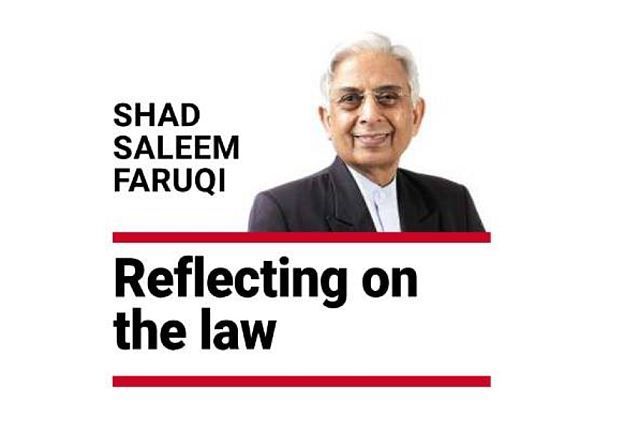
Emeritus Prof Datuk Dr Shad Saleem Faruqi is Senior Research Fellow at Universiti Malaya. He wishes all Muslim brethren the blessing and joys of Aidilfitri.
The views expressed here are the writer’s own.
Already a subscriber? Log in
Get 20% OFF The Star Digital Access
Cancel anytime. Ad-free. Unlimited access with perks.