
IF you travel from Johor Baru and cross the Permas bridge over the Tebrau river, you will enter a constituency where the Malay demographic changes.
The river separates Pasir Gudang and Johor Baru parliamentary seats. Both are neighbouring seats and yet it is a Dickensian tale of two cities for the Malay constituents.
In general, urban rich Malay voters live in the Johor capital while the urban poor Malays in its industrial neighbour.
“JB Malays are mostly local. Whereas in Pasir Gudang the number of people who are not local is higher than in JB,” said Johor Mentri Besar Datuk Seri Khaled Nordin.
Khaled is the assemblyman for Permas, a state seat in the Pasir Gudang constituency. He was also MP for Johor Baru (1990 to 2004) and Pasir Gudang (2004 to 2013).

“Now for JB, the development has stabilised. Whereas Pasir Gudang is a growing area with new people coming in and therefore we are facing challenges in an area where growth is continuous,” he said.
Many current and former civil servants, according to Johor PKR deputy chairman Jimmy Puah Wee Tse, live in the relatively affluent Johor Baru parliamentary seat. Many first-generation Malays live in the kampung in JB. But some of their children – because of limited space in the villages – move to areas such as Pasir Gudang or Tebrau, he said.
There were also Malays from Pahang and Kelantan who migrated to Pasir Gudang as they found employment in the factories or the shipping industry in the constituency or work in nearby Singapore.
“It is a classic parliamentary seat dominated by blue collar workers and there’s no Felda settlement. Most of the working class Malays live in single-storey houses or flats in residential areas,” said the assemblyman of Bukit Batu (in Kulai parliamentary seat) who lives in Permas Jaya in Pasir Gudang.
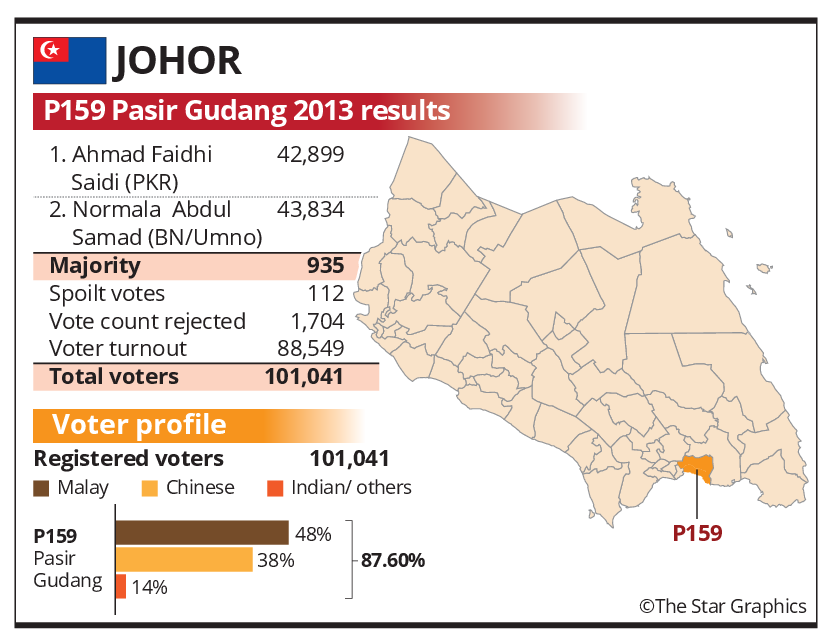
About half of the Pasir Gudang constituents are Malay blue collar workers.
Typically, they have a diploma or below and they work in a factory. On the average, a factory worker earns about RM2,000 a month. About RM1,500 go to food and transport for a family of five, RM300 to RM500 goes to rent or house loan. Their total household income depends on whether the other spouse works.
Pasir Gudang MP Datuk Normala Abdul Samad understands the blue collar workers as she was a human resource manager in a factory in Pasir Gudang before she joined politics.
“I was one of them. I used to rent a house. I began working for RM250 a month in 1981. I started as an HR clerk. I had a SPM and studied part-time to earn a Master in Business Administration,” she said.
One of their main concerns, according to Normala, is owning or renting an affordable home which is near (within 15 to 20 minutes excluding traffic jam) to their workplace and their children’s school. The short distance will help them reduce transport cost.
Unlike in the kampung where they can cope with the rising cost of living by planting vegetables or rearing livestock, the urban working class has to get a second job.
“This means they need to work more than eight hours a day in part-time jobs like a security guard,” she said.
Normala pointed out that the lifestyle of the rural Malays and the urban working-class Malays were different.
Voters have told the Pasir Gudang MP that GST (Goods and Services Tax) has a big impact on their lives.
Two out of 10 constituents, claimed Normala, will tell her: “YB, sekarang barang mahal” (YB, the price of household goods is high now). They also tell her that their income was not enough to meet their household expenses.
“We expect to get more votes from blue collar workers as they are the hardest hit by rise of cost of living,” said Puah of PKR.
It is challenging for Normala to explain to them why the Government implemented GST. She tells them the Government has to raise additional income to ensure that the needs of the people are met as the country could not rely on previous income (from oil and gas).
“We try to make them understand. Some understand while some don’t as when they go grocery shopping they feel that the price of goods has increased,” she said.
They complained to Normala that the price of fish – for example ikan kembung – which used to be RM6 to RM8 a kilo has risen to RM12 to RM15 because of GST. The one-term MP tell them that there is no GST for the fish and the price went up probably because of sea conditions or decreased supply.
Normala tells them to look at their grocery bill as some items were charged GST while some were exempted.
“But to some, it is already built inside of them that GST caused harga naik (price increase) as shop owners and friends tell that it is all because of GST,” she said.
“That’s the mindset of some of my voters. It will impact their pattern of voting.”
Depending on how the political parties exploit or defend the cost of living and affordable housing issues, to paraphrase Charles Dickens: it is the best of times or the worst of times to face the voters in GE14.
Already a subscriber? Log in
Get 20% OFF The Star Digital Access
Cancel anytime. Ad-free. Unlimited access with perks.