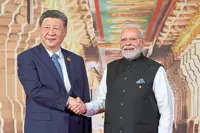
Shaping the future


Xi attending the opening ceremony of the 'Two Sessions' maps what China's policymakers will do over the next five years, amid the growing geopolitical tensions instigated by Trump. — AFP

CHINA’S most important annual meetings this month come at an unusual and intriguing time.
The weeklong National People’s Congress (NPC) meeting currently underway, flowing into another week for the Chinese People’s Political Consultative Conference, maps what China’s policymakers will do over the next five years.

Together, the “Two Sessions” sum up the substance of the incoming 15th Five-Year Plan from this year until 2030. These discussions amount to China’s most watched regular meetings around the world.

As annual events, they may seem routine at first. Western media in particular tend to dismiss the NPC as a “rubber stamp” body. Such simplistic assessments typically fail to understand important nuances. The proceedings of this year’s Two Sessions are particularly significant because these are not regular times.

The US tariff war against China and every other country lingers. Presidents Donald Trump and Xi Jinping who head the world’s two biggest economies are due to meet in Beijing from March 31.

High-stakes global competition between these two countries continues to soar. Meanwhile, the widening US-Israel war against Iran is pounding multiple ports and the vital Strait of Hormuz, impacting shipping, oil prices, access to other strategic commodities and the health of world markets.

Amid these imploding events, a China long known for careful calibrations with a long view is planning its policies over the next half-decade. What will be its priorities, solutions and resolutions, and how will it execute them?

As expected, the typical response from China-watchers has been to latch onto cited figures as vital indicators. So the 4.5%-5% growth rate for this year and the 30 trillion yuan (RM17.16 trillion) public expenditure as quantitative guideposts take centre stage.

China has certainly reached the point where its macroeconomic data can exert considerable global impact. The numbers it produces in performance or as objectives can also be vitally indicative.

However, at this particular time something else is even more definitive than raw numbers: policy approach. This year’s realism and pragmatism in shaping economic form and function are even more basic.

This approach marks the Two Sessions more than at any time in recent memory. The character of this year’s meetings is distinct in their cautious, integrated way to development through phased and measured progress. Gone are gung-ho growth and extravagant numbers for ambitious targets. Property sector doldrums continue to drag while depressed consumer demand festers.

There is a new realisation of risks and realities, better appreciation of due diligence, more moderate targets and a greater readiness for fiscal stimulus measures. The qualitative metrics now outweigh the quantitative.

This includes reduced projected growth of up to 10% from last year. But more important than the number itself is the moderate reduction expected. When 5% growth was projected for previous years, Western cynics dismissed it as unduly optimistic. But China actually achieved that figure, so any reduced growth this year should not exceed the projected maximal of 10% from 2025.

For now, priorities include technology and targeted boosts to employment and raising incomes. While fiscal incentives help the latter encourage domestic consumption, technology covers a wide swathe of manufacturing industry from robotics to the automotive sector.

China’s lead in New Energy Vehicles will continue to grow, particularly in Battery Electric Vehicles, while humanoid robots will make more inroads as home help appliances. As it widens its lead over other countries’ production, China will set more international standards in industrial safety and other benchmarks for consumer application.

This year sees a significant convergence of several recent development themes: Dual Circulation growth, New Quality Productive Forces, and Made in China 2025.

The last is not only a single-year goal ending last December. It is a continual process of upgraded manufacturing that began last year.

Dual Circulation depends as much on heightened domestic consumption as on exports. While the export front is stabilising with new or renewed markets following US tariffs, domestic consumption shows good prospects awaiting effective stimulus measures.

New Quality Productive Forces cover the kind of elevated manufacturing afforded by technology and other inputs. Resulting upgrades in output with more vertical integration ensure better productive synergies for even greater global competitiveness.

However, serious challenges remain for China’s production- export ecosystem. Even if Trump’s tariffs are settled with the coming summit in Beijing, US anxieties will not be placated completely.

Trump may still rock supply chains regarded as favouring China, even if forced changes do not favour the United States. Regardless, China’s economic presence is so vast and deep as to impact significantly on East Asia, notably South-East Asia.

For centuries, China’s economy enjoyed a complementary relationship with those of this region – and vice-versa. This reciprocity sees renewed pertinence and heightened potency today.

This means both prospective risk and potential opportunity for a country like Malaysia. Which exactly it would be depends on both the external environment and national governance.

Bunn Nagara is director and senior fellow at the Renaissance Strategic Research Institute, and honorary fellow at the Perak Academy. The views expressed here are solely the writer’s own.

Get 20% OFF The Star Digital Access

Monthly Plan

RM 13.90/month

RM 11.12/month

Billed as RM 11.12 for the 1st month, RM 13.90 thereafter.

Best Value

Annual Plan

RM 12.33/month

RM 9.87/month

Billed as RM 118.40 for the 1st year, RM 148 thereafter.

Follow us on our official WhatsApp channel for breaking news alerts and key updates!

Next In Columnists

One-time F1 stop more than just a nostalgic return to Sepang
Trading reporting on local politics for big business
Another shot at safer roads
Do-or-die battle in Chennah
Don’t let Johor become scam hub
Uneasy pause in US-Iran conflict
How about a PhD, people?
China-Malaysia Air Silk Road: Strengthening regional connectivity
PAS' pro-Islamist stance a double-edged sword
The fertility formula couples need to know

Others Also Read