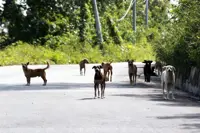
Kopi’s death should not be in vain


HER story put Malaysia in the news around the world twice this year. In March, when she captured the hearts of millions through her playful antics with a kitten in a viral video, and again on Oct 6, when she was callously shot dead.

The demise of Kopi, a gentle stray dog in Terengganu, has triggered much outrage in Malaysia and beyond, especially after the second heart-wrenching video of her death.

It showed a local resident trying to soothe Kopi as she lay in a pool of blood, whimpering in pain.

The indignation over the killing of the friendly black-and-tan dog is unprecedented.

Animal rights activists staged a protest after a report over Kopi’s killing was made at the Sentul police station in Kuala Lumpur on Oct 14. Global Human Rights Federation representative Sashi Kumar Shanmugam, who filed the report, condemned the act as inhumane and a violation of the law.

Under Section 30 (1) of the Animal Welfare Act 2015, shooting of animals is only permitted in emergencies or for disease control.

More than 20,000 people have now signed an online petition urging accountability from the Besut District Council in Terengganu for the shooting, while over 65 complaints have also been lodged with the Veterinary Services Department (DVS).

The animal rights groups also plan to sue the Besut District Council and want the officers involved in the shooting to be charged under the Animal Welfare Act 2015.

Last Friday, hundreds of Malaysians of all races gathered at the DVS headquarters in Putrajaya for the #JusticeForKopi rally organised by 13 NGOs.

Gentle soul: A screencap of Kopi playing with a kitten. — Photo from the myforeverDoggo site.

Among the placards carried by them were some that included these messages:

“Dogs save lives in disaster, yet we take theirs! Stop killing strays – show gratitude, not harm!”

“Animals have no voice. Humanity must be their voice.”

“Justice for Kopi – Stop animal cruelty!”

“No rabies, no threats. Why was I killed?”

The NGOs submitted a memorandum to DVS director-general Dr Akma Nga Hamid, demanding ethical and humane treatment of stray animals across the country.

The DVS has since responded by saying it will review the memorandum and also provide updates on its investigation into the matter.

The killing of Kopi took place during an operation involving 25 officers at Kampung Raja, Paya Rawa, Pengkalan Nyireh, Air Tawar, Tanjung Demong, Gelam Mas, and Jertih, all in Terengganu’s Besut district.

On Oct 13, The Star quoted DVS’ head of animal welfare section Dr Marzuna Md Yunus as saying that shooting could only be carried out during emergencies and to control diseases such as rabies; that “Dogs can also be shot if they are fierce and have attacked people”.

She added that shooting should not be used to curb the stray population if these elements were not present (“In shock over stray’s death”, online at bit.ly/4f45HXy).

In spite of the widespread outrage, Besut District Council president Mohd Sukeri Ibrahim had defended the action, saying it was done in accordance with standard operating procedures.

“The handling of the stray dog adhered to the SOP established by the Ministry of Housing and Local Government and complied with Section 30 of the Animal Welfare Act,” he said.

Mohd Sukeri said the operation was conducted under the Dog Licensing By-Laws of the Besut District Council, 1990, adding that this allowed the use of firearms in specific cases to manage or remove dangerous or wild animals.

“The regulation allows for any licensed or unlicensed dog, whose owner cannot be found, to be removed or handled as instructed by the council president or an authorised officer,” he said.

Was Kopi such an animal? Certainly not, according to locals.

As highlighted by the Stray Animal Feeders of Malaysia (SAFM), she was never reported to have posed a danger to anyone or disturbed the local community.

“Kopi was known to be a gentle animal, friendly with both humans and other animals, like cats. What justification was there for the decision to shoot?”

SAFM said Kopi was also not a stray as she was cared for by a regular feeder, noting that under the Animal Welfare Act, anyone who provides regular care and sustenance to an animal was legally considered its owner.

It is no secret that the more than 140 local councils in the country have been culling stray dogs to reduce their populations for decades although more humane options are available, such as the Trap-Neuter-Vaccinate-Release/Rehome (TNVR) programme practised by many of our neighbouring countries.

Our local authorities should stop looking at culling as a quick fix solution as it has been proven to be a failed method of managing stray dog populations.

There may be a momentary drop in numbers, but the population usually rebounds with the remaining dogs reproducing and new dogs moving into the area. This leads to a cycle of repeated culling, which is both inhumane and unsustainable.

Instead of culling, which can be costly – requiring resources for trapping, handling and disposing of animals, local councils would be better off implementing more sustainable and effective methods for stray dog population management, such as TNVR and vaccinations against diseases such as rabies.

Mass vaccination campaigns, sterilisation programmes to reduce reproduction rates, and community-based education to promote responsible pet ownership and safe interactions with stray dogs could be better and more humane alternatives to choose.

Our local authorities should perhaps take a leaf from the Penang Island City Council, which has been working with the International Aid for the Protection and Welfare of Animals since 2017.

The international organisation partnered with the city council to set up and manage a humane programme for strays and provide it with the support needed.

Since then, thousands of stray dogs in Penang are no longer culled and are instead neutered, vaccinated, provided with any additional veterinary care they need, and either released back to their community or placed in supportive adoptive homes.

Media consultant M. Veera Pandiyan likes this observation by Abraham Lincoln: ‘I care not for a man’s religion whose dog and cat are not the better for it.’

The views expressed here are entirely the writer’s own.

Get 20% OFF The Star Digital Access

Monthly Plan

RM 13.90/month

RM 11.12/month

Billed as RM 11.12 for the 1st month, RM 13.90 thereafter.

Best Value

Annual Plan

RM 12.33/month

RM 9.87/month

Billed as RM 118.40 for the 1st year, RM 148 thereafter.

Follow us on our official WhatsApp channel for breaking news alerts and key updates!

Next In Columnists

The incredible star power rising from the East
Make Penang AI plan a bridge for majority
Giants fall, England survive – World Cup quarter-finals take shape
Who shapes global AI rules: Asean-China cooperation role
Why the Johor election is good for Malaysian democracy
Confessions of a durian season sinner
Looming threat to social security
More predictable than the World Cup
America at 250
Coexistence with wildlife key for public safety

Others Also Read