




AT THE end of the 2022 movie, Doctor Strange in the Multiverse of Madness, a rather alarming third eye opens in the middle of Benedict Cumberbatch's forehead which made the audience collectively lose their minds.
Dramatic, yes. Fictional, obviously. But here is the genuinely unsettling part: the idea of a human third eye is not entirely made up.
Somewhere inside every human skull, tucked deep in the brain, sits a tiny gland with an evolutionary backstory so wild it makes the Marvel Cinematic Universe look understated.
Do humans really have a vestigial third eye?
Verdict:

TRUE
The organ in question is the pineal gland, a structure roughly the size of a grain of rice sitting deep in the centre of the brain.
It does not look like an eye and it cannot see anything, so do not go poking around your forehead expecting results. But in evolutionary terms, it is what is left of one.
To understand what happened, it helps to meet the tuatara, a reptile from New Zealand and the sole surviving member of an ancient order that branched away from the common ancestor of lizards and snakes about 250 million years ago. To put that in perspective, humans are more closely related to kangaroos than the tuatara is to a lizard.
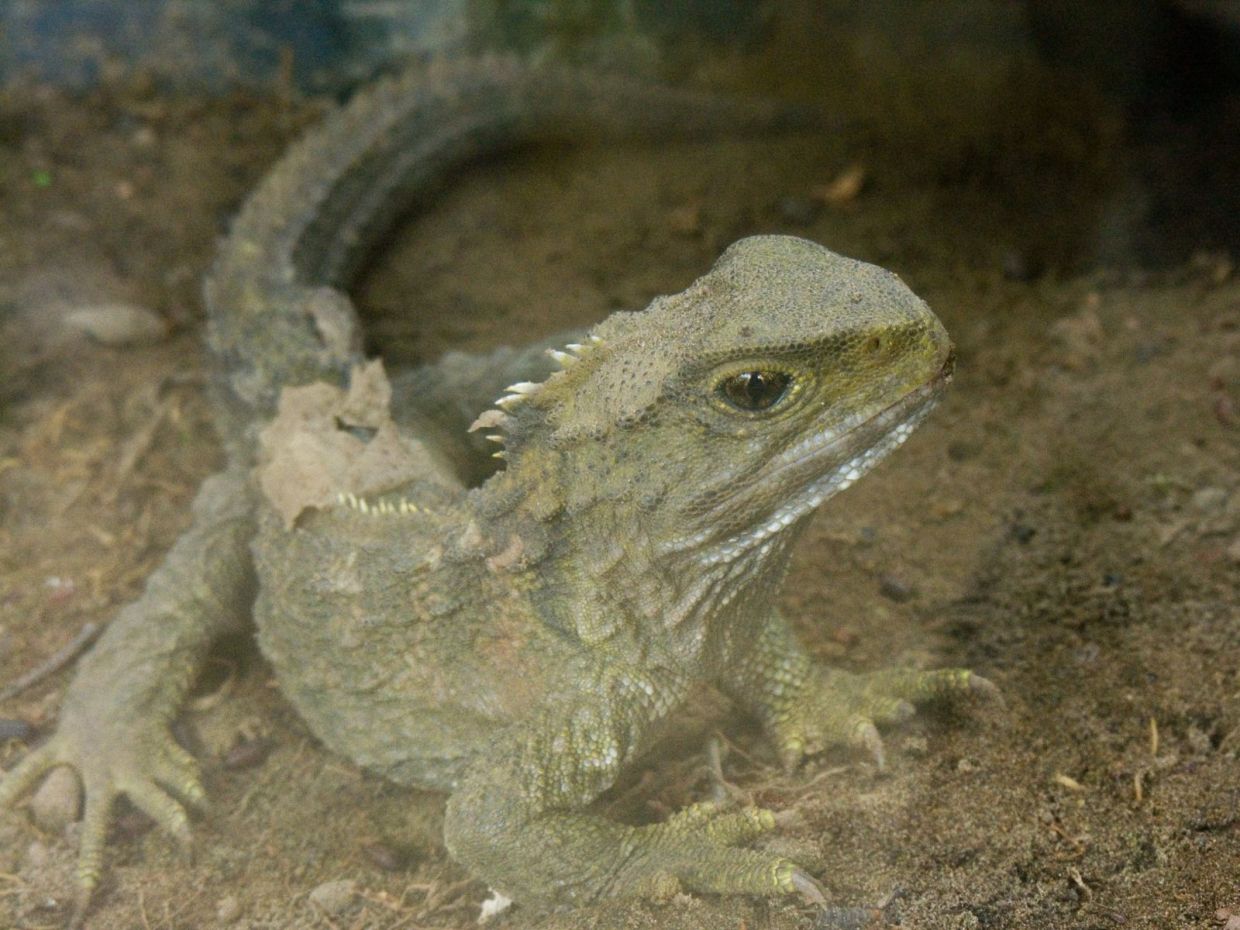
The tuatara has a genuine, functioning third eye on the top of its head called the parietal eye, complete with its own cornea-like cover, a rudimentary lens, a retina and nerve endings that connect directly to the brain.
It is visible in hatchlings as a translucent patch on the skull, though it gets covered over with scales within a few months, which is a shame because it would make for excellent conversation at parties.
The parietal eye cannot detect shapes or movement but it can detect light, and researchers believe it functions as a kind of biological compass and calendar, telling the tuatara what season it is, regulating its sleep cycle and helping it manage body temperature.
A peer-reviewed study published in Survey of Ophthalmology confirmed that the tuatara's parietal eye had a remarkably eye-like structure with photoreceptors that in other reptiles had shown genuine photoreceptive capabilities.
The parietal eye is connected to the pineal gland, the internal component of the same complex, which handles the hormonal side of things including the production of melatonin.
Now here is where the story gets interesting for humans.
Mammals and reptiles diverged from a common ancestor approximately 312 million years ago, and fossil evidence showed that most of the pre-mammalian creatures that came after shared a hole in the top of their skull through which a parietal eye connected to the brain.
Researchers at the University of the Witwatersrand studied more than 600 fossilised skulls from South Africa's Karoo region, dating back between 200 million and 300 million years, and found that this skull opening was present in most pre-mammalian species right up until about 260 million years ago, after which it began disappearing.
In the cynodont lineage, the direct ancestors of all mammals, the opening closed over entirely approximately 246 million years ago.
The working theory was that once mammals evolved the ability to generate their own body heat internally, they no longer needed an eye on top of their head to track the sun and manage their temperature from the outside.
The parietal eye became redundant, so evolution did what evolution does: it did not throw the whole system away entirely but quietly repurposed what remained for something else.
What survived was the pineal gland, the internal part of the original eye complex, redesigned over hundreds of millions of years into a hormone-producing organ.
A peer-reviewed paper published in Photochemistry and Photobiology confirmed that the pineal gland had evolved from a light-detecting structure into an endocrine gland, and that mammalian pineal cells were still recognised as cellular descendants of the original photoreceptor cells, with several vision-related genes still present in human pinealocytes even though they no longer do anything obviously useful.
In humans, the pineal gland produces melatonin, the hormone that regulates the sleep-wake cycle and tells the body when it is time to wind down for the night.
It still responds to light and darkness, just not directly through the skull anymore but via signals sent from the eyes through the optic nerves.
This is also why staring at a bright phone screen at midnight confuses the body so thoroughly, because it is essentially tricking a 300-million-year-old light-sensing system into thinking it is still afternoon.
Calling the pineal gland vestigial is therefore not quite accurate, since a vestigial organ is one that has lost its function entirely and serves no purpose.
The pineal gland lost its original job as part of a third eye but was almost immediately reassigned to a new one, which is arguably a better career outcome than most people manage after redundancy.
So while no one is going to be opening a third eye on their forehead anytime soon, the next time someone complains about not being able to sleep, they can at least blame an evolutionary echo of an ancient eye complex buried deep in the middle of their brain.
Doctor Strange would probably find that deeply unsatisfying.
Sources:
1. https://pubmed.ncbi.nlm.nih.
2. https://onlinelibrary.wiley.
5. https://www.nature.com/
6. https://www.nature.com/
7. https://link.springer.com/
8. https://my.clevelandclinic.


