PETALING JAYA: A stronger early childhood education foundation is needed before making Year One enrolment at age six compulsory in 2029.
Schools are also required to ensure children are mentally, emotionally and socially ready, says Universiti Kebangsaan Malaysia Institute for Inclusive Development and Advancement deputy director Dr Anuar Ahmad.
Starting school at six years old, he said, is unlikely to significantly affect cognitive development compared with starting at seven, but could pose challenges in self-management and classroom readiness.
“The key concern is ensuring that starting school at six does not become an unpleasant experience for children. At that age, they are naturally energetic and enjoy active learning and activities.
“If they are placed in crowded classrooms, subjected to rigid curricula and expected to follow conventional classroom routines, it could dampen their enthusiasm for learning.
“Although the policy is a good idea in principle, it must be accompanied by a supportive ecosystem, adequately trained teachers and an enjoyable learning environment to ensure children have a positive start to their education,” he told The Star.
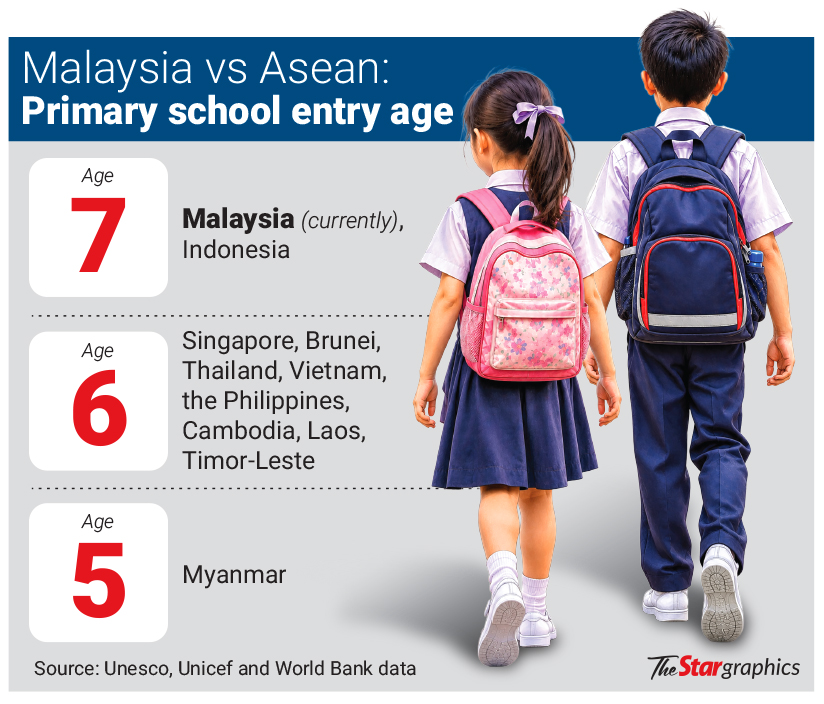
On Nov 25, Education Ministry director-general Datuk Dr Mohd Azam Ahmad announced that 2029 has been set as the target year for compulsory Year One enrolment at six, with entry optional in 2027 and 2028.
Parent Action Group for Education Malaysia chairman Datin Noor Azimah Abdul Rahim said starting at six was reasonable, but schools must be ready to accommodate younger pupils and their developmental needs.
“The question is not simply whether a six-year-old can enter Year One, but whether our schools are ready to receive six-year-olds as young children, rather than expecting them to behave like seven-year-old pupils,” she said.
An earlier start could help children develop foundational literacy, numeracy, communication and social skills, she added.
Consultant paediatrician and child disability activist Datuk Dr Amar Singh HSS said the Year One curriculum should be play-based, language-rich and place less emphasis on writing and examinations.
He said school readiness depends on the learning environment, adding that the ministry must also consider children with disabilities and learning disorders.
At least one in 10 children had a disability, with many requiring additional learning support, he added.
Dr Amar said conditions such as attention deficit hyperactivity disorder (ADHD), language disorders and milder intellectual disabilities might also go undetected at five, making Year One the first point of identification without early screening and support.
National STEM Association president and founder Emerita Prof Datuk Dr Noraini Idris said starting school at six is feasible, but children need a stronger foundation in reading, communication and social skills, as well as emotional and mental readiness.
She said countries such as Finland, the United Kingdom and the United States have more established early childhood education systems, supported by trained kindergarten teachers and well-equipped facilities.
Noraini urged the ministry to ensure all four- and five-year-olds, including those in rural areas, have access to quality early childhood education.
Association of Childcare Centres Malaysia Ng Chun Piew said the move must be accompanied by comprehensive planning that accounts for after-school care needs for families where both parents have full-time jobs.
This is to ensure younger pupils transitioning from preschool to primary school could successfully adapt to the school environment and its routines, he added.
“The success of educational reform hinges on comprehensive policy support, adequate preparation for entry into the schooling environment, and a collaborative effort involving schools, families and community,” he said in a statement.
Ng also proposed that registered childcare centres be involved in the national education reform planning to address the need for after-school childcare.
Such childcare centres, he said, do more than just provide after-school care as they serve as part of a social support system that contribute to character building as well as the physical and mental development of children.