
JOHOR BARU: A staggering 404,848 Malaysians face travel restrictions for issues such as income tax matters, court orders or outstanding payments to enforcement agencies, says the Immigration Department director-general Datuk Zakaria Shaaban.
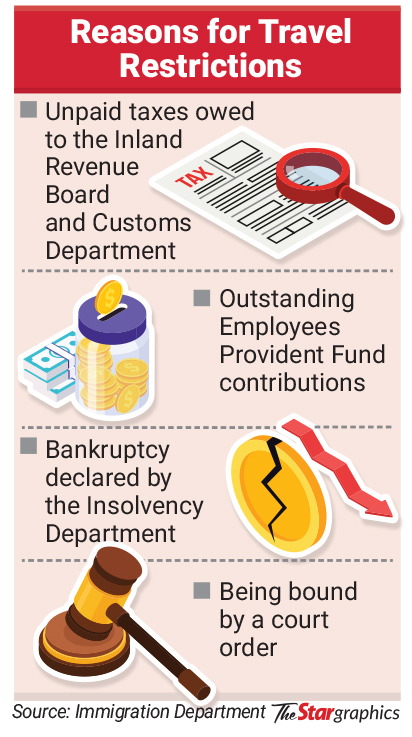
These include unpaid income tax liabilities owed to the Inland Revenue Board, outstanding payments or enforcement matters involving the Customs Department, outstanding contributions or other statutory obligations involving the Employees Provident Fund and court orders or restrictions, he said.
“We also stop those with bankruptcy-related cases administered by the Department of Insolvency, outstanding payments to the National Higher Education Fund Corporation (PTPTN) and other restrictions imposed by enforcement agencies,” he said in an interview.
Zakaria stressed that the Immigration Department acts on instructions or notifications from relevant government agencies and enforcement authorities.
“Since 2024, a total of 404,848 Malaysians have been subjected to immigration travel restrictions,” he said, adding that in some cases, a person could be subject to restrictions imposed by more than one agency.
Asked whether a person stopped at a checkpoint could make payments on the spot to lift the restriction, Zakaria said the department does not collect outstanding payments on behalf of other government agencies.
“If a Malaysian is prevented from leaving the country due to outstanding liabilities or other restrictions, the person must resolve the matter directly with the agency that imposed the restriction.
“Once the relevant agency has confirmed the settlement or issued instructions to remove the restriction, the Immigration Department will update the individual’s immigration status accordingly,” he said, adding that making a payment at an immigration checkpoint does not automatically result in the immediate lifting of a travel restriction.
Asked how many new blacklist cases the Immigration Department received from other agencies daily, Zakaria said that the department receives notifications and requests for travel restrictions through established communication channels and information-sharing arrangements.
“The frequency of submissions and updates varies depending on the respective agencies’ requirements, operational arrangements and system capabilities,” he said, adding that the department updates its records based on the information and instructions received from the relevant authorities.
He said the actual number of new cases received daily depends on the volume of requests submitted by the respective agencies.
“This enables Immigration officers at designated entry and exit points to verify an individual’s immigration status during border clearance,” Zakaria added.
Asked if the department had successfully apprehended criminals using this database, he said the department worked closely with the police and other enforcement agencies by using relevant immigration information, including records of individuals wanted by the authorities.
“When an individual is identified through immigration screening as being subject to an active arrest warrant, wanted person notice or relevant enforcement instruction, the department will take the necessary action in accordance with the law and established procedures, including referring the individual to the relevant enforcement agency,” he said.
Zakaria advised Malaysians to check their travel restriction status through the Sistem Semakan Status Perjalanan Imigresen at https://sspi.imi.gov.my/sspi before travelling overseas.
He also reminded travellers to ensure their passports are valid, check the visa and entry requirements for their intended destination, and settle any outstanding matters that might result in travel restrictions.