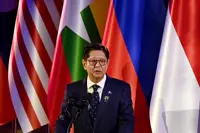
MANILA: China and Asean remain committed to defending multilateralism and free trade despite a sharp rise in global trade restrictions and protectionist measures, says Chinese Premier Li Qiang (pic).
He said both sides have continued to expand economic cooperation despite growing unilateralism, geopolitical conflicts and an increasingly challenging international environment.
“Although economic and trade restrictions have substantially increased around the world, we remain firmly committed to safeguarding multilateralism and promoting free trade, and endeavour to make the pie of cooperation bigger,” he said.
Speaking at the 29th Asean-China Summit here on Monday (Nov 16), Li said China and Asean had long championed economic globalisation and regional integration, with openness and mutual benefit remaining central to their partnership.
He said the two sides had demonstrated resilience over the past five years, maintaining strong economic momentum despite mounting global uncertainties.
“As you can see over the past five years, we have witnessed a growing counter-current of unilateralism and protectionism, and recurring geopolitical conflicts on a global stage.
“Despite such a challenging environment, China-Asean cooperation has maintained strong momentum and scored encouraging achievements,” he said.
Li pointed to the expansion of bilateral trade, which exceeded US$1 trillion (RM4.09 trillion) last year, representing a 20.1% increase compared with 2021.
Trade between China and Asean grew by a further 29.6% in the first 10 months of this year, he said.
“To date, two-way investment has exceeded US$500 billion in cumulative terms, an increase of over 50% compared with five years ago,” he said.
Li said cooperation had expanded into emerging sectors, including the digital economy, green economy and artificial intelligence.
He also highlighted the signing of the China-Asean Free Trade Area 3.0 Upgrade Protocol, which he said had laid the institutional foundation for the development of a massive regional market.
Both sides had also adopted and implemented the Plan of Action to Implement the Asean-China Comprehensive Strategic Partnership 2026-2030, setting out their cooperation priorities for the next five years.
On regional connectivity, Li cited major infrastructure developments, including the Jakarta-Bandung High-Speed Railway and China-Laos Railway, as examples of projects that had strengthened economic integration.
He said the opening of the Pinglu Canal and implementation of the Asean Visa Programme had further facilitated the movement of people, capital and technology across the region.
“The past five years have been truly extraordinary, and the achievements we scored have not come easily,” he said.
Li identified friendship and mutual assistance, openness and mutual benefit, and innovation-driven development as three principles underpinning the success of China-Asean cooperation.
He said both sides must continue strengthening their innovation capabilities and exploring new sources of economic growth.
“These experiences and inspirations are a valuable asset for us all.
“We must carry them forward and harness them to the fullest so as to keep writing new chapters of China-Asean cooperation,” he said.