PETALING JAYA: More Malaysians will have additional funds to spend on daily necessities under the expanded Sumbangan Tunai Rahmah (STR) and Sumbangan Asas Rahmah (Sara) programmes, a move welcomed by economists and consumer advocates amid rising household expenses.
Under Budget 2027, the allocation for STR and Sara would be increased from RM15bil to RM16bil.
All STR recipients will receive up to RM150 monthly, or RM1,800 annually, under Sara, benefiting up to nine million people.
Another 13 million Malaysians aged 18 and above who are not STR recipients, including those in the M40 income group, will receive RM100 twice next year, ahead of Hari Raya Aidilfitri and Malaysia’s 70th National Day celebrations.
Economist Prof Dr Barjoyai Bardai said the expanded assistance would help lower-income households meet their basic needs while extending support to middle-income earners facing financial pressures.
“The expansion of STR and Sara assistance provides important support to lower-income households, particularly when food prices and other essential living costs remain a major concern,” he said when contacted.
However, Barjoyai said financial assistance should serve as a safety net rather than a permanent solution to the cost-of-living problem.
He stressed that eligibility criteria must be fair, assistance must reach the intended beneficiaries and the value of the aid must not be eroded by rising prices.
He also welcomed the expansion of Sara to cover fresh produce at 216 farmers’ markets and tamu markets under the Federal Agricultural Marketing Authority.
Barjoyai said the initiative could improve access to nutritious food while benefiting local farmers by reducing the number of intermediaries.
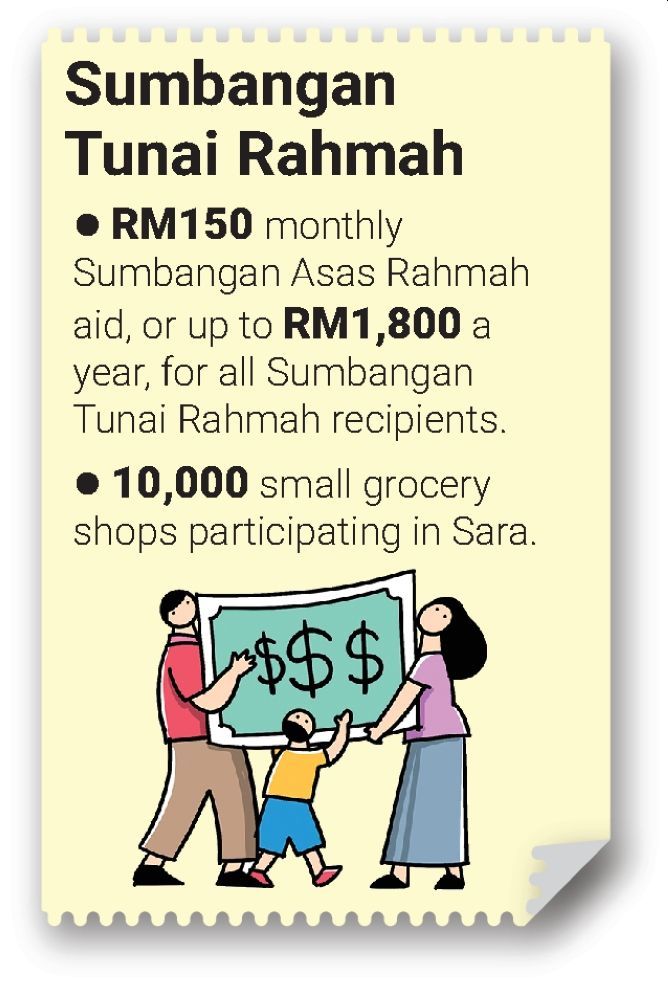
The government’s target of increasing the number of small grocery shops participating in Sara to 10,000 by the end of this year could also support local businesses, particularly in rural and lower-income communities, he added.
Federation of Malaysian Consumers Associations chief executive officer Dr Saravanan Thambirajah welcomed the expanded assistance but urged the government to adopt more comprehensive eligibility criteria.
“Eligibility should not be determined solely by household income classifications such as B40 and M40.”
Saravanan said household size, geographical location, number of dependants and healthcare expenditure should also be taken into account.
“A household earning RM6,000 in an urban area with several dependants may face greater financial pressure than a smaller household earning less in another location,” he said.
Centre for Market Education chief executive officer Dr Carmelo Ferlito described Sara as the right approach, particularly its shift from subsidising goods to providing direct assistance to individuals.
“It is close to the purpose-voucher approach I have long advocated,” he said.
However, Ferlito questioned the broad distribution of RM100 payments to 13 million adults, including middle-income earners.
“Giving RM100 each to 13 million adults is not targeted assistance. Aid should be concentrated, flexible and temporary.”