PETALING JAYA: How many plates of nasi lemak can a typical Malaysian salary buy?
Fewer than before the pandemic, according to Department of Statistics Malaysia (DOSM) data.
From 2019 to 2025, the country’s median monthly wage rose by 20%, from RM2,442 to a record high of RM2,940.
But the average price of nasi lemak went up even faster, rising 32% from RM2.81 to RM3.70.
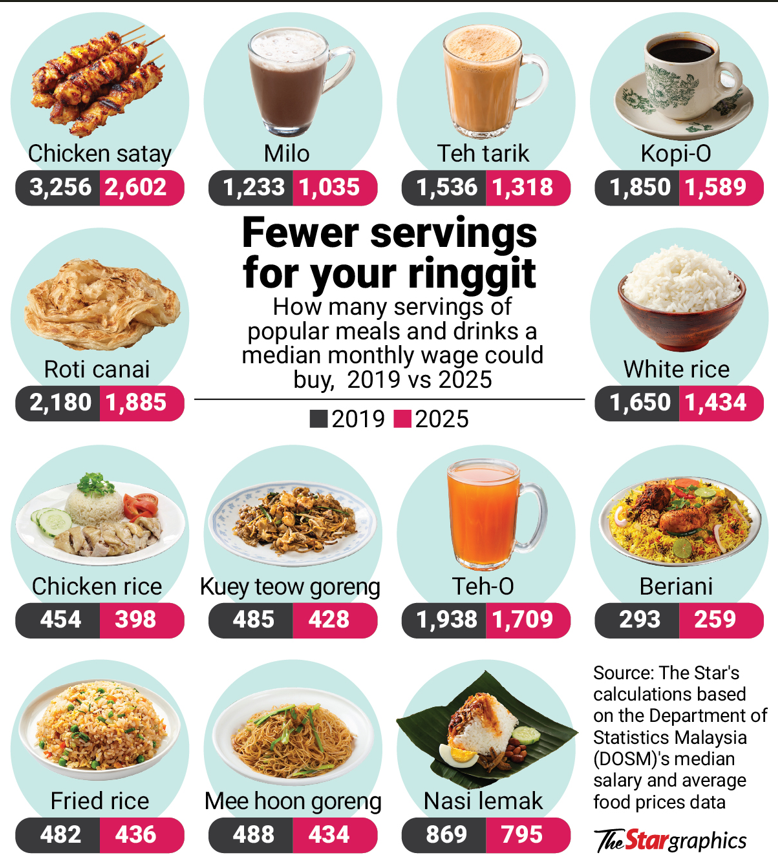
This means that a worker earning the median salary could buy 869 plates of nasi lemak each month in 2019, compared with only 795 in 2025.
That’s 74 fewer plates, or an 8.5% decline.
While nobody is likely going to spend their entire monthly salary on nasi lemak, the example illustrates the declining affordability of the popular food item in recent years.
ALSO READ > Ministry to strengthen Menu Rahmah, price monitoring
And it’s not just nasi lemak that has become less affordable.
From roti canai to chicken rice, DOSM’s figures show that prices of at least 12 other common food items rose faster than the median wage between 2019 to 2025 (see graphic).
For Malaysians who eat out regularly, the squeeze on household budgets is real.
Content writer Ho Jia Wen, who often eats out due to her busy work schedule, said even economy rice, her usual budget option, now costs up to RM12 for a plate with meat and vegetables.
“Previously, we could get it for less than RM10, but not anymore.
“I always eat out for lunch, and with prices like these, I spend at least RM400 a month and that is only for one meal a day,” said the 27-year-old from Petaling Jaya.
She said she had tried cooking dinner at home, but groceries had also become more expensive.
“If you compare the cost of mixed rice with cooking at home, there is not much difference,” she added.
ALSO READ > Wages losing the race against food prices
Freelance religious teacher Raihanah said food prices at pasar malam had also risen sharply.
“Food at roadside stalls and pasar malam now costs about as much as food as restaurants.
“Even fried chicken is sold for RM10 at pasar malam these days,” said the 33-year-old from Klang.
She said than when eating out, she would opt to eat at restaurants instead, as the prices were similar.
Marketing executive Angela Peter, who frequents pasar malam every week, said she had noticed food prices becoming more expensive each year.
“Even a bowl of curry laksa is around RM10 to RM11. Rice with vegetables and meat costs about RM12 to RM13 now.
“It defeats the purpose of going to pasar malam if prices are almost the same as at restaurants.
"The appeal used to be that you could buy many things to eat at affordable prices, but that is no longer the case as prices keep going up,” she said.
She said she spent around RM200 a month on food at pasar malam, despite visiting only once or twice a week.
“At work, I try my best to bring food from home.
“It is the only way I can keep my food expenses down and save money each month,” said the 27-year-old from Cheras.