
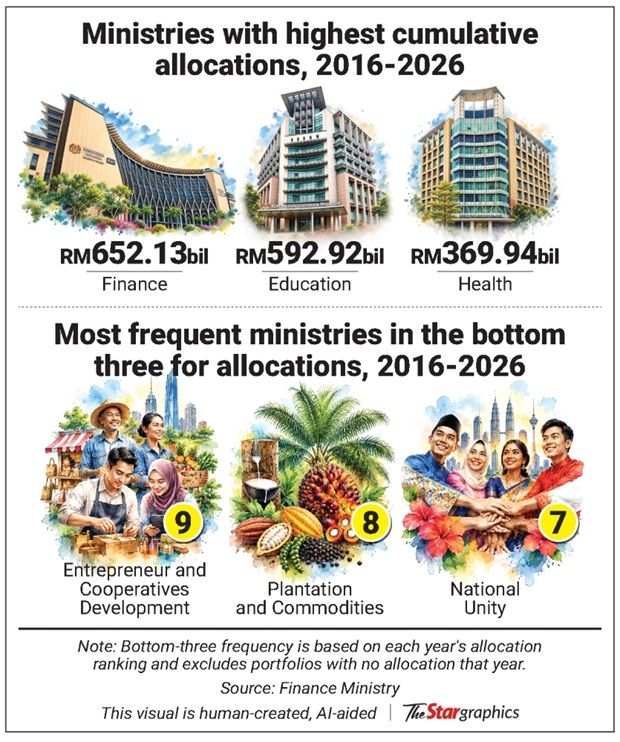
PETALING JAYA: Malaysia’s next big infrastructure investment should be in its people, with greater spending on education, healthcare, skills and technology seen as crucial to sustaining long-term economic growth, say economists and consumer experts.
Economist Prof Emeritus Dr Barjoyai Bardai said Budget 2027 should treat education, healthcare, artificial intelligence, research and workforce skills as productive infrastructure capable of generating long-term economic returns.
“The issue is not simply how much we spend but how government expenditure builds Malaysia’s productive capacity for the next 10, 20 and 30 years,” he said when contacted yesterday.
He said education and higher education should remain among the biggest recipients, but allocations should increasingly be tied to measurable improvements in learning, employability and productivity.
Prof Barjoyai said priority should be given to science, technology, engineering and mathematics (STEM), AI and digital literacy, technical and vocational education and training (TVET), teacher quality, university research and commercialisation, lifelong reskilling, and narrowing the urban-rural learning gap.
Healthcare, he added, also deserves more funding as Malaysia faces an ageing population, rising non-communicable diseases and growing pressure on public facilities.
“I would regard healthcare as economic infrastructure, not simply social expenditure,” he said.
Assoc Prof Dr Foo Lee Peng, chairman of the Centre for Business and Policy Research at Tunku Abdul Rahman University of Management and Technology, said Budget 2027 should give greater attention to autism education and early intervention.
She said this is in view of the growing number of children suspected of having autism, which rose to 1,685 in 2024 from 1,453 in 2023, based on information from the Statistics Department.
As such, she said increased allocations for the Education Ministry and Women, Family and Community Development Ministry were key.
“This highlights the need for timely assessment, trained teachers and specialists, and affordable support for families, including those outside major cities, which fall under the purview of these two ministries,” she said.
Assoc Prof Foo said more funding should also go to the Health Ministry to reduce waiting times for appointments and retain doctors in public service.
“Funding should be directed more specifically towards sufficient permanent posts, specialist training, manageable workloads and better appointment systems,” she said.
“This is because timely treatment helps people remain healthy and productive, while retaining experienced doctors sustains the quality of public healthcare.”
She also called for greater funding for the Energy Transition and Water Transformation Ministry to reduce the occurrence and impact of flash floods across the country.
Federation of Malaysians Consumers Associations chief executive officer Dr Saravanan Thambirajah said Budget 2027 should prioritise ministries that directly affect household costs and quality of life.
He said these include the Domestic Trade and Cost of Living, Agriculture and Food Security, and Transport ministries, as well as those responsible for housing, energy and essential infrastructure.
“The priority must be areas where additional government spending can actually reduce household expenditure or improve the quality and accessibility of essential services.
“Food security is especially important because food expenditure cannot be avoided.
“As such, greater investment in domestic food production, technology, logistics, storage and supply-chain efficiency can strengthen supply and reduce Malaysia’s vulnerability to external disruptions such as the current energy crisis,” he said.
Saravanan said transport allocations should also be prioritised to make public transportation more reliable and improve first- and last-mile connectivity, reducing dependence on private vehicles and household transport costs.