
MELAKA: Not long ago, paying a bill, checking a local authority matter or completing a government transaction could mean finding the right office, taking a number and waiting at a service counter.
Today, an increasing number of those interactions are moving onto a screen. But Melaka’s digital ambition is beginning to go beyond putting existing services online.
Under the state administration led by Chief Minister Datuk Seri Ab Rauf Yusoh, digitalisation is being positioned as part of a wider transformation in how the government communicates with people, manages information and delivers services.
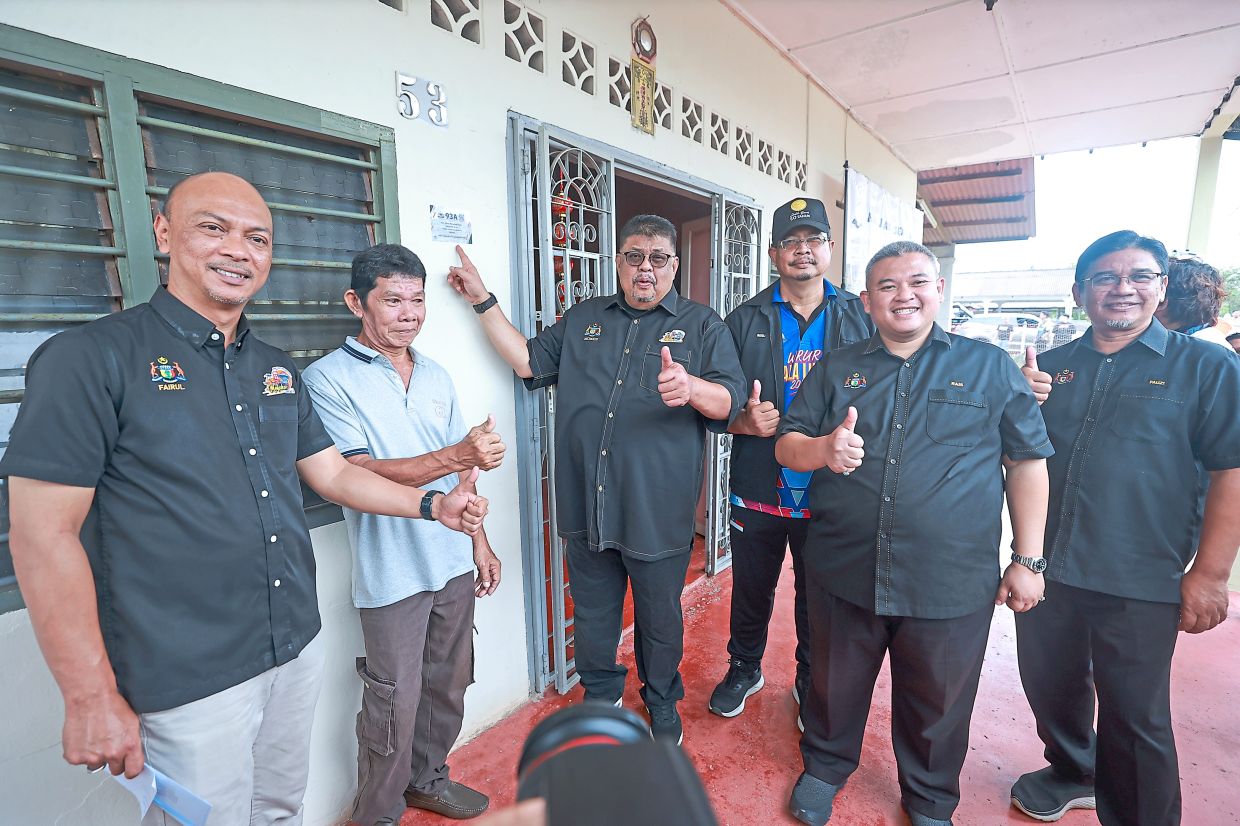
The objective is straightforward: make dealing with the
government simpler, faster and more accessible whether a person lives in the city centre or in a traditional village.
It is an approach closely tied to Melaka Sayang Rakyat (MeSRa), the state administration’s people-centred philosophy. In this context, technology is not intended to replace the human element of public service, but to make that service work better.
A digital identity for Melaka
Perhaps the clearest recent indication of that direction came in July with the launch of E-mel Rakyat Negeri Melaka. Through the official @melaka.my domain, residents were provided with a dedicated digital communication channel connecting them to the state government.

As of July 22, some 203,000 E-mel Rakyat accounts were
registered, including more than 193,000 accounts involving students and teachers. The state has set a target of 250,000 users.
Rather than functioning merely as another email address, the platform is designed as part of a wider digital ecosystem through which residents can receive official information and communicate views and suggestions to the state.
It is also linked with services including eTAPEM, MelakaPay, the online tender system, housing services and e-Tanah, creating a more consistent digital touchpoint between a citizen and the state.
That could eventually mean less fragmentation between platforms and a simpler route for people seeking government information and services.
When a village address goes digital The transformation is also taking place far beyond Melaka’s urban centres.
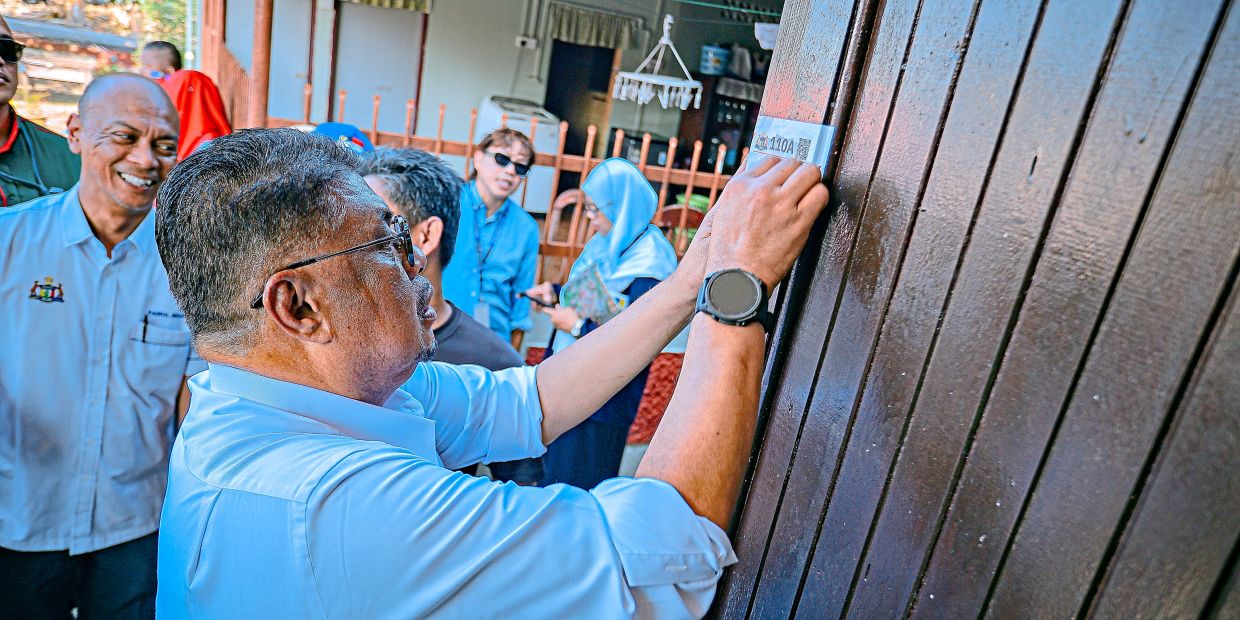
The Kampung Digital initiative addresses a basic but significant problem: many homes in traditional villages have historically lacked sufficiently structured addresses. Under the system, premises are assigned QR-coded digital addresses containing information such as the full address, district, lot number and location link.
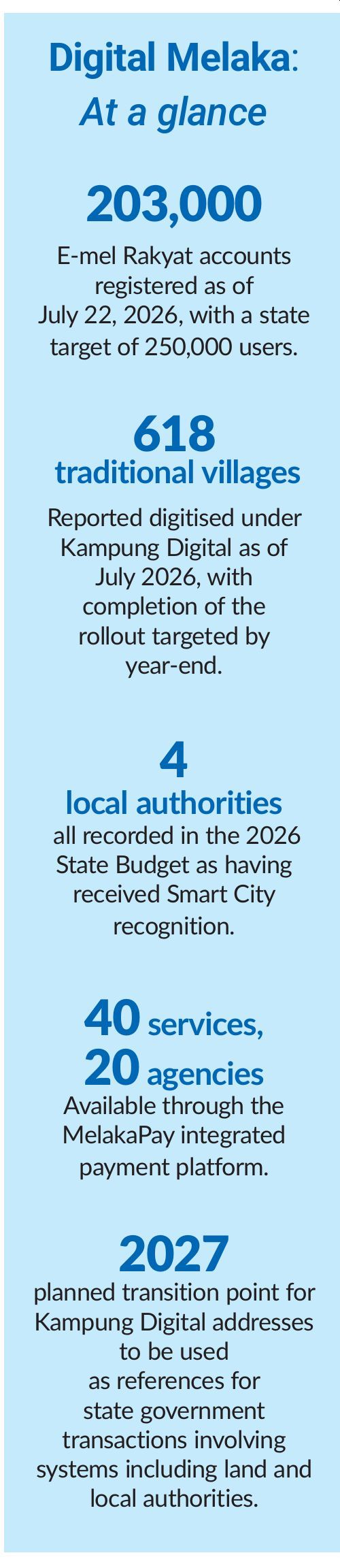
In July, Ab Rauf said 618 traditional villages had been digitised, with the remaining rollout expected to be completed by the end of 2026.
He also said the new Kampung Digital addresses are intended to become the reference for state government transactions from 2027, including land and local authority systems.
That makes Kampung Digital more than an addressing programme – it potentially becomes part of Melaka’s digital backbone, connecting a physical household to a standardised government database and, through E-mel Rakyat, to a digital communication identity.
Four local authorities, one smart-state direction
Digitalisation is also increasingly visible at the local-government level. Melaka’s 2026 budget states that all four local authorities in the state have received Smart City recognition, placing local government at the centre of the state’s smart-city agenda.
The existing state feature also records the expansion of online services across these local authorities and the adoption of technology to improve the efficiency and quality of service delivery.
For the public, “smart city” has to translate into fewer unnecessary trips to government offices, easier payments, quicker access to information and more responsive services.
That principle can already be seen in MelakaPay. The state’s integrated payment gateway brings together 40 services involving 20 government agencies, allowing users to make payments through a portal or mobile application for services including land tax, assessment tax, compounds and education loans.
A clear direction for a digital Melaka
Behind these initiatives is a broader policy direction being pursued under Ab Rauf to move Melaka from individual digital projects towards a more connected, data-driven state administration.
The Kampung Digital initiative itself traces back to an idea introduced by Ab Rauf in April 2023 to address a longstanding but often overlooked problem: homes in many traditional villages did not have sufficiently clear, systematic and structured addresses.
The initiative subsequently developed into a digital addressing system that gives homes unique QR-linked identities
and geographical coordinates, improving location accuracy for government agencies, emergency services, deliveries and everyday transactions.
The state has now outlined Kampung Digital Melaka 2.0, which is set to extend the initiative across Melaka to areas including Kampung Baru, Felda and Felcra settlements, residential neighbourhoods, commercial centres and industrial areas. Preliminary work for non-traditional villages is proposed to begin between October and December 2026, followed by a phased implementation from 2027 to 2030.
The framework for Kampung Digital 2.0 also covers governance, data coordination, infrastructure, community security and the expansion of the digital economy.
The aim is for an address to become more than a location. It can become a digital reference point connecting a household, community and government database, enabling information to be organised more accurately and potentially allowing public services, assistance, utilities, development planning and other government functions to be delivered with greater precision. That direction is also being supported by investments in the infrastructure beneath Melaka’s digital ambitions.
In August, Ab Rauf announced plans for what he described as a “digital highway”, involving an approximately RM30mil investment by Maxis to connect 151 telecommunications towers across Melaka through some 200km of fibre-optic network. The project is intended to strengthen digital connectivity and provide infrastructure for future technology and digital-economy development.
Taken together – Kampung Digital, its 2.0 expansion, E-mel Rakyat, smart local authorities, MelakaPay and stronger fibre connectivity – these measures point to a consistent direction in the state’s digital agenda. The next phase is about building the infrastructure, identity, data and connectivity that allow those services to function as one ecosystem.
For Melaka, that represents a shift from using technology as a supporting tool to making digital capability part of how the state itself is planned, managed and connected to its people.
Transforming government behind the screen
A digital state cannot depend only on what citizens see on their phones. Behind every convenient online service is another challenge: government systems themselves have to be able to communicate, manage information and make decisions more efficiently.
The Melaka Chief Minister’s Department’s strategic plan provides a glimpse into that less visible side of the transformation. It sets programmes for expanding end-to-end online services, adding digital dashboards and content to the Melaka Digital Command Center, increasing the use of the Digital Document Management System and using e-MMKN for state executive council administration.
Earlier state budget measures also provided for AI chatbot facilities on the state government and Tourism Melaka portals, expansion of free Wi-Fi, upgrades to the State Data Centre and coordinated digital infrastructure including fibre-optic networks.
Taken together, they point towards an important next stage: digital government is no longer simply about converting a paper form into an electronic form,
but connecting data, systems and services so that the government itself can respond more effectively.
Digital first, but not digital only
There is, however, another side to the transformation. Not everybody moves online at the same speed. Senior citizens, people with limited digital literacy and residents without confidence in using online systems can easily find themselves on the wrong side of a digital divide.
That is why the human component remains important. Assisted counters continue to provide guidance to residents who need help navigating portals and applications – an approach already highlighted in the state’s MeSRa Digital framework.
As Ab Rauf puts it: “Technology should bring the government closer to the people, not create another barrier for those who need assistance.”
For Melaka, a digital-first government need not mean a digital-only government. The measure of inclusion is not simply how many services are moved online, but whether people can actually use them.
One digital ecosystem
Seen separately, E-mel Rakyat, Kampung Digital, MelakaPay, smart local authorities, e-Tanah, digital government dashboards and online service portals can appear to be individual projects.
Viewed together, however, they reveal a more consequential direction:
> A village home receives a structured digital address
> Its residents can hold an official @melaka.my account
> That account can become a channel for government information and services
> Payments can be made through a state gateway
> Land and local authority transactions are increasingly digital
> Government information can, in turn, be organised through more integrated databases and dashboards.
The next test for Melaka will be how well these systems connect with one another, how much time they save the public, how effectively they support decision-making and how widely their benefits reach.
The state’s long-term development framework, Melakaku Maju Jaya 2035 Strategic Plan (PSMJ 2035), already places
technology, infrastructure, data and sustainable development within Melaka’s broader development planning.
Measured in everyday moments
For residents, the success of digitalisation will rarely be judged by technical terminology. It will be felt when land payments can be made without a long journey, homes in traditional villages can be located accurately, parents can access reliable information through official channels, businesses can settle government payments from their devices, and elderly residents can still find an officer ready to help when navigating online systems .
That is where Melaka’s digital transformation becomes meaningful — not when technology becomes more visible, but when government becomes easier to reach.