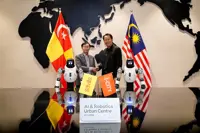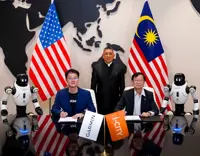
AFTER establishing humanoid robots across industrial and commercial applications, AgiBot is turning its attention to what it sees as the next frontier for embodied intelligence – the home.
This ambition is already moving from concept into development.
Its collaboration with i-City represents more than deploying robots into the 500 residences planned for AI Living @ i-City.
The company sees AI Living as a potential global reference project for understanding how embodied intelligence can move from structured workplaces into people’s everyday lives.
It aims to learn how domestic robotics applications could eventually be deployed at scale across the much larger global residential market.
From factory to home
Founded in 2023, AgiBot has moved rapidly from development into mass production. By the end of 2025, it had produced more than 5,000 humanoid robots and was ranked by technology research and advisory group Omdia as the world’s largest supplier by humanoid robot shipments and market share.
Its robots are already being deployed across manufacturing, logistics, hospitality, entertainment, security, research and education.
The home, however, presents a very different challenge and a potentially much larger addressable market.
Factories and commercial facilities are relatively structured environments, where robots can be deployed around defined processes. In a home, on the other hand, robots have to navigate furniture and everyday objects, interact safely with people and potentially perform a variety of tasks in unpredictable environments rather than repeat a single industrial process.
These are among the challenges the company is exploring through its AI Living Lab as it develops domestic robotics applications for AI Living.
“Bringing robots into people’s homes requires very different capabilities from industrial and commercial applications. Through the AI Living Lab, we are exploring what domestic robots need to do, how they should interact with people and how their capabilities can evolve as both people’s needs and the technology itself change.
“AI Living @ i-City gives us the opportunity to take this work into a real residential environment and understand how embodied intelligence can progressively become useful in people’s everyday lives,” said AgiBot founder, chairman and chief executive officer Deng Taihua.
A real-world reference for the future home
AI Living @ i-City is scheduled for completion in 2030 and features 500 homes designed to use artificial intelligence (AI) and emerging technologies to adapt to people’s changing needs throughout their lives.
The development is being conceived as an adaptable residential environment into which new generations of AI, domestic robotics, wellness technologies, intelligent appliances and services can progressively be introduced as both technology and residents’ needs evolve.
For AgiBot, this provides a real-world environment in which domestic robotics can be explored in the context of how people actually live.
“The opportunity for robotics in the home is not simply about putting a humanoid robot into an apartment,” said Deng.
“People’s needs change throughout their lives. When they are younger, robotics may provide convenience by helping with household tasks. As they grow older, the same technologies could increasingly support mobility, wellness, companionship and eventually aspects of care.
“If we can establish how robots, AI and an adaptable residential environment work together at AI Living, the lessons can potentially be applied to homes well beyond i-City. That is what makes this collaboration strategically important to us,” he said.
From seeing robots to living with them
The residential development builds on the strategic relationship between AgiBot and i-City established through the AI World Experience Centre at i-City, where more than 100 AgiBot robots have already been deployed.
That first phase of the partnership has allowed the public to see and experience humanoid robots across different applications.
AI Living opens the next chapter – exploring what it means to live with them.
i-City also plans to introduce a robotics-as-a-service model for AI Living, enabling residents to access evolving generations of domestic robots without having to purchase and maintain the technology themselves.
As robotics technology advances, residents could therefore gain access to new capabilities over time rather than having their experience tied to the generation of robots available when the development is completed.
A home designed to evolve with people
For i-City, the objective goes beyond accommodating robots. Its role in the collaboration is to create a residential environment capable of evolving alongside both its residents and the technologies that may eventually serve them.
“Working with AgiBot gives us the opportunity to understand how each new generation of embodied intelligence can help meet those changing needs – from convenience today to wellness, assistance and care as residents grow older.
“If AI Living can demonstrate that successfully, we believe it can become a global reference not only for the future of domestic robotics, but for how homes themselves should evolve to serve people throughout their lives in the AI era,” said i-City founder and chairman Tan Sri Lim Kim Hong.
For more information, visit https://corp.i-city.my/.