
KUCHING: Cloud-seeding exercises have started in Sarawak, Kedah and Perlis, targeting hydroelectric reservoirs and water catchment areas across the states.
In Sarawak, Deputy Premier Datuk Douglas Uggah said the operation on the first day was aimed at inducing rain over the Batang Ai dam in Sri Aman division and the larger Bakun and Murum dams in the northern part of the state.
Thirteen water catchment areas in five administrative divisions – Samarahan, Sri Aman, Betong, Kapit and Limbang – will be the target during the remaining two days.
Uggah, who is also Sarawak Disaster Management Committee (SDMC) chairman, said the exercise was part of the state government’s integrated measures to address hot and dry weather conditions and the deterioration of air quality caused by haze.
He said the objective of the exercise was to increase the water levels of the hydroelectric reservoirs and the 13 catchment areas before the onset of an expected hot and drier October.
“That’s our objective. October might be hotter and drier. (So) we want to increase the water level as much as possible while we still can,” he told reporters after witnessing the Royal Malaysian Air Force (RMAF) C-130 aircraft take off for the operation at the base here yesterday.
In a media statement, Uggah said that while water levels at some reservoirs were “lower than usual”, the situation remained manageable.
He added that state utility company, Sarawak Energy Bhd, would continue to monitor the water levels at its hydropower reservoirs during the prolonged hot and dry weather.
Uggah also hoped that the resulting rainfall from cloud seeding could help reduce the concentration of airborne pollutants, thereby supporting efforts to address air quality deterioration and the impact of haze.
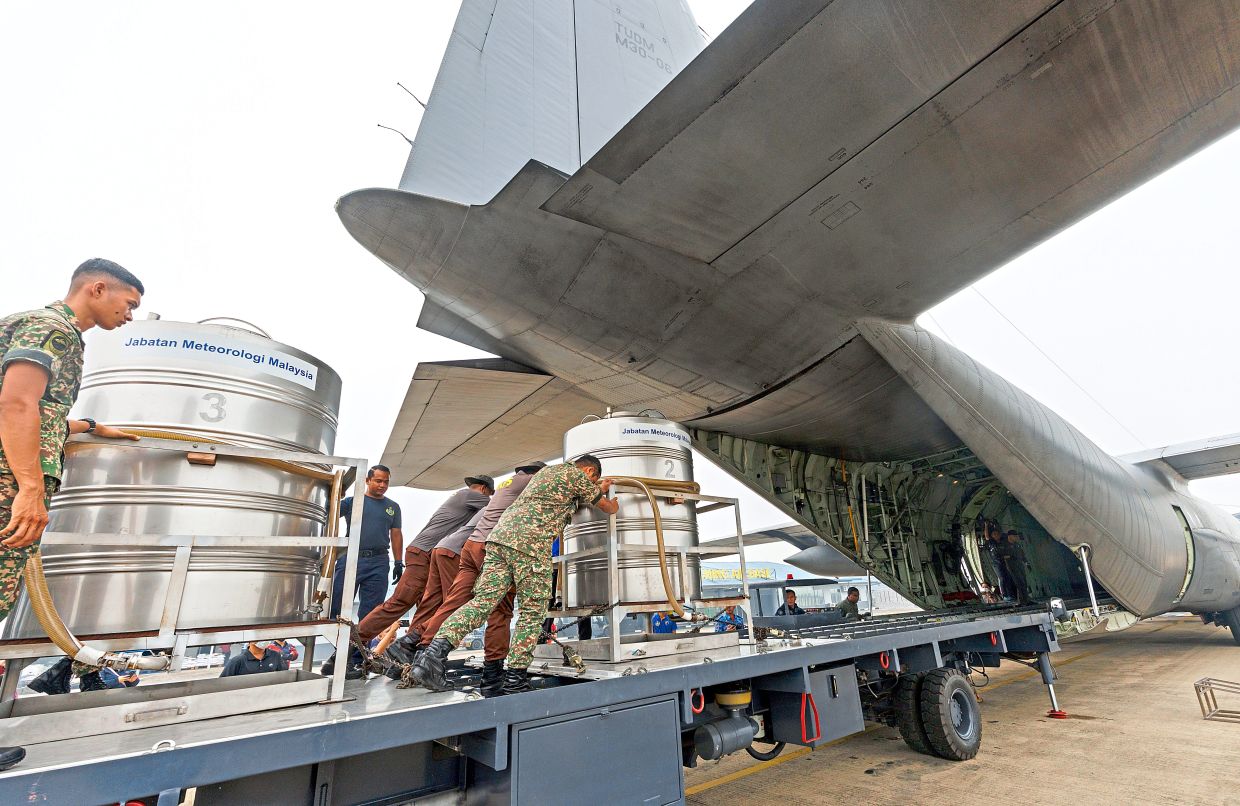
The RMAF plane in yesterday’s operation carried four steel water tanks, each containing 1,800 litres of water with 200kg of salt dissolved in it.
Meteorologist Mohd Ridzuan Adam said as the plane flew to the designated target areas, his job was to look for suitable clouds with enough moisture.
The clouds, he said, were normally towering cumulus at altitudes of 1,500 to 2,100m.
Once suitable clouds are identified, the plane would fly into them to release the salt water. Rain would normally start fall ing within one to three hours, Ridzuan said.
However, he said the rainfall could take a little longer in Sarawak at this time of the year.
“There could be no winds to push the cloud higher up the atmosphere,” he said.
He said the winds blowing from the southwest were normally not strong enough to push the clouds higher.
“So we cannot guarantee there would be rain after the cloud seeding. Nonetheless, we will continue with this operation until we find the suitable clouds,” he said.
Clear skies or clouds with insufficient moisture generally cannot be seeded effectively.
This is the third cloud seeding operation to be carried out in Sarawak this year.
The earlier two were conducted in May and June over the three hydroelectric reservoirs.
Meanwhile, cloud seeding operations are also being carried out in Kedah and Perlis.
The operations, which will be conducted until tomorrow, will target the Pedu, Muda, Ahning and Beris dams in Kedah and the Timah Tasoh dam in Perlis.