



PETALING JAYA: Despite higher living and fuel costs, Malaysians continue to see private vehicles as a necessity, driving car sales and production to new highs.
Malaysia’s automotive total industry volume (TIV) rose 5% year-on-year (y-o-y) to 73,615 units in July, from 70,057 units a year earlier, according to the Malaysian Automotive Association (MAA).
Monthly vehicle production also reached a 30-month high at 75,490 units, up 5% from 71,739 units previously, driven mainly by national models.
Passenger vehicle sales increased 7% year-on-year to 68,900 units from 64,438 units, although commercial vehicle sales fell 16% to 4,715 units.
“The 7% improvement in passenger vehicle sales is actually coming from the SUV segment, and this segment is driven mainly by the national mix.
“All our members are very aggressive in promoting. They are giving a lot of good rebates,” Malaysian Automotive Association (MAA) president Mohd Shamsor Mohd Nor said.
“That entices people to come in because it helps in terms of the down payment,” he added.
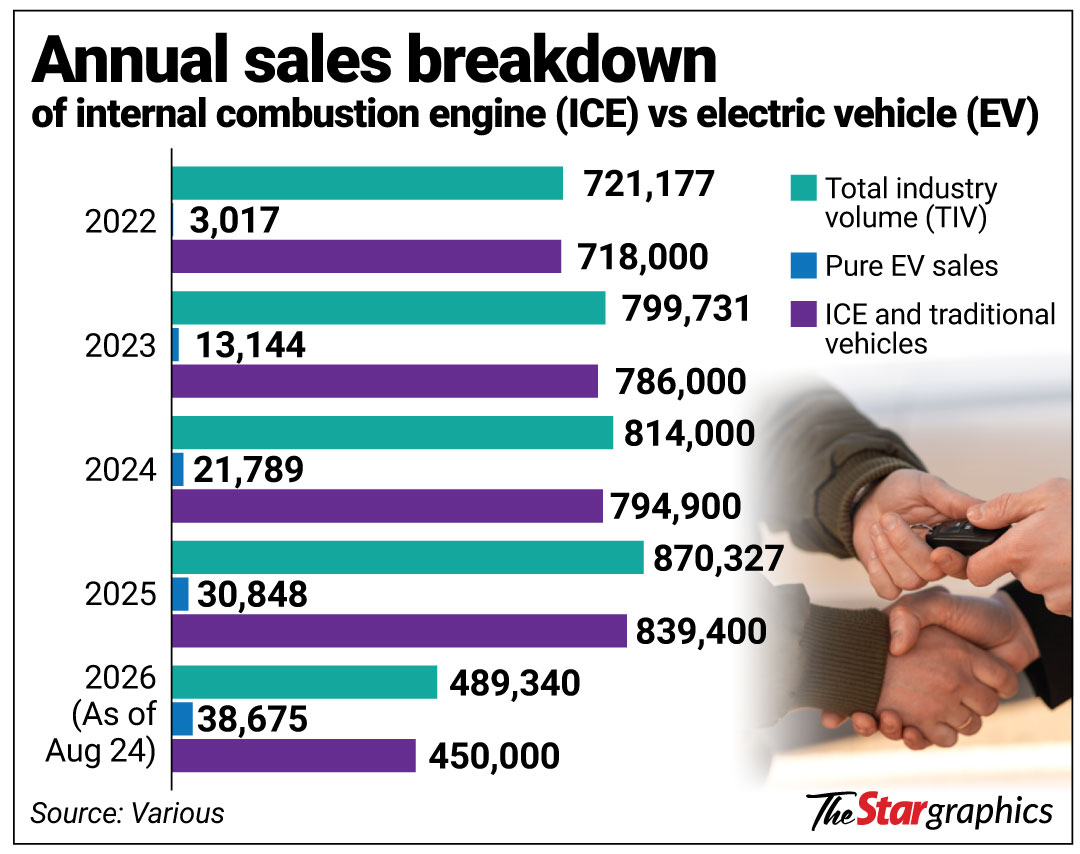
He also pointed to stronger pickup truck sales following the expansion of the Budi diesel subsidy, with the segment recording a sharp month-on-month increase in July.
At the same time, rising fuel costs could be encouraging some high-mileage motorists to consider EVs as a way to reduce running costs.
“Because of the concern about fuel cost, there are people who have to travel a lot. They may now be looking into EVs so that they can lower their cost,” he said.
Bank Muamalat Malaysia Bhd chief economist Dr Mohd Afzani-zam Abdul Rashid said the figures showed that Malaysians remained heavily dependent on private vehicles, particularly because public transport was still largely concentrated in urban areas.
“It means Malaysians have been depending on private vehicles as their mode of transportation despite the existence of public transport in urban areas,” he said.
He added that private vehicle ownership had effectively become a necessity for many Malaysians.
“Perhaps, what is more important is to ensure a more competitive and fairer automotive industry which would bring better pricing for the consumers,” he said.
Afzanizam also said the sharp increase in EV sales could help reduce carbon emissions and support Malaysia’s transition towards a more sustainable economy.
Afzanizam said public transport ridership had nevertheless continued to grow, with LRT and MRT ridership in the first seven months of the year reaching 94.3 million and 55.2 million passengers respectively.
Sunway University economics professor Dr Yeah Kim Leng said new job entrants, car purchases and the shift towards EVs were supporting vehicle demand despite cost-of-living pressures.
He said car ownership remained a necessity for many due to gaps in public transport and its importance for commuting.
“Car ownership is a necessary rather than discretionary item, due to inadequate public transportation and its importance as an essential means of transport for work,” he said.
Yeah said better public transport was needed to reduce dependence on private vehicles, fossil fuels and exposure to energy price shocks.
“The continuing rise in car ownership without an accompanying improvement in road and parking infrastructure is not sustainable,” he said.
