
PETALING JAYA: Product returns are becoming an increasingly common part of Malaysia’s e-commerce landscape, as easier return policies give consumers greater confidence to shop online.
However, it also creates additional costs for sellers.
According to industry feedback, online sellers are facing higher costs from returns, with sizing disputes, differences between product photographs and actual items, and multiple-variant purchases among the common pain points.
The Malaysia Cross Border e-Commerce Association (MCBEA) president Datuk Dr Danny Tan said some consumers were also buying several sizes or colours of the same product to try at home before returning the unwanted ones – a practice known in the industry as “bracketing”.
“This is common, especially in fashion and footwear, where buyers may order multiple sizes or colours to try at home and return the rest,” he said in an interview yesterday.
Tan said easier and free-return options could encourage such purchasing behaviour, although returns remained an important part of online shopping as they gave consumers greater confidence to buy products they could not physically inspect or try before purchase.
“Returns and refunds are rising, driven by easier platform policies, ‘change of mind’ options and high cash-on-delivery volumes. Many sellers, especially those operating on tight margins, feel that platform rules tend to favour buyers over small sellers,” he said.
He added that returns could involve additional inspection, restocking, repackaging, logistics and inventory costs.
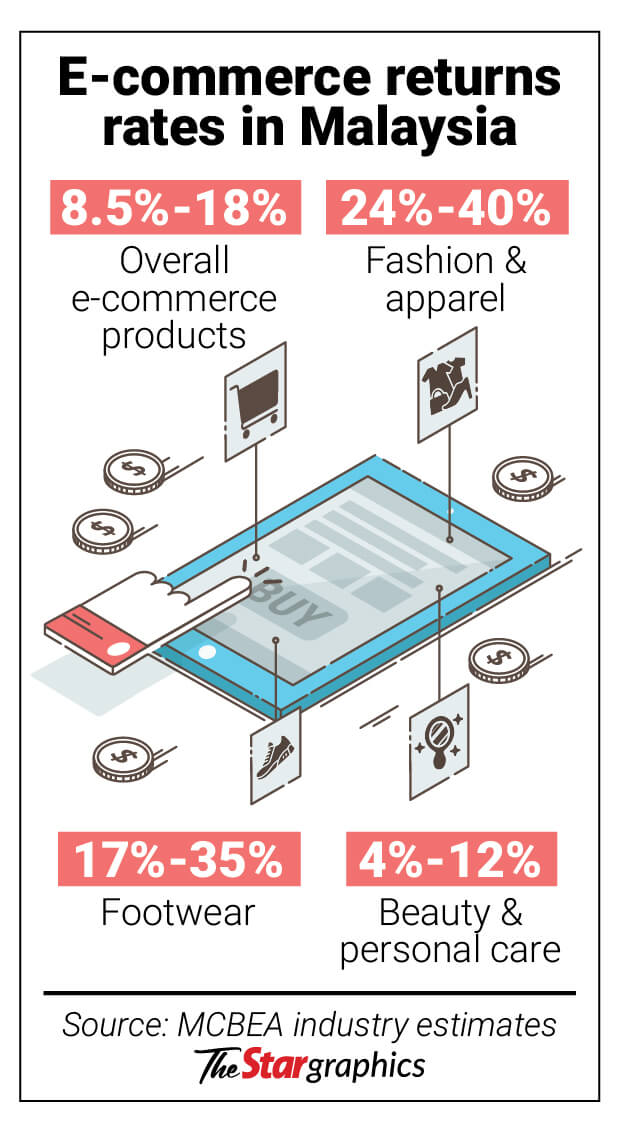
Based on members’ feedback, MCBEA estimates that between 8.5% and 18% of Malaysian e-commerce purchases are returned, with apparel and other fashion items recording higher rates of 24% to 40%, footwear 17% to 35%, and beauty and personal care products at 4% to 12%.
“The cost of a return generally depended on the reason for the return and the platform’s policy,” said Tan.
“Sellers will typically bear the cost when goods are wrong, defective, damaged or misdescribed, while buyers may bear the cost for change-of-mind or sizing returns unless the seller or platform offers free returns.”
Platforms could also cover return costs under certain free-return programmes, he said.
However, Tan said the courier fee was only one part of the cost faced by sellers.
Other costs include inspection and restocking labour, repackaging, inventory write-downs, logistics administration, payment and processing fees, as well as the cost of holding stock.
He noted that returned goods that remained unopened and in their original condition could generally be restocked and sold as new, while opened, worn or damaged items might have to be repaired, repackaged and sold at a discount.
“Some used or hygiene-sensitive products might not be resaleable and could be written off, while heavily damaged goods could be scrapped or returned to suppliers,” he said.
Tan said returns could erase between 5% and 15% of margins for some thin-margin SMEs, although sellers continued offering easy returns because they helped build consumer trust, boost purchases and encourage repeat business.
Malaysia Digital Chamber of Commerce emeritus chairman Dr Chris Daniel Wong said online sellers were increasingly seeing higher return rates, particularly for items such as footwear, accessories and products where size, colour or fit are important.
He said easy or free returns had helped build consumer confidence, but had also changed purchasing behaviour.
For sellers, particularly SMEs and micro-sellers, the cost of handling a return could extend well beyond the delivery fee, he said.
“Every return may involve reverse logistics costs, manpower for inspection and processing, repackaging, inventory management and, in some cases, products that can no longer be sold as new,” he added.
Wong said returned items that were opened, used or had damaged packaging could lose their original resale value, while sellers might have to repair, repackage, discount or write off such goods depending on their condition.
The impact was also different depending on the size and scale of the business, he said, with larger retailers better able to absorb return-related costs through established fulfilment systems and economies of scale.
“For Malaysian SMEs and micro-sellers operating on relatively thin margins, repeated returns can materially affect profitability,” he said.
Wong said sellers could reduce avoidable returns by giving consumers better information before purchase, including clearer product descriptions, more accurate sizing information, photographs and verified reviews.
He said technology could also play a role, with AI-assisted recommendations and virtual fitting tools helping consumers make better-informed purchasing decisions and reducing uncertainty before they placed an order.
“The objective should be to maintain the convenience and confidence that easy returns bring to e-commerce, while reducing unnecessary returns that ultimately increase costs across the entire ecosystem,” he said.
Wong said Malaysia currently lacked comprehensive data on e-commerce returns.
“There would be value in developing better Malaysian industry data on return rates by product category, reasons for returns, costs to merchants and the proportion of returned goods that can be resold.
“Such data would help platforms, sellers and policymakers better understand the scale and cost of returns and assess how return practices could be improved without compromising consumer protection,” he added.