Authentic batik remains costly as local artisans keep tradition in focus
PETALING JAYA: Authentic Malaysian batik continues to struggle against cheaper Indonesian imports, with industry players citing small-scale production, labour shortages and reliance on imported raw material as the main reasons local products remain more expensive.
Karyaneka Sdn Bhd, a subsidiary of Kraftangan Malaysia under the Tourism, Arts and Culture Ministry, said Malaysia’s batik industry remains largely artisan-based, unlike Indonesia’s mass-production model.
Its general manager Hairul Nizam Mohd Amran (pic) said Malaysian batik producers typically employ only around 10 skilled artisans, compared with Indonesian manufacturers that can hire between 1,000 and 2,000 workers.
“Production is therefore very limited. Labour costs are also a challenge,” he said.
ALSO READ: Fresh take on a timeless craft
Hairul said authentic batik production is a time-consuming craft that younger generations are increasingly reluctant to pursue.
“Many prefer quicker results, such as printed batik, rather than the tedious and lengthy process of producing authentic batik.
“To produce a single piece takes a lot of time. Every layer and every canting stroke must be done carefully. That’s why authentic batik is considered a premium artwork.
“Every stroke of the brush comes from the soul, and that becomes part of the artwork,” he said.
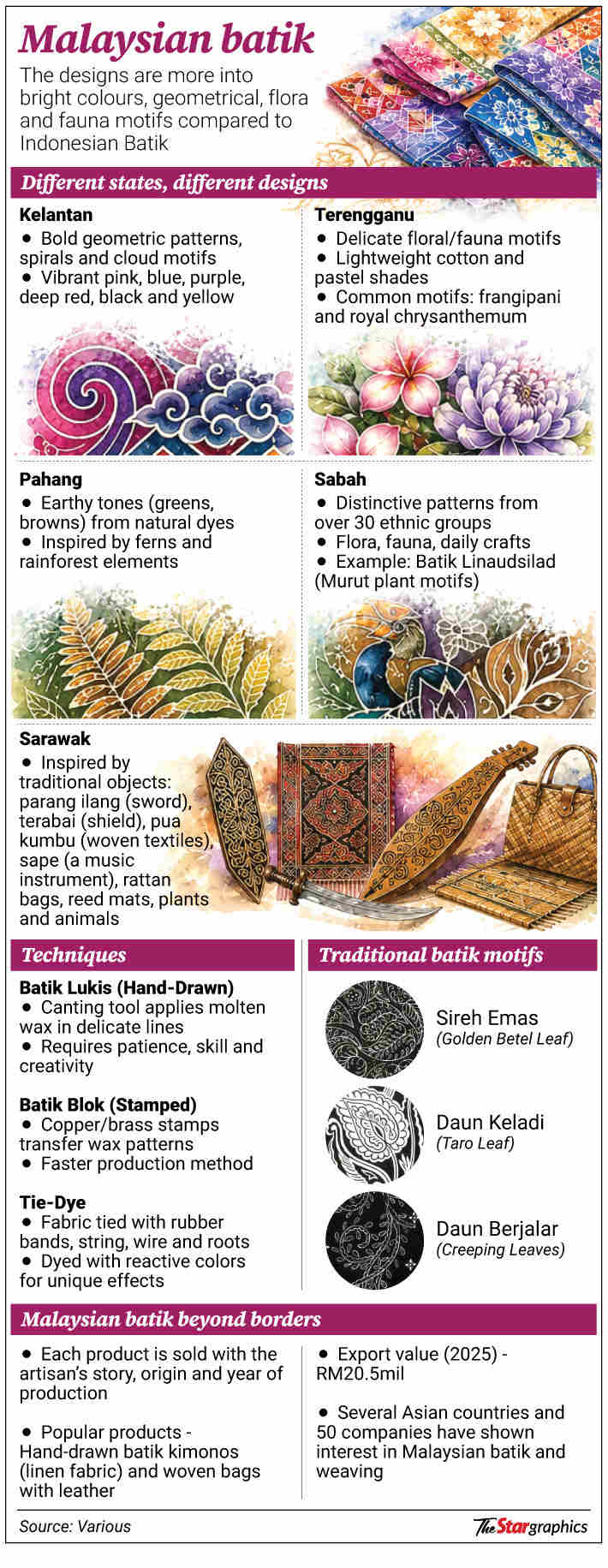
Production costs are also driven up by Malaysia’s dependence on imported raw materials.
Hairul said most fabrics are sourced from China and India, while imported chemicals used in the production process add to manufacturing costs.
He believes technology can help lower production costs without compromising authenticity.
Among the innovations being explored are eco-print batik, clay-based dyeing techniques and machine-assisted silicate processing, which can reduce waste, shorten production time and improve efficiency.
“If the government can help entrepreneurs obtain silicate machines, the process becomes faster, saves raw materials and ultimately reduces costs.”
According to Kraftangan Malaysia, there were 728 active registered batik artisans as of May this year, while another 160 had become inactive.
Hairul said the shortage of skilled artisans extends beyond batik, citing the decline of traditional tikar mengkuang or screwpine mat weaving in Terengganu.
“In Terengganu, we only have one artisan left, who is already 70 to 80 years old. The quality is still excellent, but there is no successor.”
He said Kraftangan Malaysia continues to identify and train new artisans, with Karyaneka helping commercialise products for both local and international markets.
Hairul acknowledged that many consumers have opted for printed batik because of its affordability but stressed that, under Kraftangan Malaysia’s standards, only wax-resist techniques such as canting and block printing qualify as authentic batik.
“We don’t stop people from wearing printed batik, as long as they continue to appreciate and support Malaysian batik.”
To make authentic batik more accessible, Karyaneka introduced the Batik Rahmah initiative, offering handcrafted batik priced below RM100.
The Star has contacted the ministry on plans to make authentic Malaysian batik more affordable and accessible.