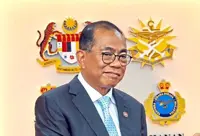
JOHOR BARU: Barisan Nasional's landslide victory in the Johor state election showed that voters prioritised political stability, economic growth and continuity in development, says Datuk Seri Mohamed Khaled Nordin.
The Umno vice-president said the outcome of the recent state polls reflected the people’s desire for a stable administration that could continue delivering results for the state.
Speaking at Pasir Gudang Umno division meeting, Mohamed Khaled said the gathering also served as an opportunity for party leaders to thank grassroots members and assess the party’s strengths and weaknesses ahead of the next general election.
“We want the party to be more prepared because there is only slightly more than a year left in the current parliamentary term,” he said in a press conference after the meeting held at a hotel here on Saturday (July 25).
Mohamed Khaled said Barisan’s success in Johor was driven by several factors, including the leadership of Johor Mentri Besar Datuk Onn Hafiz Ghazi, whose policies had resonated strongly with younger voters.
He added campaign approaches adopted by opposition parties also played a role in shaping voter perceptions.
“Open attacks and criticism became counterproductive. National issues and matters involving former prime minister Datuk Seri Najib Razak also influenced voters and contributed to support for Barisan,” he said.
Khaled added that while Chinese voter turnout in Pasir Gudang was higher than during the previous state election, Malay voter turnout exceeded 70%, resulting in what he described as a “Malay swing” towards Barisan.
He also attributed the victory to the strength of the coalition’s machinery and support from younger voters.
“In Pasir Gudang, more than 60% of young voters supported Barisan,” he said.
Khaled linked the trend to Umno president Datuk Seri Dr Ahmad Zahid Hamidi’s “Rumah Bangsa” concept, which seeks to position Umno as a national institution for Malays, including those who are not party members.
He said the concept had helped make the party a unifying force for Malays and contributed to more structured political cooperation among Malay-based parties.
Referring to developments in Negri Sembilan, Mohamed Khaled said the current understanding among Malay political parties was aimed at avoiding electoral clashes rather than forming a formal coalition.
“It is only an understanding to avoid contests. It is not a merger or a coalition. The parties can still have differing views,” he said.
Khaled added that stronger unity among Malays would contribute to national stability, while assuring that Umno and Barisan would continue to respect Malaysia’s multiracial character.
“Umno has always respected diversity and believes every government should include representation from other communities. No one should be worried if Malay unity becomes stronger because the rights of all races will continue to be protected,” he said.