PETALING JAYA: A wide range of amendments to the Copyright Act 1987 are being considered to enhance Malaysia’s copyright framework for the digital age.
The Intellectual Property Corporation of Malaysia (MyIPO) said this will include proposals on artificial intelligence (AI), online piracy, orphan works, artists’ resale rights and copyright dispute resolution.
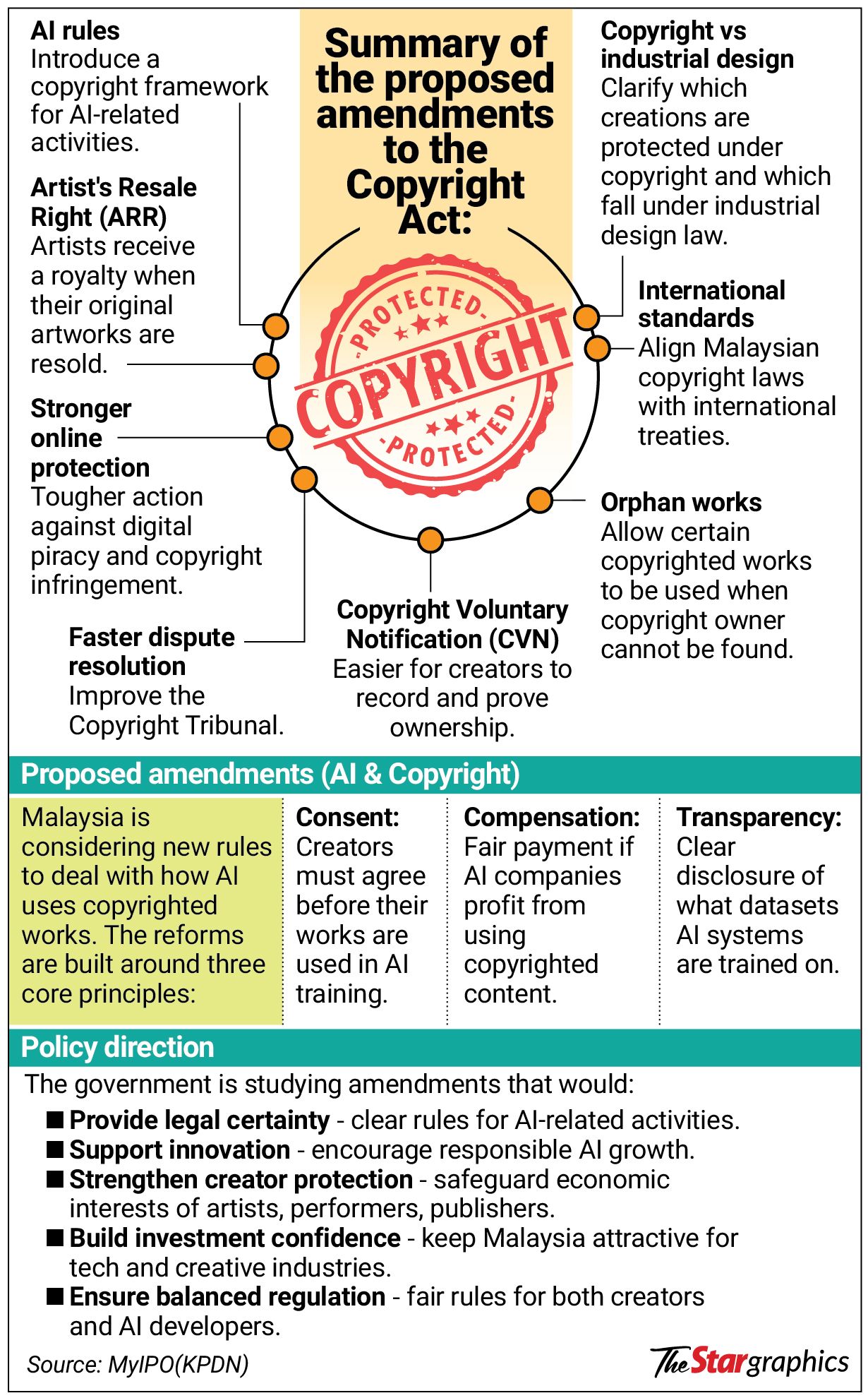
Among key proposals is to introduce a legal framework governing the use of copyrighted works by AI, with an emphasis on transparency, fairness and appropriate compensation, according to a public consultation document released by MyIPO.
“Creators, publishers and media want to be asked first, paid fairly and told clearly how their works are being used.
ALSO READ: Clearer rules needed in the age of AI, say experts
“Malaysia is considering a framework that balances protecting creators with supporting AI innovation,” said MyIPO, a body under the Domestic Trade and Cost of Living Ministry (KPDN).
To strengthen efforts against online piracy, MyIPO is proposing the introduction of dynamic injunctions, allowing courts to block entire networks of pirate websites under a single court order.
Under the proposal, once the initial order is granted, newly identified infringing websites can be added without requiring a fresh lawsuit each time.
MyIPO said reforms will also be considered by the Copyright Tribunal.
“Under the current Act, the Copyright Tribunal can hear royalty disputes only if both the licensing body and its member consent, allowing either party to prevent a case from proceeding.
“Under the proposed amendments, either the licensing body or its member may refer a dispute to the tribunal without requiring the other party’s consent.
“All cases will be resolved within 60 days after the conclusion of hearings,” MyIPO added.
Additionally, there is also a proposed legal framework to the Act, which is orphan works.
Orphan works are copyrighted materials such as books, newspapers, photographs and films whose owners cannot be identified or located.
The proposed amendment by MyIPO suggests that if someone does a diligent search but still cannot find the owner, there should be a legal framework allowing the work to be used for things like education, research, preservation or public interest projects.
“Libraries and universities can digitise older works, providing researchers and educators with access to historical resources, enriching public cultural knowledge and supporting the creative economy through new material for documentaries, exhibitions and innovation,” MyIPO said.
Another proposed amendment is the introduction of the Artist’s Resale Right (ARR), which will allow artists to receive royalties when their artworks are resold.
Malaysia currently has no law recognising ARR, meaning artists do not receive a share of any increase in the value of their works after the initial sale.
“The proposed Artist Resale Right aims to strengthen creative industries, promote fairness, support GDP contribution, and sustain creativity,” MyIPO said, adding that over 90 countries had implemented similar schemes.
“Eligible works under the resale right would include fine art, photography, illustrations, crafts, designs, architecture and prints,” MyIPO said.
The proposed amendments also seek to provide clearer distinctions between copyright protection for creative works, such as paintings, drawings and digital art, and industrial design protection for products manufactured through industrial processes.
“This helps KPDN quickly decide the right type of protection for products in the market and ensure more consistent enforcement.
“This will also reduce unnecessary disputes and improve coordination between the copyright and industrial design protection systems,” it said.
According to MyIPO, the proposed changes are aimed at improving access to justice, enhancing legal certainty and enabling faster resolutions by providing stakeholders a credible forum to resolve copyright disputes without lengthy delays.