



PETALING JAYA: As Malaysia ranks highly for food waste in South-East Asia by the United Nations Environment Programme’s (UNEP) Food Waste Index 2024, a latest household survey pinpointed where the problem started.
National Household Indicators Survey (NHIS) 2025 showed that expired food, forgotten leftovers and excessive cooking at home are among the main reasons households throw away food, with new statistics pointing to everyday habits as a key driver of wastage.
Chief statistician Datuk Seri Dr Mohd Uzir Mahidin said Malaysian households generate between 31.9kg and 97.3kg of food waste per capita annually.
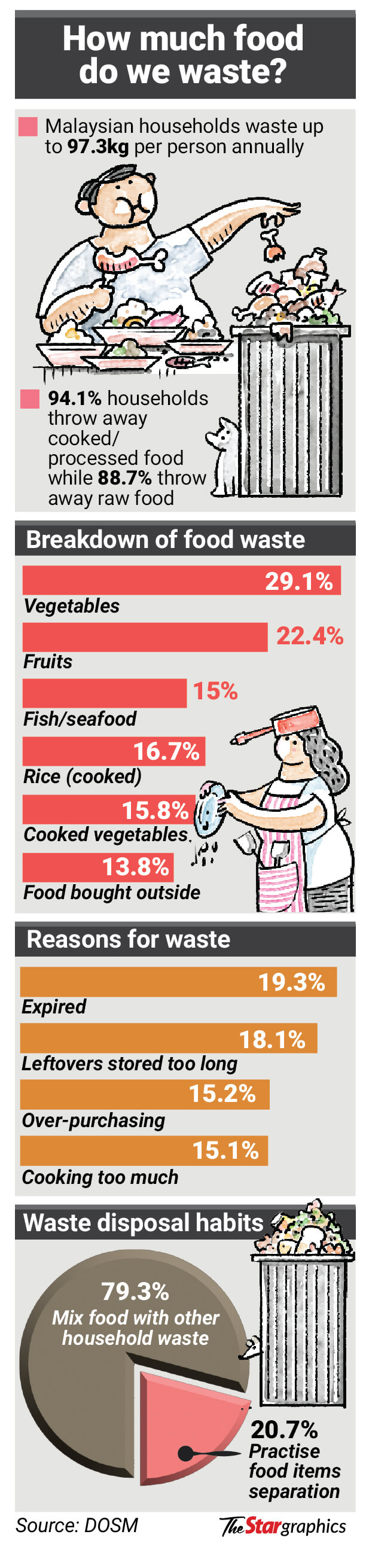
Among raw food, vegetables accounted for the highest wastage at 29.1%, followed by fruits (22.4%) and fish or seafood (15%).
For processed or cooked food, rice recorded the highest wastage at 16.7%, followed by vegetables (15.8%) and food bought from outside (13.8%).
In the UNEP 2024 report, Malaysians wasted about 81kg of food per person annually, among the higher levels in Asean.
Laos recorded the highest food waste per capita in the region at 89kg, followed by Thailand (86kg) and Cambodia (85kg).
Malaysia was followed by Myanmar (78kg), Brunei (76kg), Vietnam (72kg), Singapore (68kg), Indonesia (53kg) and the Philippines (26kg).
The latest estimate is lower than the 91kg per capita recorded for Malaysia in UNEP’s 2021 report.
Malaysia’s food waste levels are also broadly in line with the global average of 79kg per capita annually, according to the UNEP report.
Mohd Uzir said the findings showed that household food waste was largely driven by food management practices.
The leading reason for food being discarded was expiry (19.3%), followed by leftovers in refrigerators or freezers (18.1%), over-purchasing (15.2%) and preparing excessive quantities of food (15.1%).
“These findings show that food waste is largely influenced by food management practices at the household level, especially in terms of purchasing planning, food storage and portion control in food preparation,” he said.
The survey also highlighted that nearly four in five households (79.3%) disposed of food waste together with general household waste, while only 20.7% separated food waste before disposal.
Mohd Uzir said the low rate of food waste separation posed a challenge to improving organic waste management and reducing reliance on landfills.
Last year, The Star reported that the Housing and Local Government Ministry was working on a law to tackle food wastage, with the possibility of introducing stricter measures, including penalties, to curb the problem.
The proposed law would initially focus on education and awareness to reduce food waste, the ministry had said.
Several countries have already introduced similar measures.
South Korea requires households and businesses to separate food waste, with much of it recycled into animal feed.
France became the first country to ban supermarkets from destroying unsold edible food, instead requiring them to donate it to charities or food banks.
The Star has reached out to Housing and Local Government Minister Nga Kor Ming for an update on the proposed legislation and is awaiting his response.

