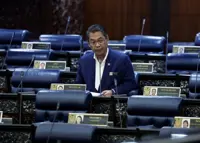
KUALA LUMPUR: Malaysian households remain financially resilient as outstanding household borrowings stood at RM1.73 trillion as at March this year, with borrowers continuing to meet their loan repayment obligations, says Datuk Seri Anwar Ibrahim.
The Prime Minister said household debt is equivalent to 84.4% of the country’s Gross Domestic Product (GDP), which is a slight improvement from 84.7% recorded in December 2025.
He said the ratio of impaired household loans also remained stable and low at 1% as at the end of December 2025, compared with 1.1% in June 2025.
“In addition, indicators of households' debt-servicing capacity remained robust, with the median debt service ratio (DSR) for aggregate household loans standing at 33%.
“Debt growth has continued to be supported by income growth, as reflected by the stable median debt-to-income ratio of 1.3 times.
“Overall, this indicates that households continue to have sufficient capacity to meet their debt obligations,” he said in a parliamentary written reply on Tuesday (June 30).
Anwar was responding to Aminolhuda Hassan (PH–Sri Gading), who asked about the government's assessment of Malaysians' financial resilience in the face of a potential global economic downturn, including emergency savings, household indebtedness and the intervention measures planned in the event of an economic shock.
ALSO READ: M’sian households walk the debt tightrope
Meanwhile, Anwar said the government remained committed to ensuring household debt growth stayed manageable and in line with borrowers’ repayment capacity.
He added that all financing approved by financial institutions is subject to Bank Negara’s (BNM) Policy Document on Responsible Financing introduced in 2012.
“To help ease cost pressures arising from the conflict in the Middle East, banks continue to provide targeted repayment assistance to affected borrowers, including loan restructuring, rescheduling and temporary repayment holidays.
“The approach is consistent with BNM's assessment that the impact of the conflict is uneven, ensuring that assistance is directed to those who genuinely require support while safeguarding the stability of the country's financial system,” he said.
He said affected individuals and businesses are encouraged to engage with their respective banks as early as possible to discuss suitable repayment arrangements based on their financial circumstances.
Anwar also said the government is strengthening long-term household financial resilience through the National Strategy for Financial Literacy 2026–2030, which promotes sustainable financial habits, responsible debt management and risk protection.
He added that the Credit Counselling and Debt Management Agency (AKPK) will continue to provide financial advisory services and debt management programmes to borrowers in need to better prepare households for future economic shocks and global uncertainties.