PETALING JAYA: Major irrigation upgrades and water management measures are being implemented in Kedah and the northern peninsula to safeguard rice production against drier El Nino conditions and other extreme weather challenges.
The Agriculture and Food Security Ministry said this includes the rehabilitation of Pedu dam and the Jeniang Water Transfer Scheme to strengthen water security in key padi-growing areas.
Despite concerns over prolonged dry weather, the ministry assured that padi cultivation in major granary areas remained stable, with national rice stocks remaining sufficient and retail prices under control through government intervention.
The ministry also noted that activities in the Muda Agricultural Development Authority (Mada) area in Kedah are progressing well, with pre-sowing work almost fully completed, land preparation well advanced and nearly half of the planting completed as of June 10.
ALSO READ: El Nino may delay planting
To manage weather-related risks, the ministry said several short-term measures have also been implemented, including rescheduling planting activities, strengthening irrigation and water management, and conducting cloud seeding operations coordinated by several agencies.
The ministry is also engaging continuously with farmers and industry stakeholders to monitor conditions and address issues as they arise.
“With geopolitical conflicts and extreme weather challenges, these factors will undoubtedly have an impact on production.
“As such, the government undertakes various efforts and closely monitors the situation in order to mitigate the adverse effects,” the ministry said in a written response to The Star.
A key concern for Kedah, which produces more than 40% of Malaysia’s white rice, is long-term water security.
ALSO READ: MetMalaysia: El Nino to peak between November and January
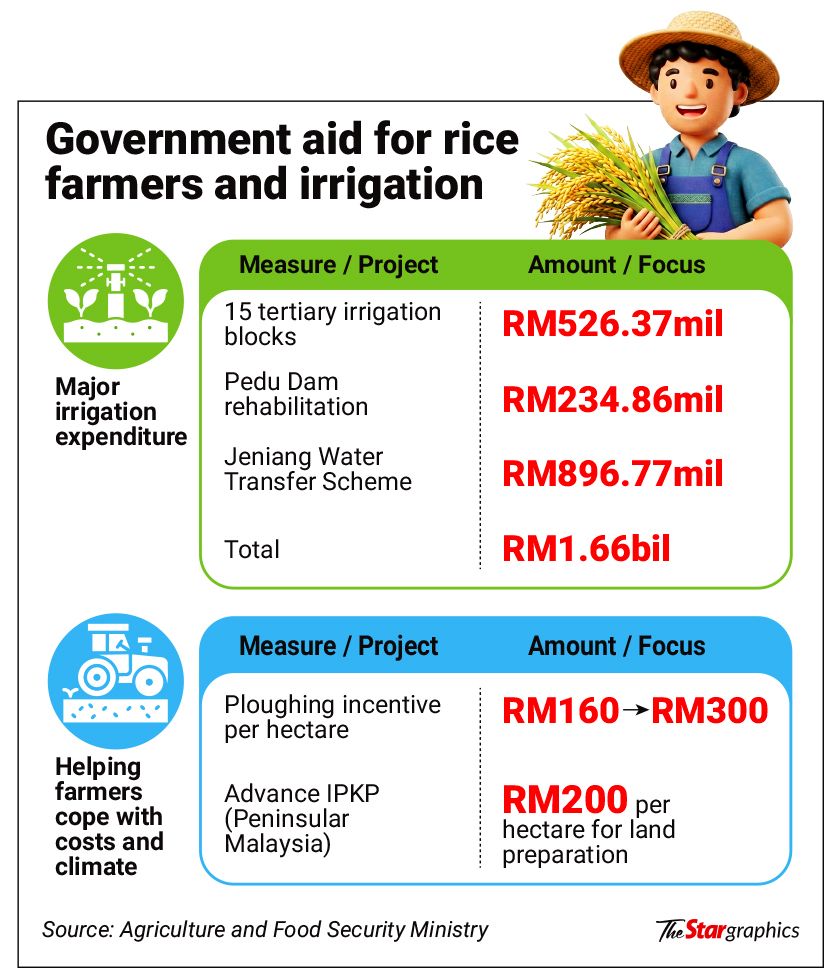
To address this, the ministry said several major infrastructure projects are underway, including the development and maintenance of 15 tertiary irrigation system blocks costing RM526.37mil, the comprehensive rehabilitation of Pedu dam costing RM234.86mil and the Jeniang Water Transfer Scheme costing RM896.77mil.
The projects are aimed at ensuring more reliable water supplies to padi fields and reducing the impact of prolonged dry spells.
The ministry said padi yields in key granary areas, including those under the Kemubu Agricultural Development Authority and Integrated Agricultural Development Area, remained stable at between three and five tonnes per hectare, supported by well- managed irrigation systems.
To ease cost pressures on farmers, the ministry said the ploughing incentive (IPKP) will be increased from RM160 to RM300 per hectare beginning next year.
Farmers in Peninsular Malaysia will also receive an advance payment of RM200 per hectare under the incentive to help them prepare their land before the planting season.
As part of longer-term adaptation measures, the ministry is promoting climate-resilient and high-yielding padi varieties, modern irrigation and drainage systems, improved planting schedules based on weather forecasts, and wider adoption of climate- smart technologies such as precision farming and digital tools.