
Major questions have been raised by recent developments
PETALING JAYA: The decision by the Perikatan Nasional chairman to drop two top Bersatu leaders from the coalition’s supreme council raises questions, as the meeting was attended by non-coalition component members, say some political analysts.
They said that although making such decisions may be the prerogative of Perikatan chairman Datuk Seri Ahmad Samsuri Mokhtar, the setting may not have met constitutional parameters.
ALSO READ: Axing of Azmin, Radzi triggers fresh turmoil in Perikatan
They were referring to Ahmad Samsuri’s announcement that Perikatan was dropping the Bersatu duo, Bersatu vice-president Datuk Seri Radzi Jidin and Bersatu secretary-general Datuk Seri Azmin Ali, from the coalition’s supreme council lineup.
On Wednesday, Ahmad Samsuri stated that Radzi would now be replaced by PAS’ Datuk Seri Mohd Sanusi Md Nor, who is also the Kedah Mentri Besar.
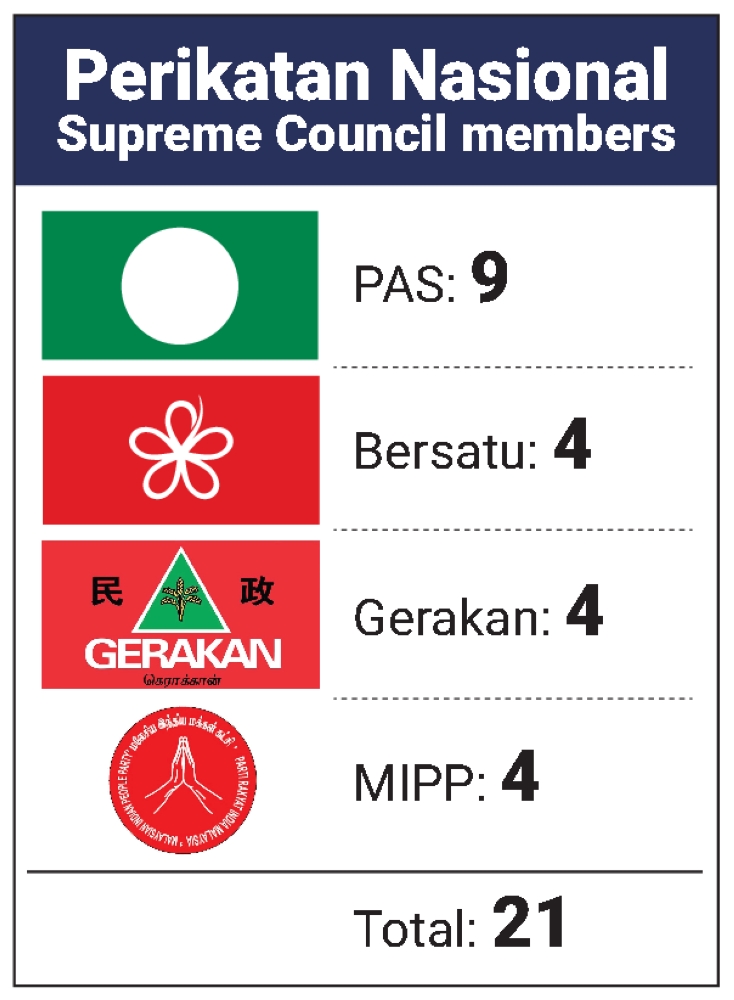
As of now, there are 21 Perikatan Supreme Council members, including Ahmad Samsuri, compared to 22 before Wednesday.
ALSO READ: Azmin, Radzi dropped in Perikatan leadership reshuffle
PAS holds nine posts, and Bersatu still holds four posts. Gerakan and the Malaysian Indian People’s Party (MIPP) each hold four posts.
Prior to this, Bersatu held six posts.
Universiti Malaya political analyst Dr Mohammad Tawfik Yaakub said that the question of whether Ahmad Samsuri can make such decisions unilaterally must be viewed through the constitutional framework of Perikatan.
“The meeting held yesterday at the PAS headquarters was attended solely by PAS and Reset MPs and was not an official Perikatan meeting,” said Mohammad Tawfik.
The coalition’s supreme council meeting on June 17 was also attended by non-Perikatan members, including Reset MPs led by Datuk Seri Hamzah Zainudin, who were sacked from Bersatu earlier this year.
Mohammad Tawfik said it was puzzling that a decision to remove Azmin and Radzi from their positions within Perikatan was announced following a gathering not organised under the coalition’s formal decision-making framework.
He said this raised questions about the appropriateness of the process and whether such decisions were made through the coalition’s established constitutional channels.
“Based on public statements by Perikatan leaders, Perikatan is a constitutional political coalition established through consensus among its component parties rather than an organisation governed solely by the authority of its chairman,” he said.
“Although Ahmad Samsuri currently serves as the coalition chairman, the position does not automatically confer unlimited authority to determine the coalition’s direction, membership, or major strategic decisions on his own.”
Mohammad Tawfik said, “In fact, Ahmad Samsuri himself has stated that any interpretation concerning Perikatan’s status, position and future direction cannot be made unilaterally but must be referred to the coalition’s constitution and decided through its official decision-making channels.
“Therefore, from both a constitutional and organisational perspective, major decisions such as restructuring the coalition, altering relationships among component parties, or making determinations that affect the future of Perikatan would ordinarily require collective deliberation and endorsement by the coalition’s authorised leadership bodies,” he said.
“While the chairman plays a significant leadership and coordinating role, such decisions would generally need to be supported by the mechanisms provided under the Perikatan constitution rather than resting solely within the ambit of his personal powers.”
While it remains unclear in what capacity the Reset MPs attended Perikatan’s meeting on Wednesday night, Universiti Sains Malaysia’s Prof Datuk Dr Sivamurugan Pandian said there is no indication that Ahmad Samsuri had acted beyond his constitutional authority.
“The appointments and restructuring were collective decisions, although there were many different interpretations, which is the coalition’s highest decision-making body, and there was no reaction from other coalition members except from Bersatu,” said Sivamurugan.
He also said that it is now 3-1 in Perikatan, with PAS having the majority support of other components, Gerakan and MIPP.
“Bersatu is on its own in the coalition, for now. PAS, MIPP and Gerakan seem to band together. Either Bersatu or PAS, along with its supporters, would soon have to leave or be removed.
“For PAS, the question of constitutionality is not important in decision-making. The only one saying all the decisions made by Ahmad Samsuri are unconstitutional is Bersatu.
“However, all said and done, Perikatan parties need to ‘move on’ and realise that their real enemies are not within but out there,” said Sivamurugan.
Political analyst Dr Azmil Mohd Tayeb of Universiti Sains Malaysia believes that, under the Perikatan constitution, dropping the deputy secretary-general, Azmin, and appointing the election director are prerogatives of the coalition chairman.
“It is within his prerogative, as provided by the coalition’s constitution, to act as such. Perhaps it can be seen as purging those allied with Bersatu president Tan Sri Muhyiddin Yassin and putting in his own trusted people to run the campaigns,” said Azmil.