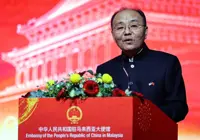
KUALA LUMPUR: China and Malaysia should step up cooperation to protect their intangible cultural heritage and work on more joint bids for Unesco recognition, says China's Ambassador to Malaysia Ouyang Yujing.
He said the two countries had already set an example for the region with their work together on cultural heritage and should now build on that.
“Malaysia has joined the Alliance for Cultural Heritage in Asia proposed by China, and the Wangchuan Ceremony jointly submitted by China and Malaysia has been inscribed on the Unesco List of the Intangible Cultural Heritage of Humanity.
“Our cooperation on intangible cultural heritage has become a model for the world,” he said in a joint interview with local media on Tuesday (June 16).
Ouyang added that Chinese culture has long had a strong presence in Malaysia, from classical literature to modern entertainment.
“In the cultural sphere, Chinese classics such as the Four Great Classical Novels have long been known in Malaysia.
“Contemporary Chinese literary works are increasingly popular among Malaysian readers. Chinese films, television and audiovisual works continue to gain popularity here,” he said.
As such, he said both countries should make better use of culture as a bridge to bring people closer.
Going forward, he said, China and Malaysia should not only work on more joint heritage nominations, but also strengthen day-to-day protection of intangible cultural heritage and explore new forms of cooperation in the digital space.
“We should actively expand new frontiers of digital cultural exchanges, strengthen cooperation on digital content and youth creativity, and continue to support exchanges and cooperation among think tanks, scholars and media organisations,” he said.
Ouyang pointed to the upcoming screening in Malaysia of the Chinese film Dear You, describing it as a “meaningful and touching production that is well worth watching” for local audiences.
On education, he said China and Malaysia already have wide-ranging cooperation, including teacher and student exchanges, short-term study programmes, joint training and collaborative education.
“The two countries have steadily advanced cooperation in emerging areas such as digital education, AI education and online learning platforms, thereby enhancing mutual understanding and friendship, especially among young people,” he said.
Both sides have also deepened vocational education ties and developed a Chinese language and vocational skills training model.
“Through school-enterprise collaboration, joint curriculum development, teacher training and skills certification, we have cultivated a large number of versatile technical professionals to support practical cooperation between the two countries,” he said.
Looking ahead, Ouyang said China and Malaysia should continue to promote “high-quality educational cooperation” and expand structured exchange and joint training programmes.
“China welcomes more Malaysian students to pursue studies in China and will provide greater opportunities while continuously improving related services.
“China is also willing to work with Malaysia to strengthen cooperation in digital and vocational education, better align education with industry needs, deepen industry-academia integration, and further improve talent development systems,” he added.
On science, technology and innovation, Ouyang said China and Malaysia had “highly complementary strengths” and had already seen concrete results from joint projects, citing cooperation in areas such as automotive manufacturing, AI, 5G communications, biomedicine, smart agriculture and green energy.
These projects, he said, had helped support Malaysia’s industrial upgrading, created jobs, boosted growth and improved people’s livelihoods.
“Going forward, China will continue to align the strengths and resources of both countries, jointly conduct research and development on key technologies, establish joint laboratories, and promote professional talent and skills training,” he said.
He said China also wanted to further promote the integration of industry, universities and research institutes, and encourage technology transfer and commercialisation that can support modernisation in both countries.
On AI in particular, Ouyang said China was ready to work closely with Malaysia to match Chinese capabilities with Malaysian needs.
“We will strengthen cooperation in AI infrastructure development, industry-specific large models and data governance, and promote the application of AI innovations in key sectors such as manufacturing, agriculture, education, healthcare, transportation and logistics, smart cities, financial services, and public governance,” he said.