



PETALING JAYA: Much work remains to improve the reliability of Malaysia’s rail system, in particular the urban network managed by Prasarana Malaysia Bhd through its subsidiary, Rapid Rail Sdn Bhd, says Prof Dr Chua Kein Huat, chair of UTAR’s Centre for Railway Infrastructure and Engineering.
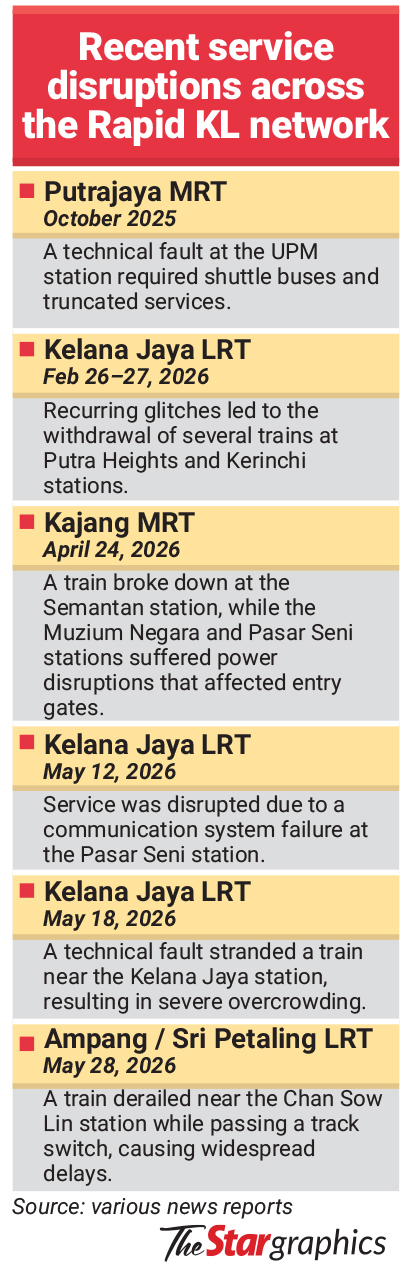
Commenting on last week’s derailment on the Ampang LRT after widespread public complaints of service disruptions elsewhere in Klang Valley, he said the incident highlights the radical mindset shift needed in order to create reliable and efficient railways.
“It is no longer enough to merely follow the prescribed service manual. It is time to take on a more predictive approach, including the use of artificial intelligence, in managing our railways,” he said when contacted.
According to Rapid Rail, which operates the MRT, LRT and Monorail network in Klang Valley, it is already on track for performance improvement by comparing itself against 45 metro systems in 42 cities including Beijing, Seoul, Jakarta, Bangkok, Hong Kong and Singapore.
Rapid Rail is a member of the Community of Metros (Comet), which benchmarks worldwide urban railway performance by using a metric called Mean Kilometres Between Failures (MKBF).
Any failure or disruption lasting more than five minutes will be logged and the interval between the subsequent failure(s) will be the recorded mileage.
MKBF is calculated by taking the total train-kilometres travelled by all trains on a line in a given period and diving the number by the total number of service delays exceeding five minutes.
A higher MKBF number indicates a more reliable and efficient train system.
For example, a MKBF of 1,000,000 means a train can travel an average of one million kilometres between faults.
On its website, Prasarana said it aspires to reach a MKBF reading of one million kilometres by the third quarter of this year.
As of late last year, the then newest line – the Putrajaya MRT – managed 1.35 million kilometres.
However, the performance of older lines such as the Kelana Jaya LRT Line, the Kajang MRT Line, and the Ampang LRT – that saw a derailment last week – and KL Monorail were nothing to cheer about.
These lines gave average readings ranging from 310,000km to 540,000km in the first half of 2025, with the KL Monorail coming out at the bottom of the ladder.
Still, Prasarana said this represented an improvement from 2023 and 2024, when its achievement was 160,000km and 330,000km, respectively.
In comparison, the oldest metro line in Singapore, the North-South Line, which opened in 1987, still managed to hit a reading of 1,648,000km last year, even though it operates under similar tropical conditions as Malaysia.
On its website, Prasarana continues to sing an optimistic tune, saying that since it implemented “multiple strategic initiatives”, the overall MKBF performance of the Kajang, Ampang and Kelana Jaya lines have improved significantly 2023 (140,000km) compared to 2022 (80,000km).
“Based on the current performance trend as demonstrated above, the analysis shows that the overall target of one million MKBF for Kelana Jaya, Ampang and Kajang lines by the third quarter of the year is achievable, ultimately delivering high service reliability to our passengers.”
More on Prasarana’s performance can be found at myrapid.com.my/rapid-rail-performance.

