



PETALING JAYA: For decades, all they had were fading family stories, unanswered questions and a few treasured possessions left behind by a man who never came home.
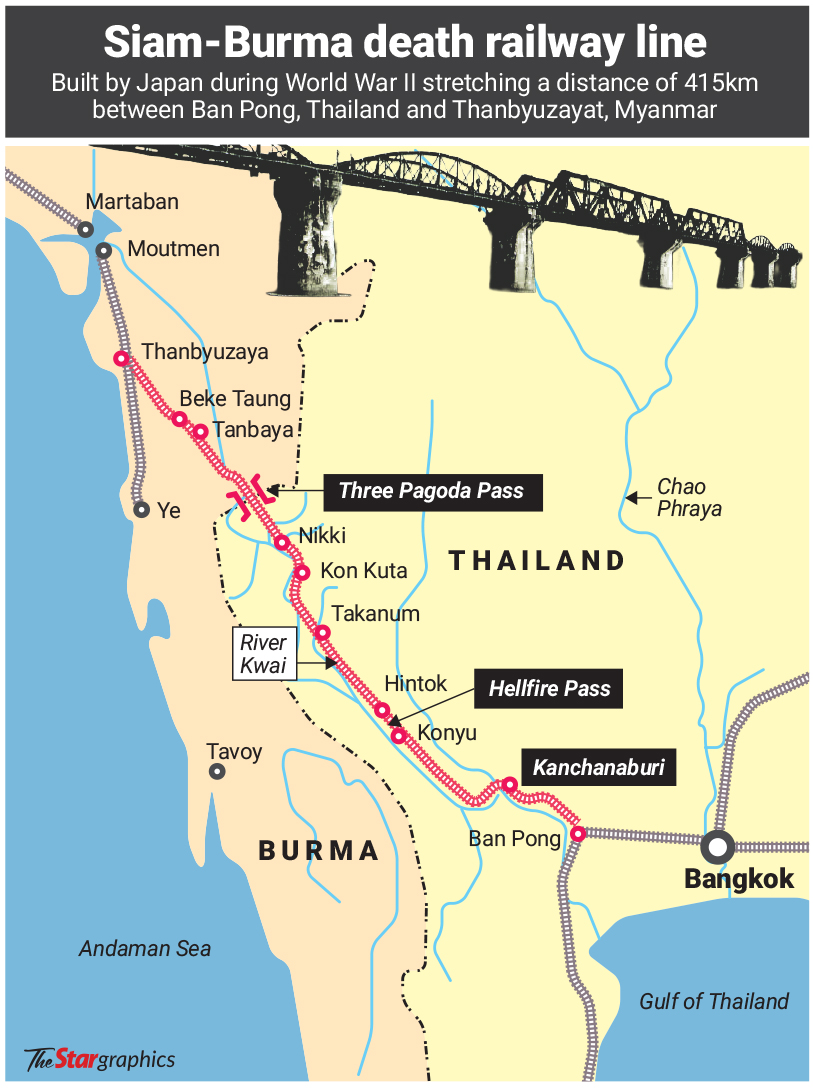
Last week, over 80 years later, Hema Subramaniam finally stood on the soil where she believes both her great-grandfathers took their last breath after being abducted from then Malaya and forced to work as labourers on the infamous Siam-Burma Death Railway during World War II.
As she gazed around the mass grave in Kanchanaburi, Thailand, on Friday, she paid tribute to the two men who lost their lives to one of the most brutal wartime atrocities in Asian history.
Both her paternal and maternal great-grandfathers were snatched by Japanese soldiers in the 1940s and never returned to their families.
While little is known about her paternal great-grandfather’s final days, family accounts paint a harrowing picture of the suffering endured by her maternal great- grandfather Munusamy Ami Kutty.
The stories were passed down by Hema’s grandfather, Jaya Raman Munusamy, who was 10 years old when his father was taken away by Japanese soldiers in Seremban.
Going by family recollections, another Death Railway labourer who managed to escape visited Munusamy’s family one day with the personal belongings entrusted to him by the dying man.
Among them were a handwritten note and a talisman that Munusamy had worn around his waist.
“He knew he was going to die and that it was his only chance to contact his family,” said Hema, 41, in a phone interview from the Thai-Myanmar border of Sangkhlaburi.
Going by the survivor’s account, the Japanese soldiers fed them rat and snake meat. Those who refused to eat were beaten.
Hema said Munusamy, a vegetarian, could not bring himself to consume the meat. The lack of nourishment, physical abuse and harsh conditions eventually led to his death.
Hema, a journalist, said the visit to Kanchanaburi finally answered a question that had lingered in her mind since childhood.
“I used to wonder why my great-grandfather did not escape like the survivor who returned to Malaya,” she said.
“But after seeing how treacherous the terrain is here, I realise he would never have made it back in the weakened state he was in.”
The journey was meant to be shared with her 90-year-old grandfather Jaya Raman, who had long hoped to visit the place where his father is believed to be buried.
However, he fell ill before the trip and died last week, just three days before the group departed.
“I wanted to cancel the trip after my grandfather passed away. But the more I thought about it, the more I felt he would have wanted me to go.
“This was a journey he had hoped to make himself and I felt it was important to complete it on behalf of our family and bring some closure to a chapter that has remained open for three generations,” said Hema.
She was among 29 people who took the trip organised by the Death Railway Interest Group Malaysia to Thailand.
Group founder P. Chandrasekaran said he has been organising the annual visit since 2016.
This year’s trip, however, was particularly significant as Thai authorities formally recognised the purpose of their visit and paid tribute to the victims of the Death Railway.
He said officials representing the governor of Kanchanaburi had greeted them on their arrival and discussions were held on the allocation of land to erect a monument for the Malayan labourers.
“They agreed that a suitable plot of land can be allocated for the purpose,” he added.
For now, he said their hope is to have the involvement of the Malaysian government and recognition for those who perished working on the railway.
He said at least 100,000 forced labourers were killed building the railway and buried in mass graves in the province of Kanchanaburi, about 160km from Bangkok.
