



PETALING JAYA: While food prices in Malaysia remain largely under control, consumers are beginning to feel the pinch as prices of some common items such as fish and vegetables are slowly rising, according to the Economy Ministry.
During a briefing on Malaysia’s economic supply challenges yesterday, Minister Akmal Nasrullah Mohd Nasir (pic) said between May 4 and 6, selected food prices either saw a 2% drop, or a 6.7% rise compared with the previous week.
“Beef prices fell by 1.4%, from RM36.40 (per kg) to RM35.88, while standard chicken prices went from RM9.50 to RM9.51,” he said during a live session on social media.
However, a few commonly consumed food items have recorded increases.
Kembong prices rose by 3.9% from RM16.76 to RM17.42, while white prawns prices increased by 1.2% to RM32.11 per kg. Sawi prices also went up by 4% to RM7.23 per kg, while fresh coconut milk prices increased by 6.7% to RM16.88 per kg.
“Although statistics show food price movements remain under control, the Prime Minister and the ministry have expressed concern that some groups, especially those in rural areas, may feel some pressure.
“The ministry will coordinate (with relevant agencies) to provide assistance for targeted groups, especially the poor and vulnerable,” Akmal Nasrullah said.
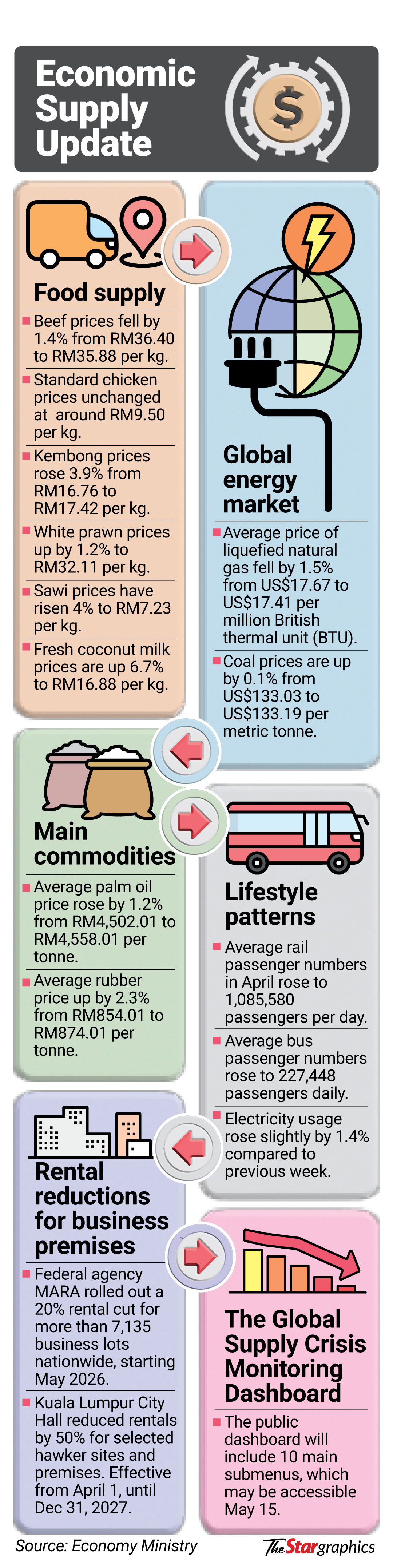
He added that the Global Supply Crisis Monitoring Dashboard, developed by the ministry and the Statistics Department (DOSM) will be made accessible to the public from May 15.
“The dashboard serves as a transparent and easily accessible central reference source for the public to monitor developments related to the global supply crisis.
“It will include 10 main submenus, including energy, commodities, cost of living, economic performance and trade flows,” he said.
Akmal Nasrullah also said a special government dashboard will be used as an internal monitoring platform.
“This is to assess crisis developments, identify early risks and formulate mitigation strategies in a more structured manner based on near real-time data,” he said.
He shared that Malaysia’s key commodities continue to show positive performance.
The average palm oil price rose by 1.2% from RM4,502.01 (per tonne) to RM4,558.01, while average rubber price increased by 2.3% from RM854.01 (per tonne) to RM874.01.
“These developments are expected to support the country’s export earnings,” he said.
On the global energy front, Akmal Nasrullah said the average price of liquefied natural gas (LNG) fell by 1.5% between May 4 and May 8.
“Coal prices, meanwhile, remained largely unchanged, rising marginally by 0.1% from US$133.03 to US$133.19 per metric tonne.
“These developments show that the global energy market is experiencing slight stabilisation, but it still needs to be monitored closely because any new disruptions could affect energy and production costs,” he said.
Meanwhile, Malaysia’s electricity demand rose by 1.4% last week to 20,097MW, indicating that consumption patterns remain stable despite unpredictable weather conditions.
“This slight increase shows that electricity consumption patterns remain controlled despite uncertain weather conditions,” said Akmal Nasrullah.
