



PETALING JAYA: Taxpayers have been urged not to panic over requesting e-invoices for individual tax relief claims, as ordinary receipts and invoices are accepted, say tax experts.
They said mandatory enforcement is unlikely in the near future due to the gradual rollout of the system and lingering operational issues.
Owen KLCA PLT managing director Datin Christine Koh said e-invoices are currently encouraged by the Inland Revenue Board (LHDN) but are not yet compulsory for taxpayers seeking personal tax relief.
“At present, ordinary invoices and receipts are still acceptable for relief claims.
“E-invoices are currently encouraged, but not yet mandatory for claiming tax relief, as the tax law has not yet been amended to impose such a requirement,” she said.
Koh said the use of e-invoices could eventually streamline tax filing through better transparency and data matching, with certain relief-related information potentially pre-filled in taxpayers’ returns in the future.
However, she stressed that taxpayers must still verify the accuracy of such information and retain supporting documents and proof of payment.
“Importantly, e-invoices do not automatically make an expense claimable.
“Taxpayers must still ensure the expense satisfies the relevant tax relief conditions under the Income Tax Act and LHDN guidelines.”
Koh also warned taxpayers against common mistakes, including double-claiming between family members and relying on incorrect classification codes selected by sellers.
She said taxpayers should carefully check the classification category used for purchases, particularly for medical-related claims, as categories such as medical examinations, serious disease treatment, dental treatment and fertility treatment each carry different codes.
“In some situations, the e-invoice may not necessarily be under the claimant’s name,” she said, citing examples such as parents’ medical expenses, where the invoice is usually issued under the patient’s name.
She added that even during tax audits, taxpayers may still be required to provide supporting documents despite the e-invoice already being recorded in LHDN’s system.
TraTax Sdn Bhd executive director Thenesh Kanna described LHDN’s initiative to link e-invoices with personal income tax filings as “timely and applaudable”.
“This helps taxpayers to account for the right amount of tax to the government,” he said.
“Taxpayers are entitled to relief only in respect of costs which satisfy the scope and criteria prescribed for relief.”
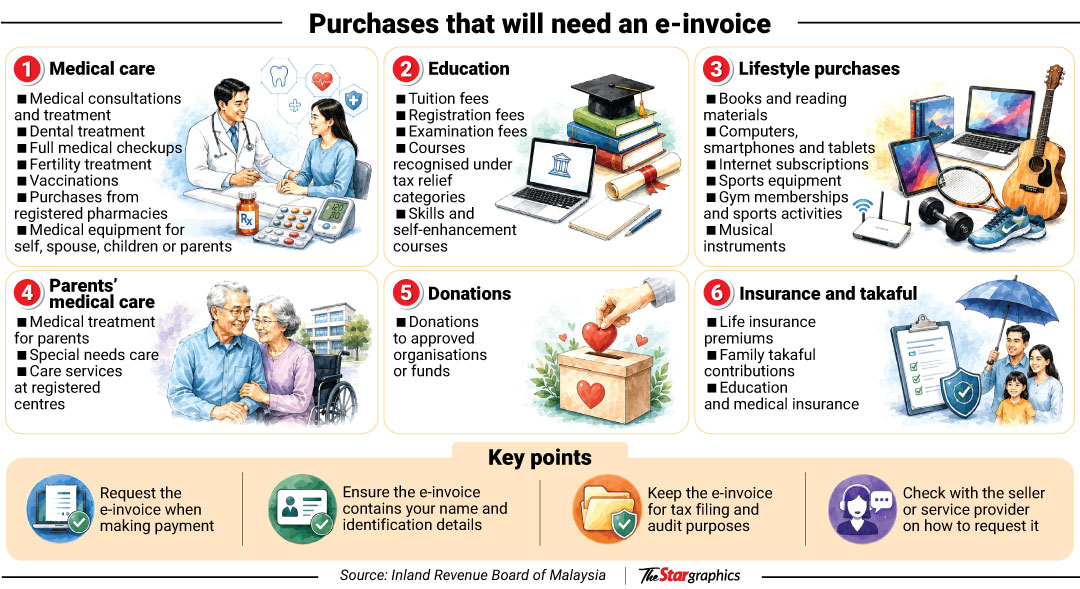
Thenesh said taxpayers are encouraged to obtain e-invoices for qualifying expenses so the details could eventually be pre-populated in tax returns.
However he added that claims can still be supported using ordinary invoices and receipts issued by vendors.
He added that the current deadline for filing personal income tax this year is not affected by the initiative, with pre-populated e-invoice relief data expected to begin from the tax year 2026 onwards.
Recently, LHDN said taxpayers are encouraged – but not required – to request e-invoices for purchases linked to tax relief claims as part of preparations for a pre-filled tax return system.

