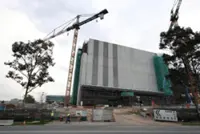
Data centres expected to benefit local economy
ISKANDAR PUTERI: The expansion of AirTrunk in Johor will bring more economic and employment opportunities for locals, says Lee Ting Han.
The Johor investment, trade, consumer affairs and human resources committee chairman said the expansion involves two new data centre projects in the SiLC industrial park, known as JHB 3 and JHB 4, covering a combined land area of 27ha.
“AirTrunk already has two existing projects, JHB 1 and JHB 2, which have been completed and are operational.
ALSO READ: Locals hopeful Johor investment gains will be felt by all
“The new projects will have a total electricity capacity of about 380 megawatts, and both have received approval of the state executive council on April 15.
"The next step is to begin construction,” he said in an interview yesterday.
He added that AirTrunk’s investment is one of the largest in Johor in this sector.
ALSO READ: Setting up to benefit from future investments
Lee noted that opportunities for locals are currently concentrated in construction and supply chains, including building materials, cabling and systems infrastructure.
While some foreign companies are involved, many have established local entities, allowing Malaysians to participate in the ecosystem, he said.
“Core components such as servers are still largely imported but local companies are actively involved in supplying supporting infrastructure,” he added.
On job creation, he said that for JHB 3 and JHB 4, more than 100 direct jobs are expected to be created, with up to 1,000 jobs generated locally across related sectors.
Lee also said more than 80% to 90% of data centre jobs in Johor are filled by Malaysians.
Addressing concerns over the environmental impact of data centres, Lee said the state government is closely managing key issues, such as electricity, water and talent development.
He said the state had received applications for 65 data centre projects, of which 20 are operational and eight are under construction, and 37 are in various stages of application.
“Data centres do not use their full capacity immediately.
"It typically takes five to 10 years to ramp up, and we plan electricity supply accordingly to avoid affecting local communities and other industries,” he added.
The state also plans to rely on treated wastewater to reduce dependence on the treated water supply.
He emphasised that data centres should be viewed beyond immediate investment returns, describing them as critical infrastructure for the nation’s digital economy.
He stated that Johor intends to emulate successful global models, such as those found in Dublin, Ireland, and Virginia in the United States, where investments have successfully fostered wider technology ecosystems.
“At present, many tech firms are based in Kuala Lumpur and Singapore, but with strong infrastructure, we hope to attract them to Johor in the future,” he said.
Lee added that the state is currently finalising a data centre guideline framework covering electricity, water, talent development and local industry participation.
He said the state’s long-term goal is to move up the value chain and not remain merely a data hosting location.