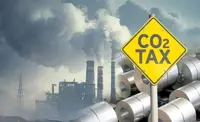
PETALING JAYA: A plan by the government to impose a carbon tax on industries will be on hold in view of the Middle East conflict, says Natural Resources and Environmental Sustainability Minister Datuk Seri Arthur Joseph Kurup.
“We have to take into account the geopolitical situation. We do not want to put any extra burden on industries and the rakyat,” he said.
Although the plan this year was to impose the carbon tax as penalties on polluters, he said the government would first work on setting up a framework to gather carbon credits.
The government, he said, would now focus on verifying carbon credits.
“Only then will we introduce laws to force compliance from industries and establish a carbon registry to gather data so that we can measure, price and trade carbon internationally.”
Carbon trading is a market- based system designed to reduce greenhouse gas emissions by putting a price on carbon.
It allows countries and companies to buy and sell “credits” or “permits” that represent the right to emit a specific amount of carbon dioxide or other greenhouse gases.
Speaking to reporters yesterday after launching the National Carbon Market Policy at the Climate Change and Sustainability Conference, Kurup said, “The government wants to implement a carbon tax, but we have to take into account the timing.
“The announcement on the carbon tax in Budget 2026 was made prior to the Middle East conflict.”
Under Budget 2026, Malaysia will introduce a carbon tax, starting with the iron, steel and energy sectors, marking a major step towards a low-carbon economy.
Kurup cautioned the industries not to let the postponement of the carbon tax slow down Malaysia’s green agenda.
“We have to move towards a green economy and renewable energy, as ultimately fossil fuels are a finite resource. Whether there is an energy crisis or not, let’s not slack off and be too dependent on fossil fuels.”
Earlier in his speech, Kurup said the National Carbon Market Policy would provide the framework to position Malaysia as a credible participant in international carbon trading.
The policy, approved by the Cabinet on April 1, is part of the National Climate Change Policy 2.0 strategy launched in 2024.
Kurup said that all these policies should be in place before Malaysia’s greenhouse-gas emissions peak between 2029 and 2034.
He also noted that the government is finalising a Climate Change Bill to underscore the country’s climate commitments.
Malaysia, he said, was committed towards achieving an absolute emissions reduction of 15 to 30 million tonnes of carbon dioxide equivalent by 2035, relative to the peak level.
Malaysia has also committed to achieving net-zero greenhouse gas emissions by 2050.
“The introduction of the policy will ensure that our efforts not only benefit Malaysia, but are also linked to the global effort to address climate and environmental issues.
“Let us act with urgency, courage and unity so that we may be remembered not as a generation that stood by but as the architects of a resilient tomorrow,” said Kurup.