



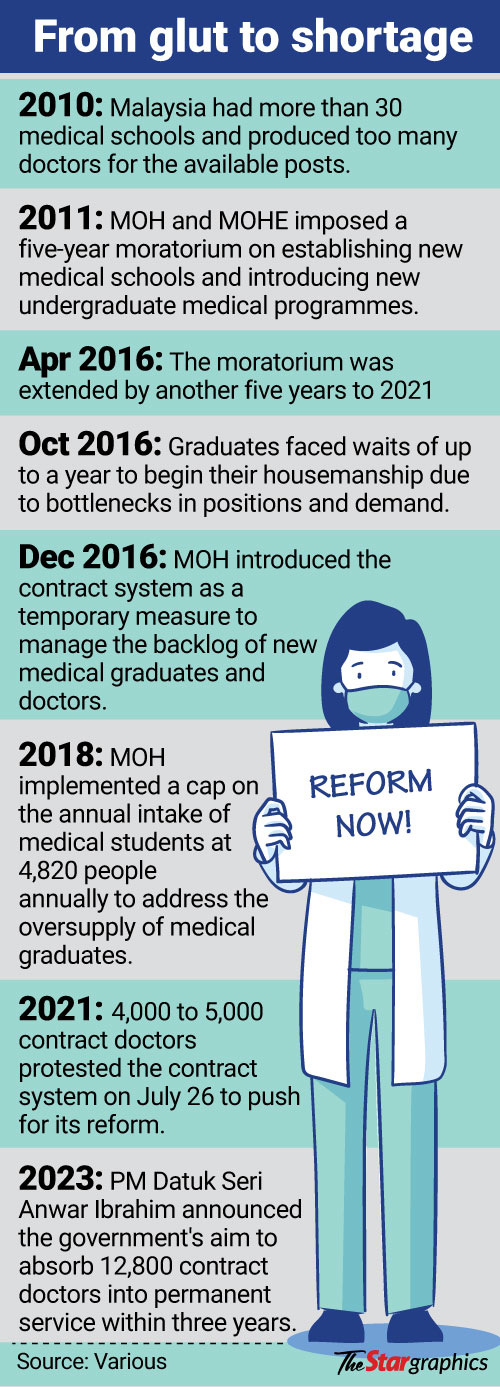
PETALING JAYA: The manpower crisis in public healthcare did not happen overnight.
The failure of the system to retain and attract doctors has caused the problem, says the Malaysian Medical Association (MMA).

“This situation did not happen overnight. It was caused by years of misalignment in policy, planning and working conditions, compounded by a growing negative narrative around the healthcare system.
“The medical profession has, over the past decade, been without clear short-, mid- and long-term solutions.”
He said the contract system and unclear career pathways have created uncertainty, and young doctors no longer see stability or a future in the public system.
ALSO READ: Dzulkefly: Failure to act could strain healthcare system
The working environment remains a concern.
“Housemanship is still perceived as physically and mentally demanding, with inconsistent support and supervision. This perception is influencing decisions,” he said.
“There are also clear policy gaps. We have not had consistent, long-term workforce planning and past policies have addressed immediate issues but created new problems over time.”
Dr Thirunavukarasu said the solutions are known. What is lacking is the will to implement them decisively.
“First, we must restore confidence. There must be a clear and transparent pathway from housemanship to career progression, with certainty in employment, remuneration, and specialist training.
“The Health Ministry and Public Service Department must be aligned, and the Finance Ministry must be involved. Without the Finance Ministry, remuneration cannot be addressed,” he said, adding that the working environment must also improve.
“We have seen burnouts. We have seen serious incidents.
“We cannot separate a doctor’s well-being from quality of care. House officers need proper supervision, rest and a system that does not normalise overwork or unsafe practices.”
Dr Thirunavukarasu added that the country was seeing a decline in interest in medicine as a career.
“This is already being acknowledged at university level. A national study in 2024 involving 859 medical students from 21 medical schools found that only 37.8% were optimistic about a future with the Health Ministry.
“These are students still in training. If this is not addressed, the pipeline problem will worsen,” he added.
He said the Health Ministry, JPA, Finance Ministry as well as the Higher Education Ministry must work together to address this problem with a whole-of-government approach.
“More than 70% of Malaysians depend on the public healthcare system. With an ageing population and rising non-communicable diseases and their complications, demand will only increase.
“If we do not act now, the impact will be felt directly by patients in terms of waiting times and quality of care,” he added.
He also said any policy changes now will only show results in five to 10 years.
“What we are seeing today reflects past decisions, and what we do now will determine the system a decade from today.
“If we want young doctors to serve, we must first build a system in which they are willing to serve,” he said.
