

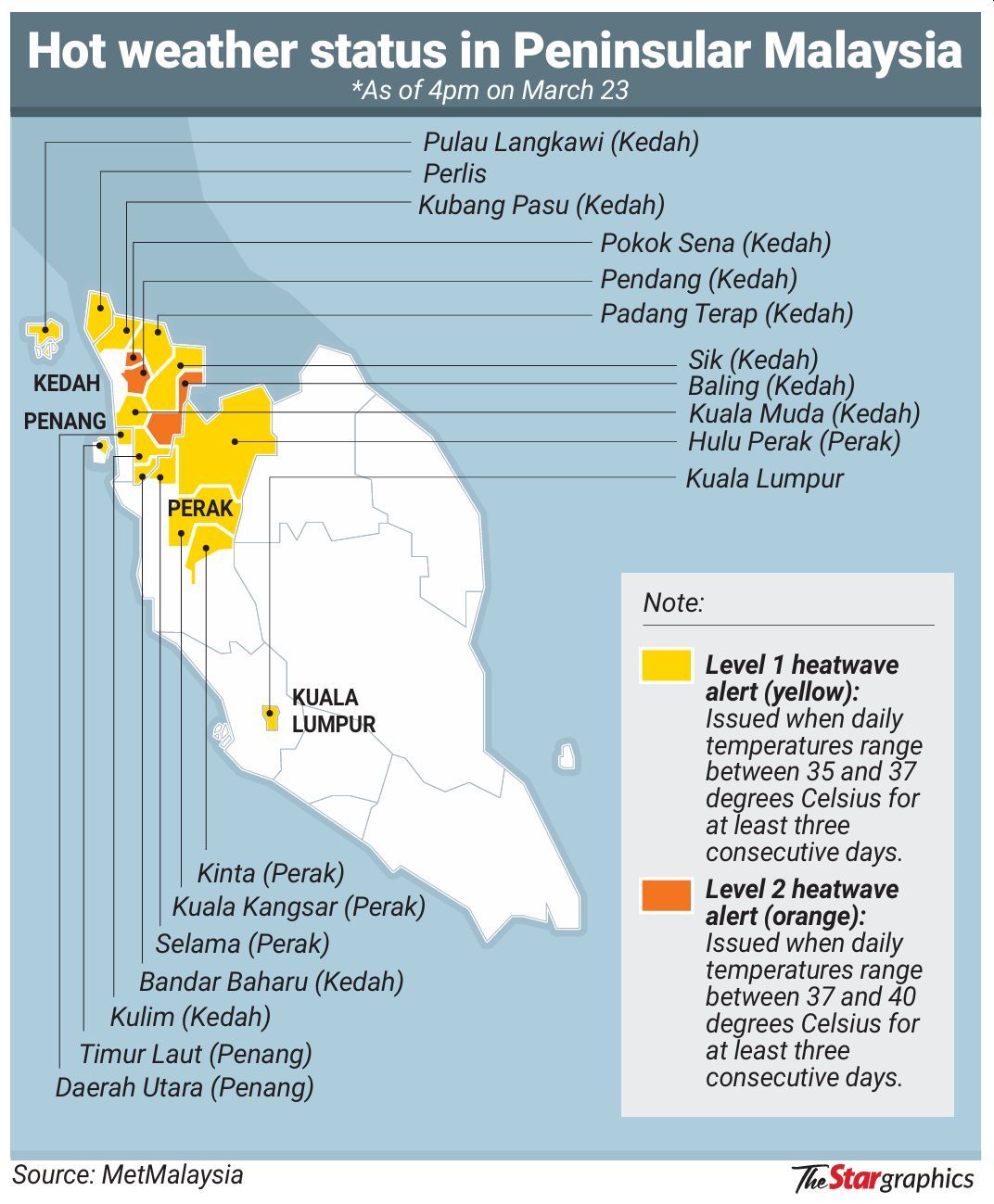
The conditions are particularly severe in Baling, Pendang and Pokok Sena in Kedah, where a Level 2 heatwave alert has been issued after temperatures ranged between 37°C and 40°C for at least three consecutive days.
According to the Malaysian Meteorological Department (MetMalaysia), Level 1 heatwave alerts have also been issued for Sik, Padang Terap, Kubang Pasu, Pulau Langkawi, Kuala Muda, Kulim and Bandar Baharu in Kedah.
Level 1 alerts are issued when temperatures range between 35°C and 37°C for at least three consecutive days.
Selama, Kuala Kangsar, Kinta and Hulu Perak in Perak, as well as Daerah Utara and Timur-Laut in Penang, were also issued alerts.
Other affected locations include Perlis and Kuala Lumpur.
The dry conditions up north have led to dwindling dam water levels, with the Muda dam in Kedah the hardest hit at just 7.97% capacity as of March 22.
Timah Tasoh in Perlis is at 38.69% capacity, while water levels have reached caution levels at the Ahning and Beris dams in Kedah, and Bukit Merah in Perak.
The heat has already proved deadly, with a child in Seremban dying earlier this year after being left in a hot car for nine hours.
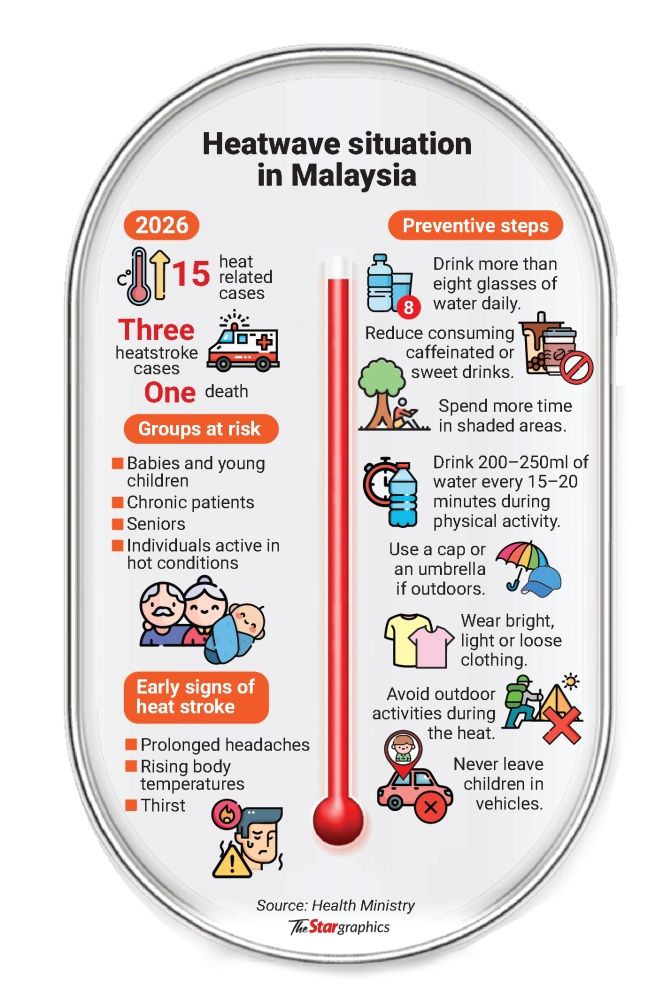
Fifteen heat-related cases and three heatstroke cases have also been recorded this year, according to the Health Ministry.
MetMalaysia has forecast a rainfall deficit exceeding 35% over three- and six-month periods due to slightly dry conditions expected to persist in western Sarawak from this March to August.
“Parts of western Sarawak are predicted to experience a cumulative rainfall deficit of up to 40% below average in July and August this year.
“A similar situation is also expected in Peninsular Malaysia starting from June, affecting Negri Sembilan, Melaka and Johor.
“For Selangor, Kuala Lumpur and Putrajaya, these conditions are expected to begin in July,” it said in a report issued on March 19.
According to climatologist Prof Emeritus Fredolin Tangang, this year could be the hottest on record, with El Nino expected to return between July and August, and intensifying towards year-end.
“Malaysia will likely face a strong El Nino, which will extend into next year, weakening around March and ending in May,” said Fredolin, who has spent over three decades researching El Nino.

He added that a positive phase of the Indian Ocean Dipole (IOD) is also forecast toward the end of the year.
“These combined conditions raise the risk of severe dry weather, forest fires and transboundary haze events.
“We must be prepared,” said Fredolin, a Fellow of the Academy of Sciences Malaysia.
Given the current heat, he noted that another possible factor is the equinox.
“If we have none or lack cloud coverage, this can exacerbate the situation,” he said.
Climatologist Prof Emeritus Datuk Azizan Abu Samah said there may be some respite for the west coast in April when the intermonsoon period settles in.
Malaysia is currently at the tail end of the north-east monsoon, which began in November last year.
“There should be rainy days by then, hence ending hot spells,” said Azizan, who believes the El Nino may only fully materialise by the end of the year.