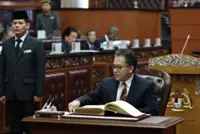
KUALA LUMPUR: The Johor Baru-Singapore Rapid Transit System (RTS) Link Bill 2026 does not require amendments to the Federal Constitution to allow the enforcement of extraterritorial laws.
Deputy Home Minister Datuk Seri Dr Shamsul Anuar Nasarah said the authority to enact the law is already provided under Article 73 and Item 1(g) of the Federal List in the Ninth Schedule of the Federal Constitution.
“Therefore, there is no issue of needing to amend the Constitution to streamline legal cooperation between Malaysia and Singapore in this project,” he said when winding up the debate on the Bill in Dewan Negara yesterday.
The Bill, which was debated by eight senators, was later passed by a majority voice vote.
Shamsul Anuar said the powers granted to Singapore enforcement officers at the Bukit Chagar station under the law are limited to Customs, Immigration and security functions within designated areas only, stressing that the nation’s sovereignty remains preserved.
“Immunity for Singapore officers is limited to ‘functional immunity’ only. If they commit personal crimes, they can be detained and tried under Malaysian law.
“Additionally, based on the principle of reciprocity, any individual detained by Singapore officers in that country will be promptly handed over to Malaysian authorities for further action,” he said.
The Rapid Transit System Link Johor Baru-Singapore Bill 2026, which is divided into eight parts containing 28 clauses and one schedule, aims to strengthen the legal framework for cross-border transport operations between the two countries.
Deputy Minister in the Prime Minister’s Department (Law and Institutional Reform) M. Kulasegaran, when tabling the Bill for its second reading, said it is important for strengthening alternative dispute resolution mechanisms that are increasingly used globally, without relying solely on court processes.
The Dewan Negara sitting will resume next Monday.