Rare tradition sees families holding nuptials for their departed loved ones
JOHOR BARU: It’s a wedding ceremony so rare that even a Taoist priest acknowledged that he had witnessed such rites only a handful of times throughout his 30 years of service.
Known as ghost wedding or “ming hun” in Mandarin, the ceremony is unlike that of a typical Chinese wedding which features auspicious symbols and the colour red to mark joy and new beginnings.
Instead, those in attendance at the ghost wedding ceremony would be dressed in mourning attire as the bride and groom had died.
“It is no longer widely practised today,” said a Taoist priest identified as Master Loo.
However, he presided over such a ceremony just two months ago for a young couple – aged 18 and 20 – who were killed in a motorcycle accident near Tangkak, Johor.
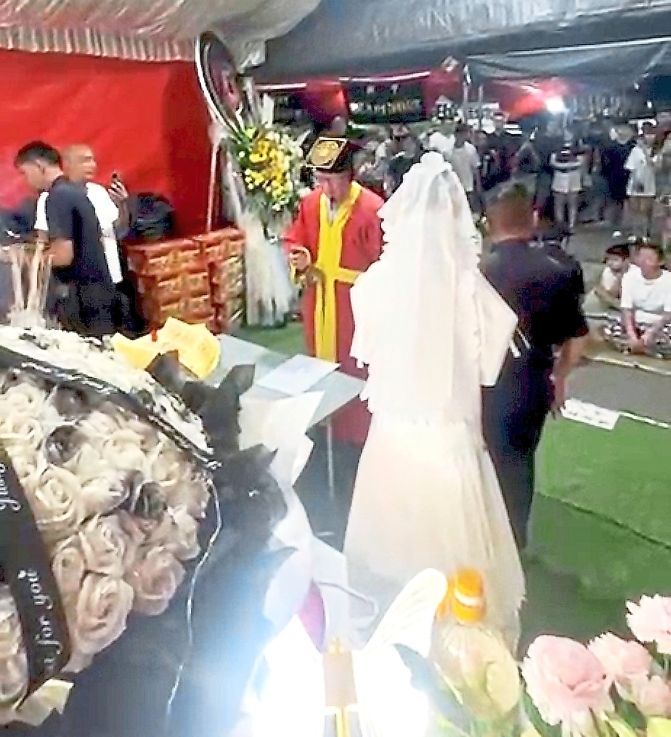
Loo said the wedding ceremony took place during their funeral wake.
The families of the deceased had requested the couple be wedded in spirit, in hopes that they would have companionship and a “home” in the afterlife, he said.
“It offers the families some closure and solace,” he said in an interview.
Loo said the ceremony was simple but deeply symbolic.
He explained that the ancient practice is rarely observed in Malaysia in modern times but for the families of the deceased, it is a final act of love and closure.
According to Loo, he assisted his mentor Master Hoo as he conducted the religious rites that echoed many elements of a traditional wedding of the living.
“The families of the bride and groom prepared physical gold jewellery and wedding rings, along with other items such as flowers.
“Offerings such as Chinese wine, tea, traditional dishes such as dried mee suah (flour vermicelli), which carry auspicious meanings, were laid out. There were also effigies of the bride and groom.”
Master Hoo conducted the prayer chants.
“He spoke on behalf of the deceased bride and groom to seek blessings from their respective ancestors to unite them in spirit.
“As with customary wedding traditions, we must inform the ancestors of the family’s intention and ask for their permission to welcome the bride and groom as son- and daughter-in-law,” said Loo.
During the ritual, family members held the deceased’s spirit tablets – wooden plaques inscribed with their names – and bowed to their ancestors, following cues from the priest.
He explained that ghost weddings originated in China thousands of years ago and that some Chinese families in Malaysia still observe the practice.
“But it is increasingly rare. Some elderly Chinese believe that if a person dies without fulfilling certain wishes, such as getting married, their spirit may not find peace in the afterlife,” he added.
In China, there are two other forms of ghost weddings – one involving young couples who died before or after becoming engaged, with their parents holding a wedding and burying them together.
The other is meant for individuals who did not know each other when they were alive but matchmakers arranged for their union after death.
In May last year, the parents of a couple – aged 31 and 33 – held a ghost marriage ceremony after they died in a car crash in Perak.