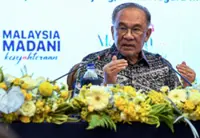
KUALA LUMPUR: Malaysia’s growing influence in Asean – from steering key resolutions at the Asean Inter-Parliamentary Assembly (AIPA) to promoting innovation at the Global Chinese Economic and Technology Summit (GCET) – shows a Parliament that is increasingly shaping the region’s direction, says Tan Sri Johari Abdul.
The Dewan Rakyat Speaker said Malaysia’s presidency of the 46th AIPA had delivered concrete results, with 42 resolutions adopted across political security, economic cooperation, climate action, gender equality and youth empowerment.

He said one of the most significant achievements was expanding AIPA’s engagement beyond parliamentarians.
“For the first time in AIPA’s history, we organised the Now and Future Conference and Exhibition, bringing together 3,000 policymakers, young leaders, businesses and civil society.
“It reflects Malaysia’s commitment to building an inclusive, innovative and forward-looking Asean,” he said.
Johari was speaking at the GCET gala dinner and awards presentation at Wisma MCA on Wednesday (Nov 20), where he drew parallels between Malaysia’s parliamentary leadership and its broader regional role in driving economic and technological cooperation.
He said genuine leadership, whether in Parliament or within Asean, required more than influence or size.
“Leadership is not defined by the ability to dominate, but by the capacity to guide. It is shaped by the courage to discern, the wisdom to engage and the humility to recognise that no nation thrives in isolation,” he said.
Johari said economic progress in the region must go hand in hand with innovation, inclusion and international partnerships.
He noted that GCET’s evolution from a purely economic forum to one that now incorporates technology, digital transformation and the green agenda reflected broader shifts taking place across Asean.
“This summit marks a renewed commitment to the digital revolution and the green transition, the two forces that will define our century,” he said.
Turning to the recently concluded 47th Asean Summit, Johari said Malaysia, under the chairmanship of Prime Minister Datuk Seri Anwar Ibrahim, had helped guide the grouping through a period of global uncertainty and geopolitical tension.
“Our leadership was not defined by size or might but by diplomacy, wisdom and an unwavering belief in unity,” he said.
He added that Asean’s economic prospects remained strong, with its 680 million population and expanding middle class putting the region on track to become the world’s fourth-largest economy by 2030.
“Malaysia sits at the heart of this transformation,” he said, citing the country’s strategic location and pro-business policies that position it as a natural hub for data centres, digital infrastructure and frontier technologies.
Johari said Malaysia’s Asean chairmanship had prioritised major regional initiatives, including the Asean Power Grid to strengthen energy security and the Digital Economy Framework Agreement to integrate the region’s digital market – moves that would shape Asean’s economic architecture in the years ahead.