
PETALING JAYA: There must be strict protections for those who assist the justice system if the judiciary allows live broadcasts of high-profile corruption trials.
Anti-graft NGOs warn that transparency must not come at the expense of silencing the very individuals whose courage is essential in exposing corruption.
The Center to Combat Corruption and Cronyism (C4) and Transparency International Malaysia (TI-M) also cautioned against turning such broadcasts into tools to name and shame the accused.
ALSO READ: Avoiding a ‘court of public opinion’
C4 chief executive officer Pushpan Murugiah noted that the idea is not new, as it has already been included in the National Anti-Corruption Strategy 2024–2028.
“Live-streaming court cases is practised in some countries, such as Australia and New Zealand.
“This would be in line with efforts to digitalise governance in Malaysia and improve public access. Much like the live-streams of parliamentary sittings, it could allow members of the public to observe the inner workings of trials and appeals,” said Pushpan.
He added that public confidence in the criminal justice system is weakened not by what happens in court, but by the opacity of processes behind the scenes.
“This can be seen in the repeated instances of politically connected elites receiving discharges for corruption charges before cases conclude. The widespread use of letters of representation to vary or drop charges adds to the perception of opacity. None of these issues is addressed in court, and live-streaming proceedings alone will do nothing to change that.
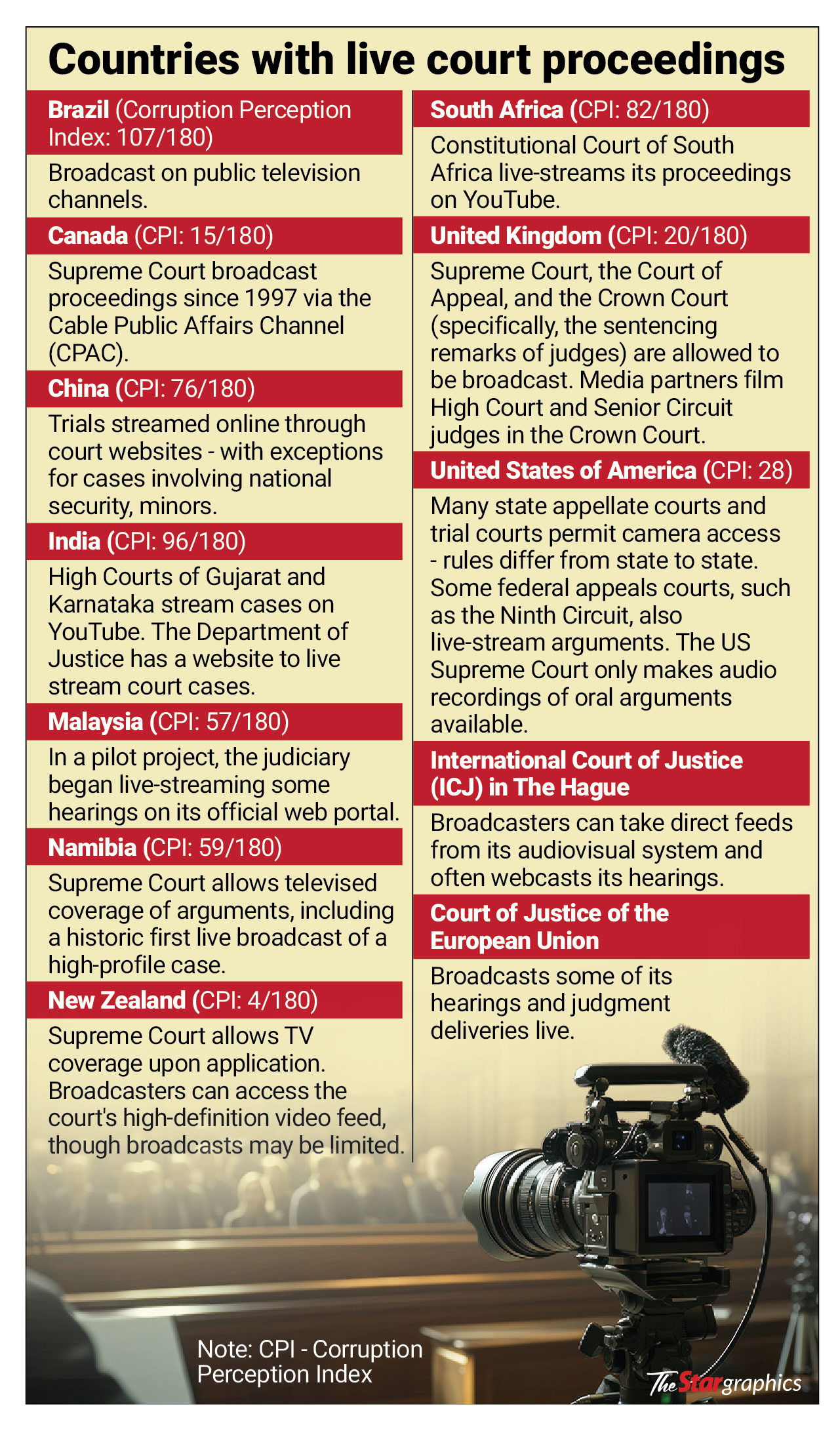
“In practice, this proposal could also have many negative consequences. There are risks of privacy breaches and the exposure of personal information during witness examinations. It might even interfere with the administration of justice if parties feel unable to speak freely and end up self-censoring,” said Pushpan.
He further warned that a lack of legal awareness among the public could lead to judges and lawyers becoming unfair targets of public ire simply for doing their jobs.
“There needs to be far more deliberation on the practicalities of this proposal. The government should consider other ways of reinforcing trust in the judicial system – for example, facilitating open access to court documents.
“Civil case files can be accessed online for a fee, but this option does not exist for criminal trials. With the ongoing development of the Freedom of Information Act, perhaps this might be a viable alternative,” he said.
TI-M president Raymon Ram stressed that live broadcasts should not be used for public shaming, but as a means of strengthening transparency and accountability.
“Justice must not only be done, it must be seen to be done. Allowing citizens to watch proceedings firsthand reduces speculation and misinformation, and strengthens the public perception that justice is applied fairly and without favour.
“That said, TI-M is concerned about unintended consequences. If whistleblowers, witnesses or informants are exposed during live proceedings, many will think twice before coming forward,” he said.
Raymon also dismissed concerns about the “public playing jury”.
“In Malaysia, judges remain the sole arbiters of guilt or innocence, and the presumption of innocence until proven guilty must remain absolute.
“Done properly, live coverage can actually improve public perception by showing the process as it unfolds, rather than leaving space for distorted narratives on social media,” he said.
He emphasised the need for safeguards to protect those who “make justice possible”.
“Without proper protections, public exposure may intimidate whistleblowers and witnesses, creating a chilling effect that undermines justice.
“Judges must have discretion to pause or restrict broadcasts during sensitive testimonies.
“Anonymity measures such as blurring, voice distortion or closed sessions for vulnerable witnesses must be put in place.
“Stronger provisions to reinforce confidentiality under the Whistleblower Protection Act 2010 are also essential. These measures can boost confidence in the justice system,” Raymon added.