
Criminals preying on youngest digital users for easy money
PETALING JAYA: It used to be that older adults and retirees were easy prey for scammers, but not any more.
Now, scammers are even targeting victims as young as seven.
That is the new disturbing reality in Malaysia: 21% of parents report their children aged seven to 17 have fallen victim to scams, says the Global Anti-Scam Alliance (Gasa).
ALSO READ: Teen heartbreak as first paycheck is lost to a scam
According to Gasa’s State of Scams in Malaysia 2025 report, one in five parents surveyed said at least one of their children had been targeted by scammers.
“This represents a new frontier in fraud – criminals deliberately targeting the country’s youngest digital users, turning family homes into battlegrounds against deception,” Gasa managing director Jorij Abraham said in the report.
Malaysia is one of 42 markets surveyed in the report released by Gasa in collaboration with anti-scam service providers ScamAdviser and Whoscall.
One thousand people aged 18 and above in Malaysia were interviewed for the report, with the sample size nationally representative of the country’s adult population.
Sixty-three per cent of the respondents were parents.
The report did not give examples of how children are being targeted by scammers in Malaysia.
According to the Commercial Crime Investigation Department, senior citizens – most of them retirees with decades’ worth of savings and wealth – are prime targets of scammers in the past few years.
Victims aged 60 and above lost about half a billion ringgit from 2021 to 2023, The Star reported last year.
The Gasa report said scammers stole an estimated RM40.1bil from victims across all age groups in Malaysia last year, with each victim losing an average RM4,967.60.
“Last year, 85% of adults in Malaysia encountered a scam. With an average of 140 scam attempts per person, nearly one every three days,” ScamAdviser chief business officer Boice Lin said in the report.
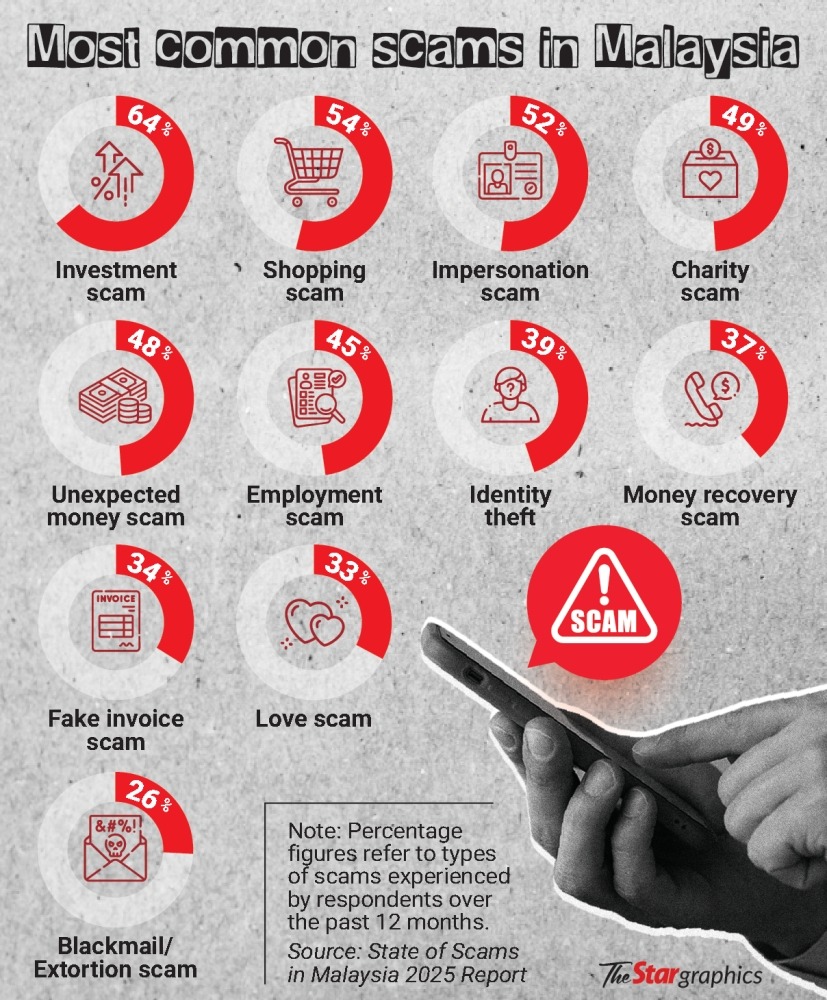
The report said investment scams were the most common in Malaysia, affecting 64% of respondents who were approached by scammers.
Shopping scams were the second most common (54%), followed by impersonation scams (52%).
Phone calls were the main channel used by scammers, representing 73% of the scam attempts encountered.
The second most common were instant messaging platforms such as WhatsApp and Telegram (56%), followed by text or SMS messages (51%).
“The Royal Malaysia Police (PDRM) has been instrumental in raising public awareness, conducting raids on scam syndicates, and working closely with digital platforms like ours to stop scams at the source,” Manwoon Joo, CEO of Gogolook, the developer of Whoscall, said in the report.