




KUALA LUMPUR: A dedicated Law Ministry is being seriously considered to ensure greater coherence in the national legal ecosystem, says Datuk Seri Anwar Ibrahim.
The Prime Minister said the move would also enable Malaysia to engage more meaningfully with regional partners in advancing the rule of law, especially with Asean member states.

Anwar acknowledged that he has a law minister who is passionate and helps to effect change as fast as possible, referring to Datuk Seri Azalina Othman Said.
“Therefore, I have to seriously consider the establishment of a dedicated Law Ministry – a step that will not only ensure greater coherence in our national legal ecosystem, but also enable Malaysia to engage more meaningfully with our regional partners in advancing the rule of law.
“By aligning ourselves with the best practices of our neighbours, Malaysia will be better placed to shape a more just and responsive regional order,” he said in his keynote address at the Asean Law Forum 2025 here yesterday.
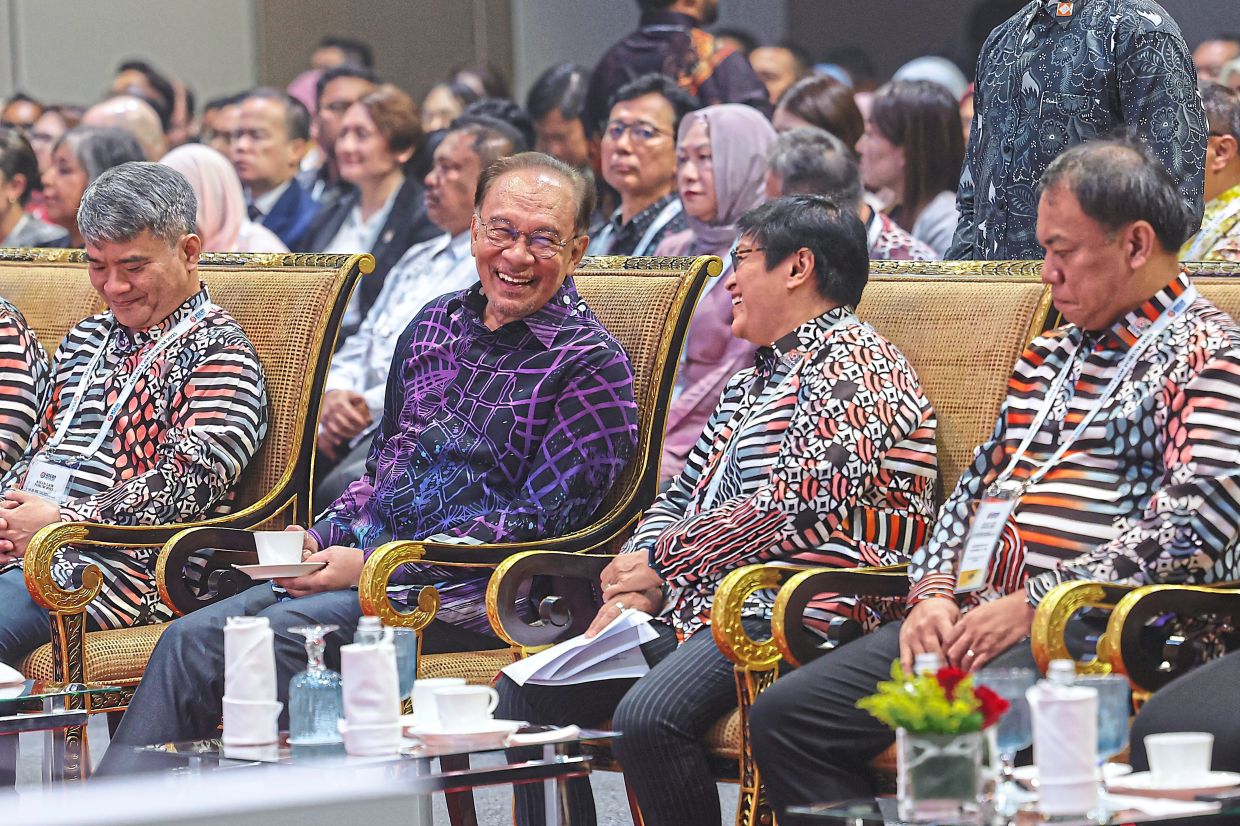
Also present were Azalina, who is the Minister in the Prime Minister’s Department (Law and Institutional Reform), her deputy M. Kulasegaran and Asean secretary-general Dr Kao Kim Hourn.
ALSO READ: Experts: Proposed ministry vital for independence and rule of law
The forum was organised by the Asian International Arbitration Centre in collaboration with the Legal Affairs Division of the Prime Minister’s Department.
Anwar said “Inclusivity and Sustainability” had been adopted as Malaysia’s central theme for its Asean chairmanship this year, stressing that inclusivity means the law must serve every person, every community and every generation.
“It is not enough for justice to exist in principle. It must be felt in the lives of our people. The law must empower and protect, not intimidate or exclude,” he said.
Anwar also stressed the importance of sustainability in building legal systems and institutions that can withstand the test of time.
“A government’s true strength does not rest in the reach of its authority, but in the integrity of its institutions, its fairness in governance, and the trust it earns from its citizens,” he said.
Speaking on Asean’s Vision 2045, Anwar said the rule of law must be the foundation of the journey, stressing that a rules-based Asean is the bedrock of trust, stability and shared prosperity.
He also noted that Asean unity does not demand uniformity, as the region’s diversity in legal traditions, cultural values and historical experiences could enrich rather than divide its members.
The Prime Minister urged the regional grouping to strengthen mutual legal assistance, enhance dispute resolution mechanisms and confront emerging challenges such as digital governance and the regulation of artificial intelligence.
“These are not abstract reforms. They are acts of trust-building, of ensuring that Asean remains relevant and resilient in a rapidly changing world,” he said.
Citing the recent border tensions between Thailand and Cambodia, Anwar said Malaysia’s mediation, backed by Asean’s collective will, had led to a ceasefire agreement.
The Asean region, he added, has proven time and again that disputes can be resolved through dialogue and principled diplomacy.
“Asean’s approach to peace has always been one of quiet strength, consensus and respect. The same spirit must guide our legal cooperation,” said the Prime Minister.
Meanwhile, Anwar said the proposal to deploy additional observers to monitor the implementation of the Thailand-Cambodia ceasefire is solely aimed at ensuring continued safety and stability in the region, and does not amount to interference.
He said the current number of Asean Interim Observer Team (IOT) members requires a more balanced distribution of resources between the two neighbouring countries.
“For example, we have 10 members in Bangkok but only two in Phnom Penh. So, we need to increase the numbers.
“If insufficient, additional personnel can be drawn from defence attachés and embassies, and supported by other teams,” he told reporters after the closing ceremony of the forum.
On Wednesday, Thailand’s Acting Prime Minister Phumtham Wechayachai rejected the proposal to send more international observers to monitor the implementation of the ceasefire at the Thailand-Cambodia border.
Phumtham said Anwar had contacted him the day before, suggesting the deployment of additional international observers on the grounds that the Asean IOT could not carry out the task alone.
At the event earlier, Ministers of Law, Justice and Attorneys-General from the 10 Asean member states reaffirmed their collective commitment to advancing international commercial arbitration and mediation as a tool for regional economic development, legal cooperation and access to justice.
The joint declaration was adopted at the Asean Law Forum 2025, which was attended by representatives from Brunei Darussalam, Cambodia, Indonesia, Laos, Malaysia, Myanmar, the Philippines, Singapore, Thailand and Vietnam.
In a joint statement, the ministers emphasised the importance of harmonising arbitration and mediation frameworks across Asean in alignment with international standards such as the Convention on the Recognition and Enforcement of Foreign Arbitral Awards, the Convention on International Settlement Agreements Resulting from Mediation and the United Nations Commission on International Trade Law (Uncitral) Model Law on Cross-Border Insolvency.


