

PETALING JAYA: SPM school leavers have been advised to be wary of unsolicited WhatsApp and SMS texts offering various courses and attractive incentives to be enrolled in some colleges and private institutions of higher learning.
It is crucial to check the legitimacy of such “offers” before making any decision to enrol to avoid ending up in debt due to high fees and other costs imposed by the operators.
Despite regulations governing the promotion of courses offered by private higher education institutions, enforcing them remained a significant challenge, according to the National Association of Private Educational Institutions (Napei).
Deputy president Dr Teh Choon Jin said while most reputable institutions adhere to the rules, some unscrupulous operators continue to promote unaccredited programmes via social media and messaging apps.
ALSO READ: Cautious response to scholarship offers
“These misleading promotions not only deceive students but tarnish the reputation of the entire private education sector,” he said.
Teh urged parents to scrutinise any claims made by these operators and to particularly get accreditation from the Malaysian Qualifications Agency (MQA).
He said fraudulent advertisements are being promoted on the social media and they often misuse the names of reputable institutions, misleading students into thinking they are enrolling in accredited programmes.
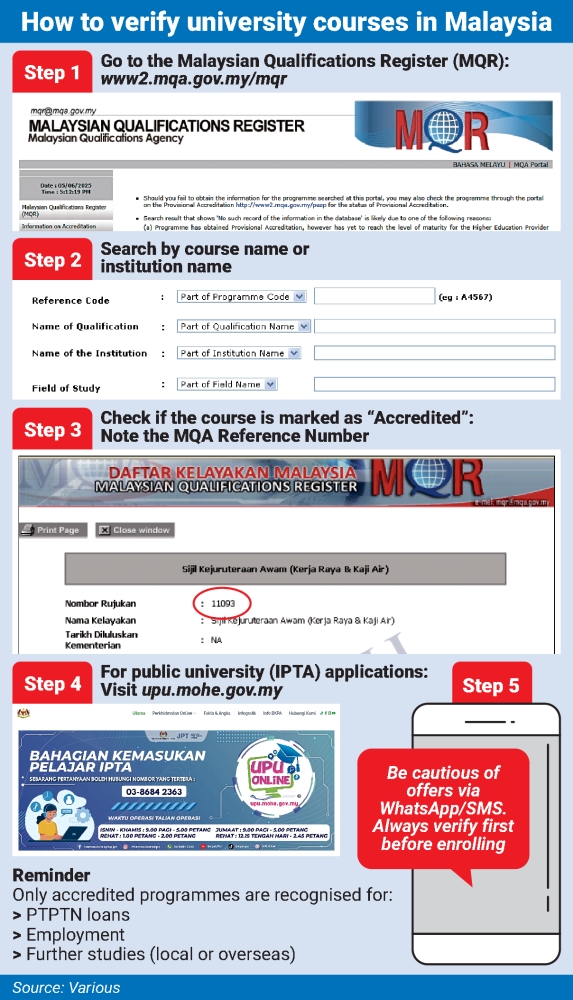
To protect students, Teh called for greater vigilance and collaboration with the authorities.
“The most important step is to verify whether the courses and institutions are accredited,” he said.
Teh also highlighted that Napei members faced significant challenges due to fraudulent advertisements and scams, especially those proliferated through social media and messaging platforms.
“These deceptive ads often misuse the names, logos, or branding of reputable institutions to appear legitimate, misleading students into believing they are enrolling into recognised programmes,” he explained.
The presence of such scams in the ecosystem creates confusion and distrust among students and parents,” he added.
Uniten vice-chancellor Prof Dr Khairul Salleh Mohamed Sahari said students and parents could verify a programme’s accreditation status via the Malaysian Qualifications Register or the Provisional Accreditation list on the MQA website.
For overseas programmes, the former MQA deputy CEO (quality assurance) said recognition status could be checked through the e-SISRAF system or by contacting the MQA.
“When a student enrols in an unaccredited programme, he or she will not be able to apply for any scholarships or financial assistance from major providers such as the Public Service Department, Majlis Amanah Rakyat and National Higher Education Fund Corporation or PTPTN.
“Upon graduation, he or she will not be able to join the public service and may be rejected by companies that strictly assess the quality of the programme,” he said.
Some institutions, he said, also misused the MQA logo in advertisements for non-accredited programmes.
He warned that such actions are offences under Act 679 and could lead to fines or imprisonment if convicted.
National Union of the Teaching Profession secretary-general Fouzi Singon acknowledged that the issue had persisted for years, with many students falling victim.
Some colleges, he said, entice students with special offers, only for them to end up in debt due to high fees imposed and other costs.
“There are also third parties acting as agents who exploit the situation to earn commissions by charging exorbitant processing fees,” he added.
Fouzi also advised parents to verify an institution’s qualification certificates and ensure that their MQA accreditation is still valid.
“Even if there is a certificate, the validity date of the accreditation certificate by the MQA needs to be verified,” he said.
He also called on the MQA to promote evaluation steps more actively and strengthen student data protection.
