
PETALING JAYA: From bustling food stalls to digital startups and retail empires, women entrepreneurs are not just working – they are leading, powering a quiet revolution.
In 2022 alone, over 219,000 women-owned establishments consisting of businesses, property or other assets were recorded, making up a fifth of all businesses in the country, according to the Department of Statistics Malaysia’s (DOSM) latest findings.
The data was based on the Economic Census 2023.
Chief statistician Datuk Seri Dr Mohd Uzir Mahidin said more than 70% of the said establishments consisted of the wholesale & retail trade (45.0%) and the food & beverage subsectors (31.1%).
This surge, he said, was not just about numbers – it’s a signal that women are shaping the nation’s economic future.
“The increasing presence of women in the entrepreneurial ecosystem reflects Malaysia’s ongoing commitment to gender inclusivity and empowerment,” Mohd Uzir said in a statement yesterday.
“These statistics serve not only as a testament to the strength and capabilities of women entrepreneurs, but also as a vital input for policymakers, researchers, and industry players in formulating informed strategies to support and accelerate women’s economic participation.”
In terms of state, Mohd Uzir said Selangor has the highest number of such operations at 15.9%, followed by Sabah at 10.4%, Kelantan at 9.6%, Federal Territory Kuala Lumpur at 9.2% and Johor at 8.9%, accounting for more than half of the total establishments.
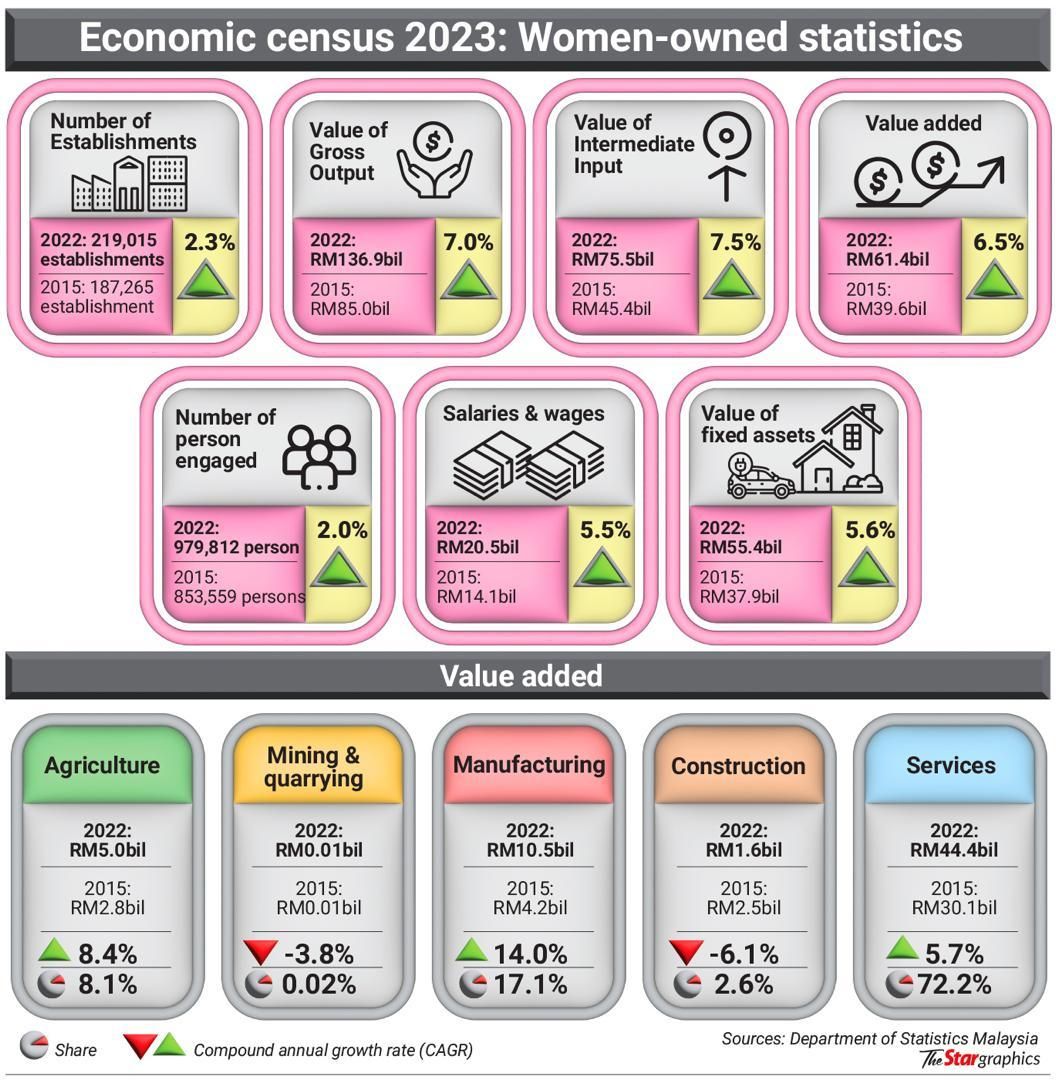
Additionally, Mohd Uzir said the value of gross output generated by women-owned establishments amounted to RM136.9bil in 2022.
He said the services sector generated the highest gross output value with RM83bil or 60.7% deriving mainly from the wholesale and retail trade subsector (37.7 %) as well as manufacturing (30%) and agriculture (5.8%) sectors.
In line with the increase in gross output, Mohd Uzir said the total value added for women-owned establishments grew 6.5% annually, increasing by RM21.8bil to a record RM61.4bil in 2022 from RM39.6bil in 2015.
The main contributor to the value-added was the services sector, registering 72.2% or RM44.4bil with an annual growth rate of 5.7% while the manufacturing and agriculture sectors contributed RM10.5bil and RM5bil respectively, he added.
In 2022, there were 185,582 women-owned Small and Medium Enterprises (SMEs) establishments, representing 17% of the total establishments in Malaysia.
Of this number, 171,800 establishments (92.6%) were involved in the services sector, followed by 8,359 establishments (4.5%) in the manufacturing sector.
These SMEs generated a gross output of RM89.3bil and a value added of RM44.3bil, which increased by 3.7% and 4.1% respectively, each year.
Additionally, women-owned establishments employed 833,311 persons, with an annual growth rate of 0.9%.
In terms of salaries & wages and fixed asset values, they recorded RM16.2bil and RM39.7bil, with an annual growth rate of 4.5% and 3.4%, respectively.
Meanwhile, Association of Women Lawyers (AWL) president Jasmine Wong said that the latest achievement was a milestone for women.
However, she urged for policies and laws to accelerate further growth.
“While women entrepreneurs drive innovation, they remain underrepresented in high-growth sectors and face systemic hurdles which include restrictive financing policies and gender pay gaps perpetuated by opaque salary structures.
“Critically, we must also address structural inequities – from pay gaps to career advancement barriers – through progressive legal and policy reforms. When women thrive, businesses flourish, families prosper. We need to do more to make that happen,” she said.
Wong added there was a need for more meaningful collaboration between government, industry, and civil society to strengthen microfinancing initiatives, bridge the digital divide through targeted training, and implement family-friendly workplace policies.
Apart from that she highlighted the much needed attention in addressing the “double shift” many women deal with as they juggle home and work.