
PETALING JAYA: Malaysia’s proposed new law on carbon capture and storage has got environmentalists worked up, with several of them cautioning that the legislation could backfire.
They pointed out that the country could end up becoming a “dumping ground” for carbon waste, adding to its struggles in managing e-waste and plastic waste from other countries.
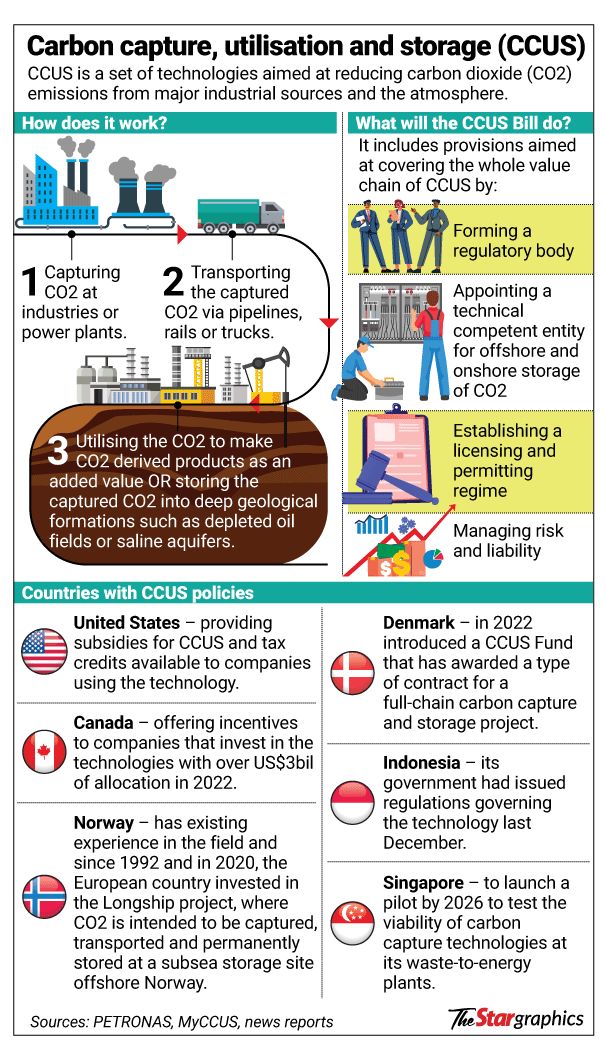
The Carbon Capture, Utilisation, and Storage (CCUS) Bill passed by the Dewan Rakyat recently is intended to combat climate change and help achieve Malaysia’s carbon net-zero target in 2050.
However, the proposed law will also pave the way for other countries to store their carbon waste in Malaysia.
Sahabat Alam Malaysia president Meenakshi Raman expressed concern that without proper management, Malaysia could indeed turn into a dumping ground for foreign carbon waste.
“The CCUS Bill is meant to regulate the sector, but once the country opens up to carbon storage, we risk becoming a dumping ground if abuses occur,” she said in an interview.
Citing the challenges of ensuring environmental integrity and safety due to the long-term nature of carbon dioxide (CO2) waste, Meenakshi felt Malaysia lacked capabilities for robust assessments, standards and enforcement.
“Relying on the industry to determine prudent practices offers little assurance that regulations will be strictly followed,” she pointed out, adding that corporations might cut corners to maximise profit.
“Managing e-waste is already a nightmare. Dealing with CO2, which is invisible and stored underwater or underground, presents even greater challenges.
“Without constant and independent monitoring, we won’t know if problems exist until accidents happen,” she said.
The Star reported previously that almost RM4bil worth of material and items were seized following raids on 90 illegal e-waste factories nationwide.
The police did not rule out the possibility that the e-waste factories were owned by locals but with financial backing from foreign entities.
Last year, Eurostat, the European Union’s (EU) data office, reported a 35% annual increase in plastic waste sent here from the continent in 2023, making Malaysia the second largest-dumping ground for Europe’s plastic waste.
Meenakshi highlighted potential overlaps between the CCUS Bill, managed by the Economy Ministry, and the forthcoming National Climate Change Bill (Ruupin) which comes under the Natural Resources and Environmental Sustainability Ministry.
“We expect the Ruupin to establish a proper governance system for climate change, including CO2 regulation.
“The CCUS Bill’s governance structure seems redundant and calls for a more coordinated approach,” she said.
Klima Action Malaysia (Kamy) communications director Aroe Ajoeni shared the concerns, saying the Bill permitted importing carbon dioxide for storage in Malaysia.
“This is already happening through agreements with countries like Japan and South Korea, effectively making Malaysia their carbon disposal site.
“This arrangement raises sovereignty concerns, as Malaysia bears long-term environmental risks while enabling these countries to continue carbon-intensive activities,” she said in criticising the proposed law.
Ajoeni said under the proposed law, oversight agencies were selected by the minister rather than creating independent regulatory bodies, which she said could lead to conflicts of interest.
“To prevent potential pitfalls, we need stronger regulatory measures, including mandatory environmental impact assessments, independent third-party monitoring systems and comprehensive emergency response protocols for potential leakages,” she added.
Ajoeni called for Ruupin to be expedited before the CCUS legislation, saying this would be “more logical” as the proposed law would also facilitate the national climate change agenda.
The Ruupin is expected to be tabled in Parliament in the middle of the year to formalise Malaysia’s climate commitments into law.
The CCUS Bill will be debated in the Dewan Negara, with Economy Minister Datuk Seri Rafizi Ramli aiming for enforcement by March 31.
The minister had told the Dewan Rakyat that the government would not be funding CCUS facilities and that a carbon tax for heavy industries like steel was being considered.
He was quoted as saying that once a carbon tax was in place, companies or individuals will have to pay for carbon storage.