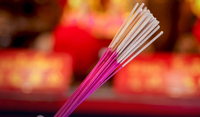
Blooming phase: Tan placing wormwood incense sticks while inspecting the flowers of durian trees at his orchard in Relau. — LIM BENG TATT/The Star
GEORGE TOWN: With thousands of durian trees in bloom, preventing pests is crucial.
Some orchard owners have turned to wormwood incense sticks to protect their trees ahead of this year’s season.
Orchard owner Tan Chee Keat, 34, said it is crucial to provide optimal care for the trees at this stage, as the success of the flowers turning into fruits depends on it.
He added that the smoke from burning wormwood incense will repel pests, protecting the durian flowers from damage.
“In the past, we burned wood to create smoke and repel insects, but it caused pollution and unpleasant odours.
“Although wormwood is a costlier alternative, it is non-toxic, unlike chemical insecticides.
“It is also known for its therapeutic properties, including air purification,” he said, adding that he ordered tonnes of wormwood incense sticks priced at about RM1 per stick.
He said the incense sticks are burned only at night to avoid deterring bees, which arrive in the morning and play a crucial role in pollinating the flowers.
Tan, a third-generation orchard owner in Relau, expects the durian harvest to begin as early as the end of April and continue through August.
“The trees began flowering at the end of February, with two batches of flowers blooming so far.
“We anticipate two major harvests this year, with the season expected to peak from May onwards.”
Tan said the hot weather remains a challenge for workers striving to maintain the trees in peak condition.
“Generally, the dry weather triggers the flowering and is ideal for fruits to develop.
“But if it is too dry, the flowers will wilt, while excessive rain could also cause them to drop before they turn into fruits.
“Fortunately, it has been relatively dry this year and we are well-prepared with water tanks from last year’s hot spell to irrigate the soil,” he said.
While pest concerns have long been an issue for orchard owners, many are now adopting new methods to promote a healthier approach to farming.
Albert Khoo, 56, who owns a durian orchard in Balik Pulau, said the shift is due to community concerns and export regulations.
“In the past, orchards were located in the hills, far from residential areas. But recent development has brought people closer to them.
“Open burning and the use of harmful pesticides are no longer encouraged to protect the environment.
“With many orchards now exporting their fruits, major importers, especially China, have implemented stricter regulations to enhance food safety.
“These regulations focus not only on the quality of the fruits but also on the fertilisers and chemicals used in cultivation.
“As approved methods and labour have become costlier, some orchards are turning to natural remedies such as using enzymes to protect and enhance their fruits,” he said.
On Feb 6, it was reported that some 64 tonnes of durians from Thailand were disposed of after being rejected by China, the world’s largest importer of the fruit.
The durians are said to have been contaminated with Basic Yellow 2 (BY2) dye, which is usually used to artificially enhance the colour of durian fruits.
Following that, China has introduced a new regulation requiring all durians exported from Thailand to undergo laboratory testing for the dye.
The export licences of 26 durian wholesalers responsible for shipping the contaminated durians to China have also been suspended.