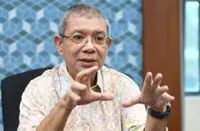
PUTRAJAYA: Datuk Seri Saifuddin Abdullah, on Thursday (Sept 1), presented the Foreign Ministry's Annual Report Card under his leadership from August 2021 to August 2022, which outlines the Foreign Policy Framework 2021 as one of five key achievements.
According to Foreign Minister, the framework titled "Focus on Continuity: Malaysia's Foreign Policy Framework in a Post-Pandemic World", which was launched on Dec 7, 2021, ensures that the implementation of the existing foreign policy is streamlined so that it is in line with current demands.
Eight new focuses were emphasised, namely Malaysia and the global economy, health diplomacy, digital economy, cyber security, language and cultural diplomacy, the concept of peaceful coexistence, multilateralism and the 2030 Sustainable Development Goals.
Saifuddin said the second achievement was Malaysia's membership in the United Nations Human Rights Council for the 2022-2024 term, which is a recognition by the world community of the country's role in the agreement and advancement of human rights at the international level.
"Malaysia will continue to fight for the rights of the vulnerable such as children, women, Orang Asli, persons with disabilities and the elderly, empowering youth in decision-making and fighting for the oppressed such as the Palestinian people, Rohingya and Afghanistan people," he said.
The establishment of the Special Select Committee on International Affairs in Parliament is the third achievement of the Foreign Ministry which he said aims to scrutinise, investigate and report on any matter under the ministry's responsibility.
The committee established on the recommendation of the ministry has discussed various matters including the Foreign Policy Framework, the ministry's expenses and the demand by parties claiming to be the heirs of the Sultanate of Sulu.
Saifuddin outlined the Myanmar Conflict Resolution Framework as the fourth achievement of the ministry, which according to him has placed Malaysia as the main voice in the effort to resolve the conflict.
The framework presented in the Asean Foreign Ministers' Meeting on Aug 3 aims to improve the implementation of the Five-Point Consensus in resolving the crisis in Myanmar, which so far has not shown results.
The framework suggests that there should be a clear endgame, namely the establishment of democracy through an inclusive and fair negotiation and transition process involving the main stakeholders in Myanmar, including the National Unity Government (NUG) and the National Unity Consultative Council (NUCC).
"Malaysia also called on the Asean Summit in November to make a big decision to resolve the conflict," he said.
Saifuddin said the fifth achievement was to strengthen the ministry's diplomatic capabilities, especially in matters of human resource development.
"Several new or renewed measures have been implemented, for example, the Diplomat Scholarship Programme, the preparation of a glossary of diplomacy and international relations book and the upgrading of the eConsular system," he said.
Regarding the current geopolitical landscape of the world compared to when he first led the ministry between 2018 and 2020, he said the biggest challenge was the conflict in Myanmar and Ukraine.
"These are two challenges for us at Wisma Putra. It's just that the impact of the Ukraine conflict is more far-reaching because it involves the issue of food security, and inflation.
"The impact extends beyond the assignments at the Foreign Ministry, which is why some ministries and some ministers are directly involved with issues related to the conflict in Ukraine," said Saifuddin. - Bernama
Already a subscriber? Log in
Get 20% OFF The Star Digital Access
Cancel anytime. Ad-free. Unlimited access with perks.