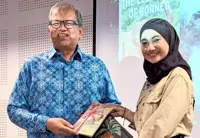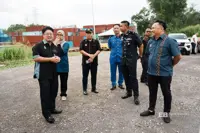
KOTA KINABALU: The Quion Hill Agriculture Research Station in Tawau, which has been operating since 1957, has the potential to diversify its operation to include eco-tourism.
Deputy Chief Minister Datuk Seri Dr Jeffrey Kitingan said the facility would be appealing to foreign researchers interested in local fruits, as well as food enthusiasts wanting to sample the station’s new varieties of fruits.
“I am confident ecotourism will help promote the station, as well as studies conducted here to a wider audience. We only need to upgrade a few facilities to make this place more attractive,” he said after launching the station’s 65th anniversary on Saturday (Aug 20).
Kitingan, who is also state Agriculture and Fisheries Minister, said since the station’s inception, it has introduced several commercially available fruit varieties - this includes two varieties of avocados and plantains in 2012, two "salak" clones in 2014, two breadfruit clones in 2019, and one red-fleshed durian clone and jackfruit clone in 2021.
“I am also pleased that, in conjunction with the station’s anniversary, we launched two new fruit varieties today: the avocado variety QAV 3 and the tarap variety QTRP 1.
“Both varieties were the result of a 20-year study in this station.
“The fruits are larger, have shorter maturing periods and are more disease resistant,” he added.
Kitingan said that new varieties like these were crucial during a time when the state needs to ensure food security, adding that many countries were forced to halt their manufacturing operations due to the Covid-19 pandemic, including food production.
“While there are no food shortages in Sabah, our self-sufficiency level (SSL) is still too low, and we are at the mercy of food exporters in other countries.
“We still import 75% of our rice, 74% of meat and others as well.
“This is a problem, but it is also an opportunity for us to find ways to feed ourselves because any disruptions in global food production will put us in jeopardy,” he said.
Sabah, said Kitingan, has land that could be cultivated to increase food production, not only to meet current demands but also as stockpiles for future supplies.
One way to promote this is to encourage both local and foreign investors to invest in food production, he added.
He also mentioned the possibility of converting a small percentage of oil palm plots into paddy cultivation.
“Oil palm is currently planted on 1.8 mil hectares of our agricultural land.
“If only 10 per cent of the land is converted to paddy cultivation, it could have a significant impact on our paddy SSL.
“So we are also looking into ways to work with oil palm companies,” said Kitingan.
Already a subscriber? Log in
Get 20% OFF The Star Digital Access
Cancel anytime. Ad-free. Unlimited access with perks.