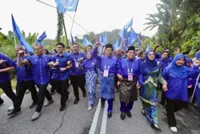
MALAYSIA may have been formed in 1963, but believe it or not, it wasn’t until 2010 that Malaysia Day was celebrated as a national public holiday. Prior to that, it was a state holiday only in Sabah and Sarawak.
The declaration of a national holiday may have had a political tinge to it, since the previous opposition coalition Pakatan Rakyat had made election promises around it before a holiday was finally declared by Barisan Nasional.
But it makes sense, given that we are one country. The idea was to also bring both east and west Malaysians together, to help us understand and appreciate one another more.
Peninsular Malaysians can learn a lot from our brethren across the South China Sea. Sabah and Sarawak are home to dozens of different ethnic groups, hundreds if you count sub-ethnic groups, all with their own languages and cultures – and all living in relative harmony.
In many ways, east Malaysia is a microcosm of what greater Malaysia is aspiring to, where diversity is our strength, and where appreciation – not mere acceptance or tolerance – of other cultures is a way of life.
With that in mind, let’s shine a light on the two east Malaysian states:
The Sabah and Sarawak FAQ
Q: What were Sabah and Sarawak before entering Malaysia in 1963?
A: Back then, Sabah was known as North Borneo. Both North Borneo and Sarawak were states governed by the British Crown Colony shortly after the dissolution of the British Military Administration at the end of the Second World War.
The states were under the administration of Governors who were appointed by King George VI, and later Queen Elizabeth II, until 1963 when they signed the Malaysia Agreement 1963 (MA63) to form Malaysia.
Q: What is the Malaysia Agreement 1963?
A: The Malaysia Agreement or the “Agreement relating to Malaysia between United Kingdom of Great Britain and Northern Ireland, Federation of Malaya, North Borneo, Sarawak and Singapore” was the agreement that led to North Borneo (Sabah), Sarawak, and Singapore combining with the existing states of the Federation of Malaya to form Malaysia.
The agreement was signed on July 9, 1961 and came into effect on Sept 16, 1963 (hence, Malaysia Day).
However, on Aug 9, 1965, Singapore became an independent state.
Q: Why do we say that Sabah and Sarawak helped ‘to form’ and not ‘joined’ Malaysia?
A: Prior to the formation of Malaysia, the Cobbold Commission was established in 1962 to conduct a study to determine whether the people of North Borneo (now Sabah) and Sarawak supported the proposal to form the Federation of Malaysia.
Based on the study, North Borneo drew up a 20-point agreement while Sarawak proposed a 18-point agreement.
After reviewing the Cobbold Commission’s findings, the British government appointed the Lansdowne Commission to draft a constitution for Malaysia, similar to the 1957 constitution, which also recognised the special position of the natives of the Borneo States.
In the draft, North Borneo, Sarawak and Singapore were also granted some autonomy.
Q: Why do I need a passport or MyKAD to enter Sabah or Sarawak?
A: That comes from the autonomy granted to the two states under MA63.
Under the Immigration Act 1959/ 1969, west Malaysians who are entering either state to work or study are required to get permits. Those merely visiting these two states still have to fill up an immigration form, and would then be granted a 90-day pass.
Either a MyKAD or passport would do for identification.
Q: What’s with the immigration autonomy in Sabah and Sarawak?
A: Both states have the authority to regulate immigration under Section 66 of the Immigration Act 1959/1969, and can bar individuals who “pose a threat to order and security” from entering the state.
In fact, several politicians from what was previously the opposition have been barred from either Sabah or Sarawak. These include the DAP’s Tony Pua and Lim Kit Siang, PKR’s Nurul Izzah Anwar and Datuk Seri Azmin Ali, and Sabah STAR president Datuk Dr Jeffrey Kitingan.
Q: Why do Sabah (Land Below the Wind) and Sarawak (Land of the Hornbills) have such cool, descriptive nicknames?
A: See what we mean about learning from east Malaysia?
Q: What language is used in the courts of Sabah and Sarawak?
A: English has been the official language of the courts in Sabah and Sarawak since Malaysia was formed in 1963. This is stated in Articles 161(1) and (2) of MA63.
Q: Why is English still used in the Sabah and Sarawak state legislative assemblies?
A: Like the courthouses in Sabah and Sarawak, English is the official language of the state assemblies as stated in the above Article of MA63.
The same agreement also allows the use of English by Sabah or Sarawak MPs in Parliament.
Q: Can west Malaysians lawyers practise there?
A: Under Article 161B of MA63, Peninsular lawyers are not allowed to practise law in Sabah or Sarawak unless they get a licence from the High Court of Sabah or Sarawak, and a work permit from the respective state Immigration Department.
Q: Why is stuff more expensive in Sabah and Sarawak?
A: Some items in east Malaysia can be more expensive by 30 percent compared with Peninsular Malaysia, and this is widely believed to be due to the cabotage policy implemented by the shipping industry in both states.
This policy requires all domestic transport of goods to be conducted by Malaysian vessels. Thus, any goods bound for Sabah or Sarawak will have to come in via Port Klang, increasing the cost.
In 2017, then Prime Minister Datuk Seri Najib Tun Razak announced an exemption of the cabotage policy for Sabah and Sarawak as well as Labuan from June 1.
However, the then Transport Minister Datuk Seri Liow Tiong Lai said that a World Bank study on national port strategy found that cabotage and shipping costs are not the main reasons for the higher price of goods in Sabah and Sarawak.
“According to the study, the high costs are a result of weak distribution channels, high handling charges, and inefficient inland transportation,” he said.
Already a subscriber? Log in
Get 20% OFF The Star Digital Access
Cancel anytime. Ad-free. Unlimited access with perks.