
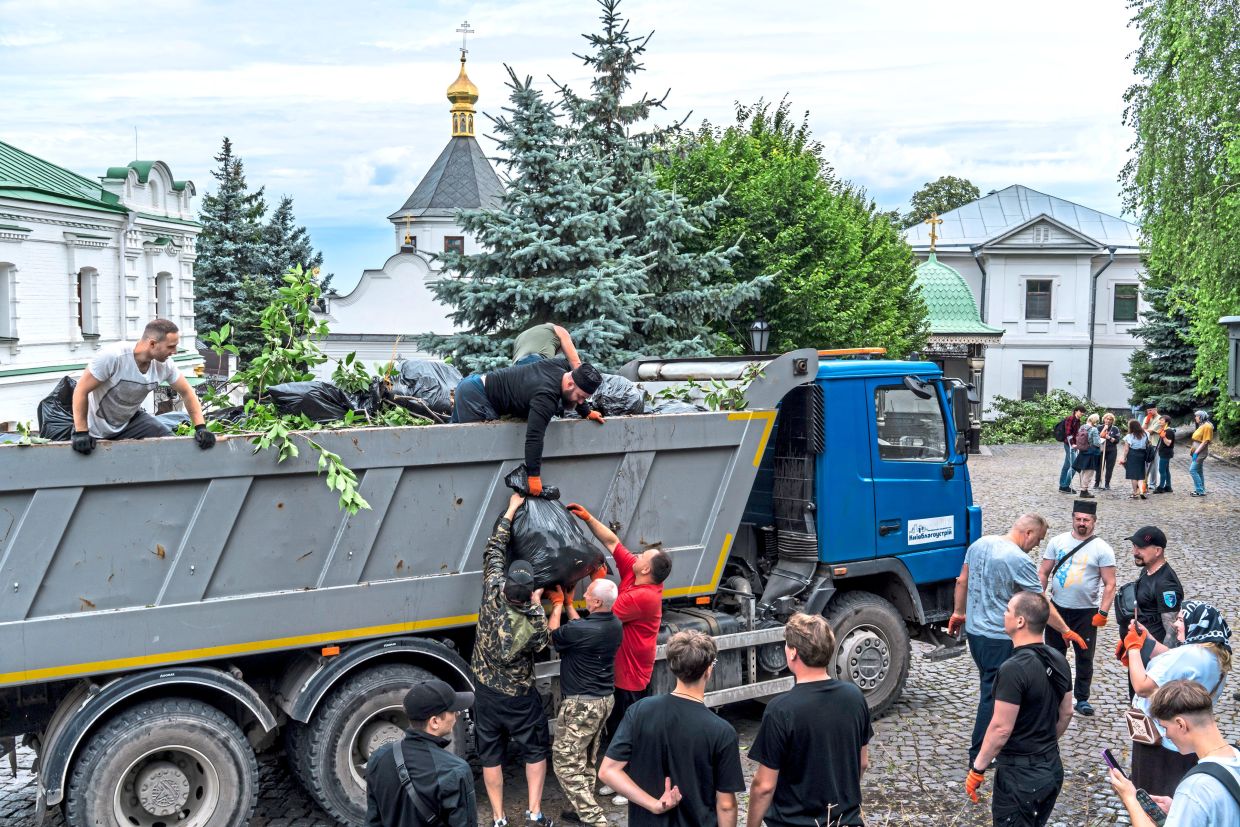
THERE was a bustle on a recent morning on the quiet grounds of Kyiv’s oldest monastery, as volunteers gathered beside Orthodox priests with hoes and rakes to assist in a grand clean-up.
Mostly parishioners, military veterans and charity workers, the volunteers had answered a call from the head of the monastery after a Russian drone struck the Dormition Cathedral, at the centre of the monastic complex, in June.
It is unclear whether the drone, which was part of a broader bombardment of Ukraine’s capital, had intentionally targeted the cathedral.
Still, the strike damaged one of its golden domes and set the roof ablaze.
“I cried when I saw the Dormition Cathedral was on fire,” said Olha Mukha, an economics teacher and parishioner who lives nearby and came to help.
“For our enemy, there are no sacred places,” she said.
The cathedral is part of the Kyiv-Pechersk Lavra preserve, an extensive complex of churches, monastic buildings and ancient catacombs perched above the Dnieper River.
The preserve is a Unesco World Heritage Site and a revered place of pilgrimage.
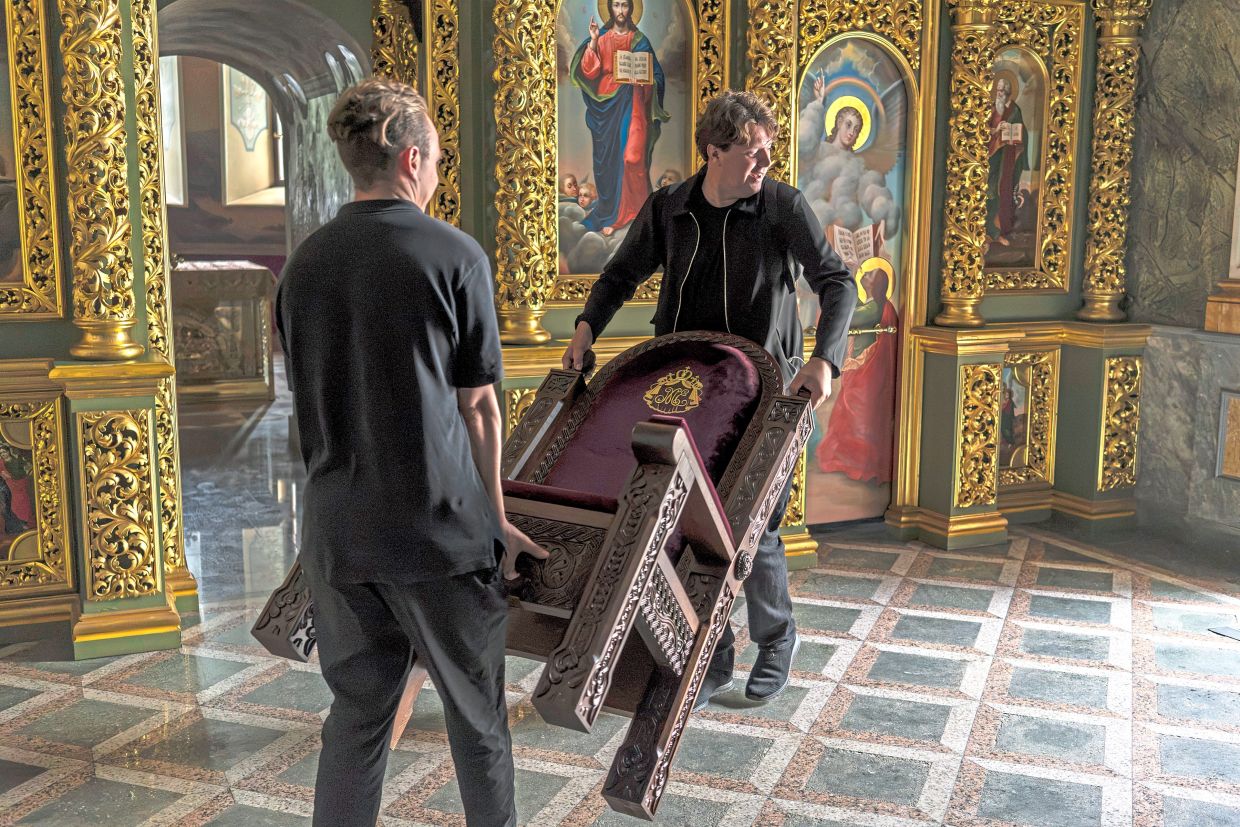
The volunteers gathered in July to clean up the site before its 975th anniversary, which Ukrainian President Volodymyr Zelenskyy and other dignitaries celebrated on Aug 15.
Founded in the 11th century, the monastery was home to 1,000 monks at its height and drew patrons among royalty, politicians and pilgrims. Its catacombs house underground churches and the bodies and relics of 120 saints.
After Russia’s full-scale invasion of Ukraine, the monastery became the centre of a stand-off between dozens of resident monks who follow the Moscow Orthodox patriarchate, and Ukrainian monks who adhere to the Orthodox Church of Ukraine, which split off in 2018.
Abbot Makariy, 45, who leads the nearby monastery of St Theodosius and who is set on claiming the entire preserve for the Ukrainian church, was one of the first on the scene on the night of the Russian strike.
He recorded his dismay as he filmed the conflagration with his cellphone from an adjacent bell tower.
The footage went viral, sparking global outrage and sympathy.
He also filmed as he ran into the burning church.
“There was nobody there: no firefighters, nobody,” he recalled.
His voice in the footage relayed shock: “Poor Dormition,” he said as he filmed.
“Everything is burning.”
The devastation was particularly painful, he said, because of the effort that had gone into building the cathedral.
It was levelled in 1941 during World War II and rebuilt only in 2000, after the Soviet Union fell and Ukraine gained independence.
In June, the cathedral escaped major destruction. The strike tore chunks of brick out of the masonry and set the roof ablaze, but emergency workers prevented the flames from spreading, officials at the complex said.
Another drone passed overhead that night and struck an 18th-century fortress and former arsenal across the road.
On a recent visit, the cathedral roof was encased in plastic sheeting and the windows of its cupolas were boarded up.
A burning smell lingered in the dimly-lit interior, as portable fans whirred at full speed to dry out walls that had been soaked by firefighters’ hoses.
The ornate iconostasis, a gilded screen – the largest in Ukraine – concealing the sanctuary, survived intact.
Priests rescued valuable artifacts, icons and religious utensils, including a heavy silver coffin encasing a relic of St Stephen, which is now in a nearby museum building, museum officials said.
Ivan Yahovenko, a deputy director at the Kyiv-Pechersk Lavra preserve, said Ukraine’s Culture Ministry was considering plans to build a stronger roof covering to protect the cathedral from snow through the winter.
Reconstruction work would depend on funding, he said.
But even as air raid sirens and explosions sounded in Kyiv, Abbot Makariy was moving on, intent on readying the cathedral and the preserve for the anniversary event.
“We are going to open the catacombs for the first time in three years, and there is a big mess down there,” he said before the clean-up.
With only 30 monks in his monastery, he had appealed to volunteers, among them military veterans who have been encouraged to use the space as a refuge and place of healing.
Over three days, they cut and cleared overgrown gardens and courtyards and weeded the cobbled pathways.
Petro Hadzhala, 22, a novice priest and chorister, was among those helping.
“Maybe it was God’s will,” he said of the strike.
“Maybe we need a sign to tell us that we have an enemy and we need to unite under one church and one country.”
Parishioners laid out plates of sandwiches for lunch.
Then teams of women armed with buckets and mops set about cleaning the cathedral, some climbing up to the choir gallery and others mopping the marble floor over and over.
“This is an incredibly difficult time for all of us,” said Liudmyla Balashova, 56, a director at a textile firm in Kyiv, who paused to say a prayer.
“We need to prove, perhaps to ourselves above all, that with God’s help, we can overcome anything.” — ©2026 The New York Times Company
This article originally appeared in The New York Times