IN Malaysia, an “auntie” does not necessarily have to be your aunt. You might call a neighbour “uncle”, or say someone is “speaking”, and have it mean something quite different from what an English speaker elsewhere might understand.
Over time, familiar English words have taken on new meanings and uses here, shaped by Malaysia’s multilingual and multicultural environment.
As Universiti Malaya professor of Languages and Linguistics Dr Stefanie Shamila Pillai explains, this process is part of the evolution of Malaysian English, a variety shaped by how Malaysians communicate with one another.
This week, Sunday Star celebrates this distinctive local flavour of the language, where English words have been adopted into the Malaysian setting and, over time, developed meanings or usages that differ from their original meanings.
A brief history of Malaysian English
English has been on our shores since the 18th century, developing through education, public administration, and business, says Pillai. After independence, its use in these domains diminished, while English increasingly developed through communication among Malaysians, particularly in urban areas.
That interaction gave the language elements shaped by Malaysia’s culture and customs.
“As with other varieties of English, the English used in Malaysia had to be able to refer to and reflect the physical environment, and the social and cultural elements of our multiethnic country,” she says.
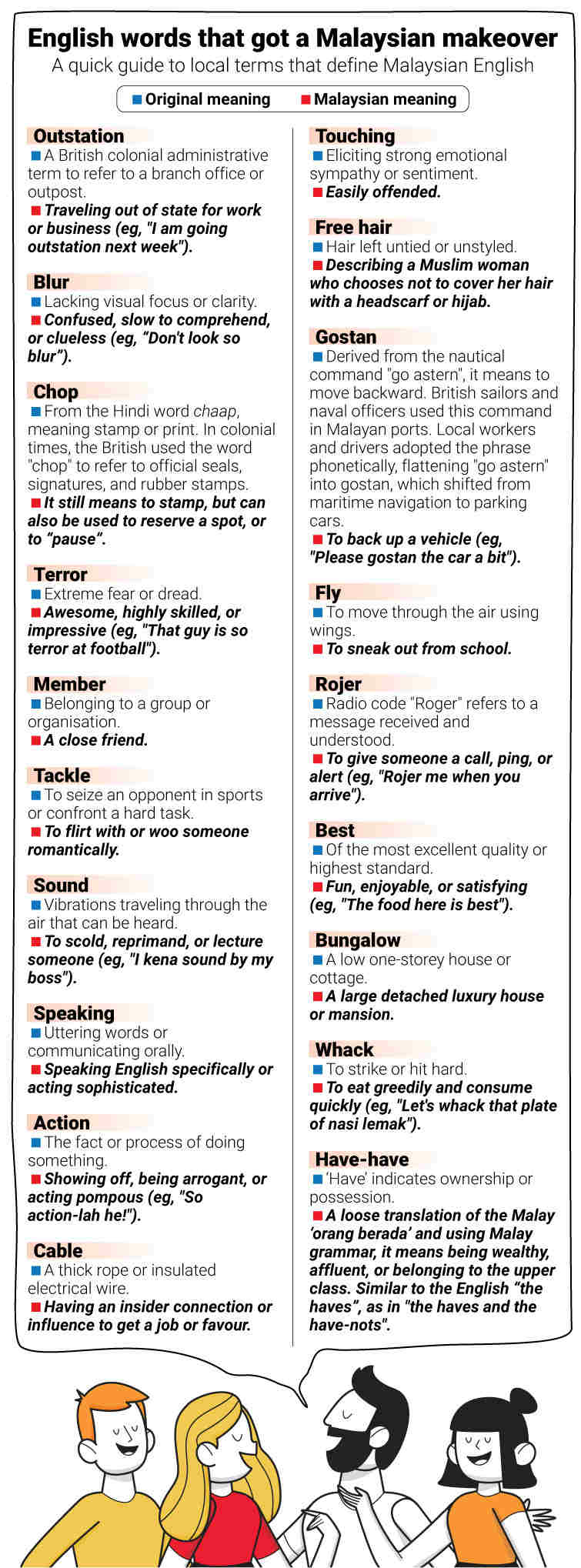
“Apart from local food and terms of respect such as auntie, uncle, sis, or brother, English words also began taking on new meanings, and because of our multilingual context, Malaysian English incorporates words from local languages such as lepak, mamak, and tapau, systematically peppered with lahs and ahs,” she explains.
Colloquial Malaysian English, often dubbed Manglish, also has sentence structures and question forms that differ from those taught in school, such as “Wah, so pretty lah you!”, “What time you going to see her?”, or the Malaysian standard, “Makan already, ah?”
Evolution of pronunciation
Malaysian English is also recognisable in the way words are pronounced.
“There are distinct pronunciation features which cut across ethnic boundaries. For example, most of us have a similar vowel for these pairs: bid and bead, beg and bag, and duck and dark. Or the way we say bed, bread, and egg, boat and coat, and their and our,” says Pillai.
These pronunciation features are not necessarily confined to the colloquial variety of Malaysian English and this gives us our discernible Malaysian accent even when we are speaking in a more formal context.
She says the words Malaysians use, whether borrowed from local languages or English words given new meanings, reflect shared values such as respect, family, and cooperation.
Not ‘broken English’ but our own variety
For Pillai, features of Malaysian English are more than quirks of speech. They are shaped by the physical, social, and cultural environment in which the variety has developed.
“It is a unique entity that reflects our physical environment, food culture, festivals, cultural norms, and social activities,” she says, pointing to expressions and terms such as kaya toast and roti John, as well as ang pao, balik kampung, and gotong-royong.
Beyond vocabulary, colloquial Malaysian English has its own linguistic features, which even proficient speakers may use when switching from standard English.
Part of its appeal, Pillai says, is that it can be economical and efficient. “Wanna go mamak?” is a simple example suited to the quick, informal exchanges of messaging apps and social media.
It can also help close the social gap between speakers and signal solidarity. The familiar “lah”, “ah” and other features are therefore part of a system used in particular social contexts.
Not wrong-one, just different-lah
Pillai says colloquial Malaysian English should not be dismissed as “broken” or “incorrect” English. Rather, it is a local variety of English primarily used in informal settings, with its own vocabulary, structures and conventions, and should be celebrated.
At the same time, the two varieties serve different purposes. Colloquial Malaysian English should not be confused with the standard variety used in education and other formal contexts.
Learning standard English, Pillai says, does not mean Malaysians have to abandon the colloquial variety.
“The two are different varieties of English used in different contexts; thus, having both in your linguistic repertoire is definitely an advantage.”

The future of Malaysian English
Universiti Teknologi Mara (UiTM) Pulau Pinang Academy of Language Studies senior lecturer Dr Nur Husna Serip Mohamad says Malaysian English is constantly evolving alongside its speakers.
“What was recognised as Malaysian English in 1998 may not completely represent what younger Malaysians recognise it as today. Malaysian English changes together with the people who speak it,” she explains.

New expressions can emerge and circulate, while older ones may gradually lose recognition.
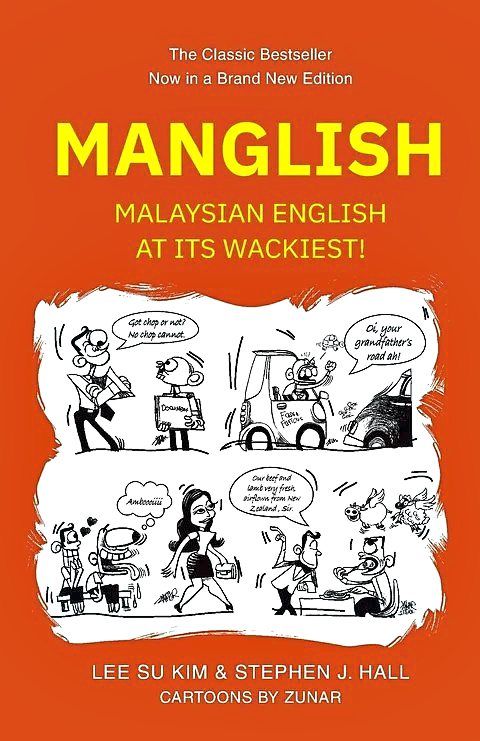
Earlier collections of words, such as those described in Lee Su Kim’s Manglish dictionary published in 1998, may therefore look different from the Malaysian English used by younger speakers today. Social media has also introduced new forms, including “dongibap”, from “don’t give up”, and “kipidap”, from “keep it up”, says Nur Husna.
The changing language also reflects how we view Malaysian English. While it was once often avoided in formal settings, Malaysians today may use it deliberately to signal Malaysian identity, says Nur Husna.
She adds that Malaysian English can carry both Malaysian and ethnic identities, with features rooted in Malay, Chinese, or Indian Malaysian ways of speaking becoming part of a broader shared way of communicating.
“Our different ways of speaking can come together to create something that is collectively Malaysian,” she says.
A new generation of speakers
Dr Nur Fatima Wahida Mohd Nasir, a senior lecturer at UiTM Perak’s Academy of Language Studies, observes that younger Malaysians are growing up in a different linguistic environment from previous generations.
While earlier generations were influenced mainly by local multilingual interaction and Malaysian or regional media, Gen Z (born between 1997 and 2012) and Gen Alpha (2013 and 2025) are exposed to both Malaysian English and global English through TikTok, YouTube, gaming, streaming platforms, and online culture.
This means their everyday speech can draw from both local and global sources.
“A young Malaysian might use a very Malaysian expression in one sentence and then incorporate Internet slang or expressions associated with American, British, Korean, or other global popular cultures in the next,” she says.

Nur Fatima Wahida clarifies that this does not necessarily mean Malaysian English is losing its local character.
“Language is constantly evolving. Younger speakers may retain some established Malaysian English expressions, modify others, abandon some older expressions, and create new ones.
“Online communication also allows linguistic innovations to spread much faster than they did among previous generations,” she says.

Gen Z and Gen Alpha are therefore participating in the next stage of Malaysian English, and we may soon find out which newer expressions eventually become established features of the variety.
What cannot be denied is that Malaysians have innovatively taken a global language to express local experiences, relationships, and identities.
We have folded words from Malay, Chinese, and Indian languages into it, given familiar English words new meanings, and developed expressions and speech patterns that can instantly mark something as Malaysian.