
ALI Saifuddin used to wrestle with code. Now, he lets artificial intelligence (AI) do the heavy lifting.
After taking a short course on AI, the 30-year-old programmer from Kuantan says his workload has eased significantly – and his output has improved. Not too long ago, he was, in his own words, “wracking his brain” working with rule-based automation tools rather than the generative AI models used today.
“But with AI, it helps me code faster. I’ve cut down hours and work much more efficiently, provided I know what I want and have the right prompts in place.”
But as tools become more powerful and accessible, a new tension is emerging; the same systems that boost productivity can also blur accountability, raising questions about accuracy, ethics and oversight.
Ali’s experience reflects findings from Microsoft’s 2026 Work Trend Index, which show that more Malaysian workers are becoming adept at utilising AI at work. Some 24% are classified as “Frontier Professionals” – advanced AI users – compared with 16% globally. These workers use AI for analysis, problem-solving, evaluation and creative thinking. At the same time, 69% of Malaysian AI users say they now produce work they could not have created a year ago. Among advanced users, that figure rises to 80%.
Nevertheless, the report shows that employers and companies are struggling to keep up, with only 32% of AI users in Malaysia saying their leadership is clearly and consistently aligned on AI. Even fewer, just 19%, say they are rewarded for “reinventing” their work processes.
This growing uptake of AI in the workplace hence raises a pressing question: should there be a national framework for AI use at work to ensure it remains fair, ethical and credible?
There have already been several cases of misuse or poorly governed deployment. In 2023, an AI-powered chatbot for a car dealership in California, United States, was manipulated by a customer into agreeing to sell a vehicle for US$1 (RM4.09) – a deal deemed legally binding.
Last year, a consulting firm in Australia made headlines after failing to disclose its use of AI in a report prepared for a public agency, which was later found to be riddled with errors.
These cases underscore the kinds of risks that can arise when AI systems are deployed without sufficient oversight – risks that Malaysia will need to anticipate as adoption accelerates across industries.
Back home, as the Artificial Intelligence Governance Bill is being drafted – reflecting the technology’s growing presence – experts say that while oversight is crucial, cultivating responsible users is equally important.
Lines of guardrails
Malaysia’s push towards digital transformation has accelerated in recent years, with investments in infrastructure and technology aimed at modernising public services and boosting competitiveness.
Yet, as the country deepens its digital journey, it has been cautioned that hardware and software alone cannot deliver lasting impact, says World Bank Country Manager for Malaysia Judith Green in her speech at the launch of Malaysia’s GovTech Flagship Report, where she highlighted the importance of “analogue complements”.
“As global experience shows, digital investments alone are not enough. Technology must be matched by what we call ‘the analogue complements’, which include robust institutions, effective coordination mechanisms, transparent data policies and practices, and a digitally capable public service.”
When asked if Malaysia should establish a formal gatekeeping system – such as independent ethics boards or regulatory frameworks – to oversee AI use in workplaces, International Islamic University Malaysia computer science expert Prof Datuk Dr Tengku Mohd Tengku Sembok agrees.
“Malaysia should first establish a comprehensive national AI regulatory framework that defines standards for safety, transparency, accountability, data governance, privacy, cybersecurity and the ethical use of AI.
“Once these regulations are in place, an independent AI Ethics and Governance Board should be appointed to oversee their implementation across government, industry and educational institutions.”

He says the framework should include clear guidelines on human oversight, risk-based AI classification, data protection and security, fairness and bias testing, transparency and explainability, academic integrity, regular AI audits, certification of high-risk systems, public complaint and appeal mechanisms, and continuous review to keep pace with technological advances.
“Such a system would encourage responsible innovation while strengthening public confidence in AI technologies.”
Tengku Mohd adds that recurring cases of scams, spam, identity theft, data breaches and online fraud have left many uncertain about whether digital and AI-enabled systems are truly secure, transparent and accountable.
“Institutions can build trust by ensuring that AI produces clear and beneficial results, such as faster services, better fraud detection, fairer decisions and more accurate public assistance.
“This must be supported by strong cybersecurity, transparent procedures, human oversight, independent audits, clear channels for appeal, and firm accountability when systems fail.”
Checks and balances
What mechanisms should be in place to verify that AI-generated work is credible and accurate before it is used in daily operations?
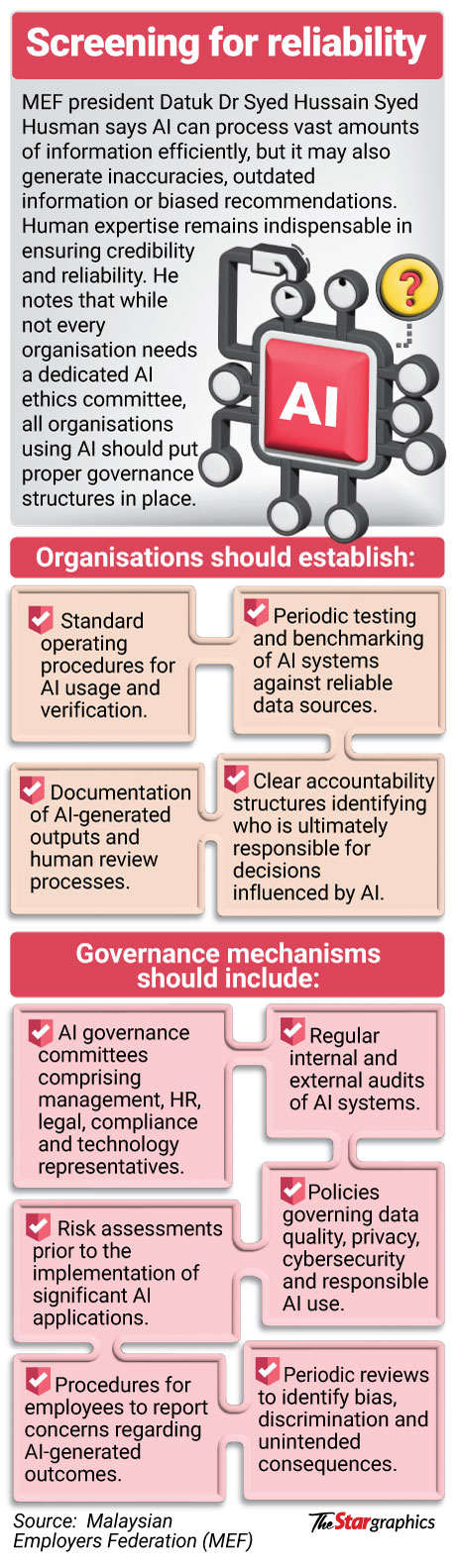
Malaysian Employers Federation (MEF) president Datuk Dr Syed Hussain Syed Husman says that as AI rapidly transforms workplaces by enhancing efficiency, improving decision-making and enabling employees to focus on higher-value tasks, it should be viewed as a tool that augments human capability rather than replaces human judgment, accountability and responsibility.
“The successful adoption of AI requires robust governance, transparency and continuous human oversight to ensure that productivity gains do not come at the expense of accuracy.
“AI-generated output should never be accepted at face value. Organisations must establish clear verification and validation protocols before AI-generated reports, analyses, recommendations or operational decisions are adopted and implemented.”

Syed Hussain proposes that employers establish policies clearly defining the appropriate use of AI tools and identifying tasks that require human review and approval.
“Rather than monitoring every AI-assisted activity, organisations should focus on creating accountability frameworks where employees remain responsible for the quality and accuracy of their work, irrespective of whether AI tools were used.”
Echoing Green’s point on analogue complements, he says human intervention should focus on evaluating outcomes rather than merely the use of technology.
“Employees should be encouraged to apply critical thinking, professional judgment and subject matter expertise when using AI-generated suggestions.
“An important concern is the potential over-reliance on AI, which may erode analytical skills, creativity and independent decision-making. Employers should invest in continuous upskilling programmes that strengthen employees’ ability to critically assess AI outputs rather than simply accept them.”