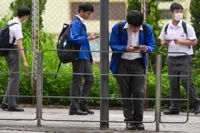
THE news that the social media ban for under-16s is set to be implemented in Malaysia by June is causing excitement in Ahmad’s house. The 14-year-old, who declines to use his real name, says he has not seen his mum smiling so much.
But Ahmad shares that he is not too worried with a small smile of his own.
“I think I can still get on social media. We kids have our ways.”
The teen may be right.
More and more countries are following Australia’s example last December to ban minors from social media by enacting a law that requires platforms to “take reasonable steps” – such as age-assurance and verification requirements – to prevent them from opening or keeping their accounts.
However, early assessments in Australia found that its ban may not be as effective as it aims to be.
According to the most recent compliance report by the Australian eSafety Commission, many have avoided the enforcement, with 61% of children aged 12–15 who had accounts before the ban still having access to at least one of them as of March 2026.
The Australian organisation responsible for enforcing the ban also reported that many kids are able to “game the system by changing their appearance to look older and fool age-estimation software”.
Others, it revealed, have used false IDs or VPNs to maintain their access to their accounts.
More worryingly, another recent poll showed that 27% of parents reported that their kids have moved to alternative or less regulated platforms.
What’s more, it has been reported that data also showed that the regulation has not effectively achieved its main target of keeping kids safe from harm online: since it was implemented on Dec 10 last year, there has been no notable change in cyberbullying or image-based abuse reported by children in the country.
Kids vs government
The good news is that at least 4.7 million under-16 accounts have been disabled in Australia, and hundreds of thousands of new accounts have been blocked.
It was also reported that the aforementionedYouGov poll found that about 60% of Australian parents saw positive behavioural outcomes following the ban, and only 40% recounted negative impacts.
In Malaysia, the government implemented a sandbox model to gather feedback from affected parties, while observing developments in countries with similar laws such as Australia and France before moving ahead with its proposed measure.
Communications Minister Datuk Fahmi Fadzil also cited the need to protect youths from online harms such as cyberbullying and child sexual abuse as the main rationale behind the policy decision.
Rightfully, the concerns over exposure to inappropriate content online for children and younger teenagers spiked last year following a few violent incidents involving young Malaysians. This was underscored by a United Nations Children’s Fund (Unicef) report warning that one in four Malaysian children were exposed to sexual or harmful content online.
Fahmi said the government has consulted with big tech firms and will give social media platforms sufficient time to implement clean-up measures, including ensuring that no more children under 16 register new accounts or maintain existing accounts on their respective platforms.
He said the government expected to implement the ban at the end of June, if not earlier. The ban is “not impossible, and if everything goes smoothly, we may even start earlier”, he was reported as saying by Bernama.
Ahmad says he and his friends have also been “exploring measures”, especially programmes to fool age-verification tools and alternative platforms.
“I also have a 17-year-old brother,” he jokes.
Parents vs rights advocates
For many Malaysian parents, this measure will be “better than nothing”. In fact, a recent survey shows that many are for it.
According to a Family First study conducted by the United Kingdom-based Varkey Foundation, Malaysian parents are the strongest supporters of the under-16 social media ban in the world.
As The Star reported, the study that was conducted across 15 countries found that 77% of parents in Malaysia support such a ban, followed by India with 75% and France with 74%.
Interestingly, the survey also revealed that 62% of Malaysians aged nine to 18 support prohibiting those under 16 from using social media – compared with the 37% global average.
However, while acknowledging the importance of protecting children and young people from online harm and the negative impact of social media on their wellbeing, rights advocates warn that Malaysia’s proposed blanket ban on social media for children under-16 risks undermining the privacy and freedom of expression of all social media users, both adults and children.
“It does not address the systemic and structural drivers of harm in digital spaces and may ultimately prove ineffective. Far from solving the problem, it threatens to entrench it,” they said in a joint letter to the Prime Minister on Friday.
The civil society groups, which include Article 19, Centre for Independent Journalism, and Child Rights Coalition Malaysia, urge the government to withdraw the ban and instead, confront the root causes of online harm: platform design, exploitative business models, invasive data practices, and weak regulatory accountability.
They also suggest that the government focus on building resilience among young people by empowering them with the necessary skills, knowledge, and support to navigate digital environments safely.
“It is critical that we adopt evidence-based, rights-respecting regulations grounded in nuance, rather than a total prohibition on children under 16 from participating in the digital world.
“Children do not need to be excluded from digital spaces; instead, they need protection within them, along with the skills and safeguards to participate safely and meaningfully,” the letter stated, highlighting that what we need is digital literacy and critical thinking education; accessible and affordable mental health and support services; and ongoing engagement with children, parents, educators, and civil society.
Tricia Yeoh, an academic attached to the University of Nottingham Malaysia’s School of Politics and International Relations, reiterates that greater attention should be put on social media platforms’ accountability and governance, specifically how they use engagement-based algorithms and design techniques that reportedly “manipulate user behaviour and promote unhealthy usage, harming young users’ mental health and wellbeing”.
Yeoh, who is also a visiting senior fellow at the Iseas-Yusof Ishak Institute in Singapore, has proposed on the institute’s blog, Fulcrum, that the Malaysian government look at the possibility of enacting a law that requires social media platforms providing services in Malaysia to conduct mandatory algorithm risk audits, similar to the proposed Social Media Algorithm Accountability Act, which is currently being debated in the US Congress, or Brazil’s Digital Child Protection Act (August 2025).
Beyond a ban, Malaysia could also consider instating mandatory parental controls at device level, a mechanism that is already available in smartphone operating systems.
“This places the responsibility on parents to activate device- level controls, including honestly setting their child’s age at the outset – which can be automatically linked to any web-based platforms and accounts,” she wrote, adding that digital parenting training programmes are also needed to equip Malaysia’s parents with the right skills to help their children use social media safely.
As for Ahmad, he believes having more social media safety lessons will be helpful for him and his peers.
“Seriously, I think me and my friends know how to keep safe on social media; our parents also always talk to us about it and give us tips on how to be careful and deal with anything that makes us upset online.
“But if you teach us more, I think we’ll be safer.”